
Research Signal – Source date 2026-02-15
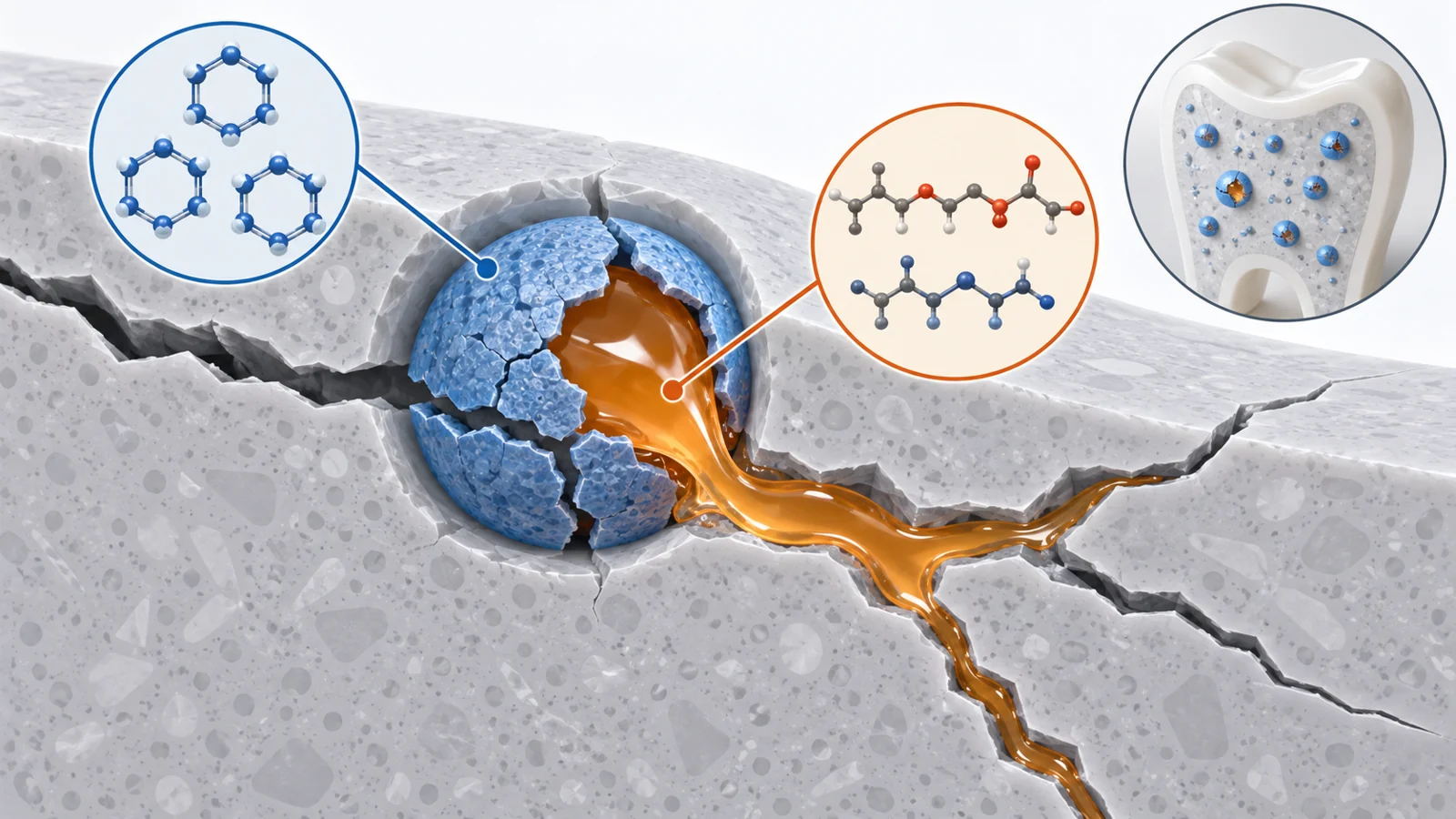
A capsule used in a self-healing polymer has two jobs that can pull in different directions. It must stay intact while the surrounding material is undamaged, then rupture when a crack reaches it so its contents can help seal the break. Researchers tested whether changes to the capsule shell and its healing agent could improve that balance, while also measuring formaldehyde release and cell viability.
The study, published on 15 February 2026, compared poly(urea-formaldehyde) (PUF) microcapsules made with melamine in the shell precursor and with different contents: triethylene glycol dimethacrylate (TEGDMA) alone or a blend of TEGDMA and N,N-dimethylacrylamide (DMAM). These were laboratory material and cell tests, not tests of dental restorations in patients.
The recipe changed the shell and its contents
The team added melamine to the shell precursor at levels up to 10% by weight. The capsules held either TEGDMA or a blend containing 20% DMAM by weight. In the design, melamine modified the capsule shell, while DMAM was part of the healing-agent blend inside it.
Melamine made the shell surface rougher and increased the reported physicochemical stability. Among the formulations tested, the authors identified 5% melamine as the best balance. Adding DMAM improved shell elasticity, and the combination of melamine and DMAM produced the highest reported elasticity, 57%.
Those measurements describe properties of the tested capsules. A more stable shell could help a capsule retain its contents before damage, while elasticity concerns how the shell responds to force. Neither measurement alone says whether capsules will last longer inside a finished restoration or rupture at the right point under real conditions.
Repair performance remained high in the tests
The researchers also measured healing efficiency in the materials containing the capsules. Every tested material reached at least 82%. Systems with DMAM showed an approximately 20% improvement compared with formulations whose healing agent was TEGDMA alone. That is a reported relative improvement, not a difference of 20 percentage points.
This repair result matters alongside shell durability because a capsule that resists damage must still release its contents when a crack forms. The experiments show that the additive changes did not prevent strong measured healing in these formulations. They do not reveal how many damage-and-repair events a material could withstand or how a dental restoration would perform over years of use.
Formaldehyde release rose with melamine content
The shell chemistry also brought an exposure question. In a Purpald assay, measured formaldehyde release increased as melamine content rose, reaching up to 21 micromolar after one week. The highest reported value makes clear that greater physical stability did not mean less release in this set of formulations.
The study separately assessed dental pulp stem cells. Viability remained at least 95% across the tested formaldehyde concentrations. With direct exposure to the microcapsules, viability was above 85% for all formulations. These are specific laboratory readouts; they do not establish what exposure would occur in a person’s mouth, how it might change over time, or whether long-term use would be safe. The results therefore support comparison of the tested recipes, while leaving patient exposure unresolved.
Could dental fillings one day seal their own small cracks?
A dental composite containing repair capsules could, in principle, release a healing agent into a developing crack and help seal it before damage grows. If the improved capsule properties and repair performance hold inside the intended dental material—and exposure proves acceptable under relevant conditions—such composites might help restorations last longer. This study offers an early materials-level reason to explore that possibility, not evidence that self-sealing fillings are ready for patients.
Key Sources
- Primary source: Enhancing the stability of urea-formaldehyde microcapsules for self-healing polymers through additive modulation.
DOI or Journal Page · Peer-Reviewed Paper · 2026-02-15
Keep exploring