
Research Signal – Source date 2024-06-12
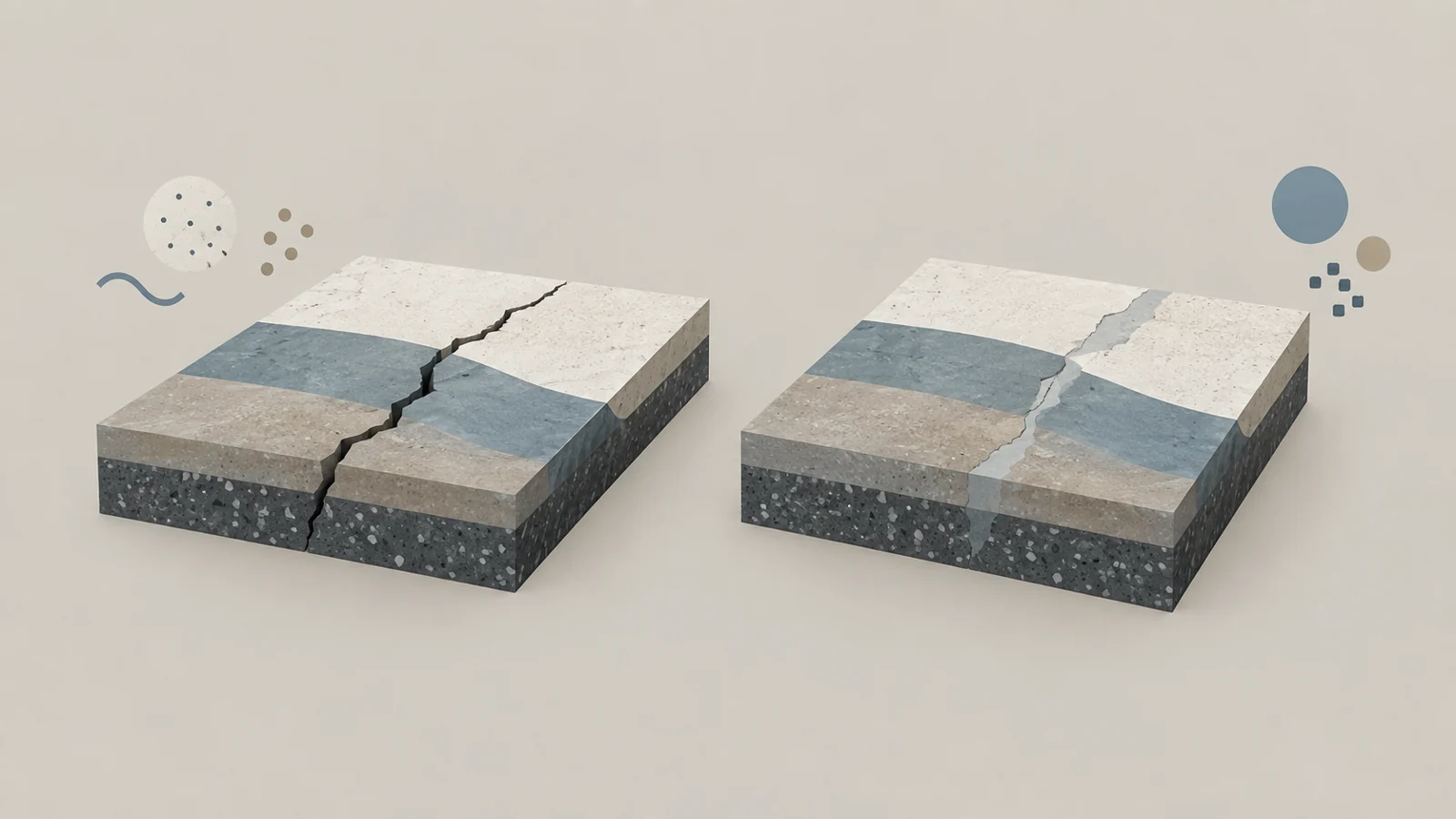
Calling a material “self-healing” invites a simple question. Does damage set repair in motion on its own, or must someone intervene? For composites—materials made by combining different constituents—the label alone does not answer that question.
A June 12, 2024 version-1 preprint, Smart Composite Materials with Self-Healing Properties: A Review on Design and Applications, organizes approaches across a field the authors describe as multidisciplinary and methodologically varied. Its abstract introduces distinctions that help readers understand what different repair designs aim to do.
Two different questions about repair
Autonomous and non-autonomous describe whether healing proceeds independently or requires outside intervention. That distinction concerns the help a repair process needs. “Self-healing” therefore should not automatically be read as “works unaided.”
Intrinsic and extrinsic are additional categories used in the review. The abstract names them without defining them or explaining the mechanisms involved, so it cannot establish what supplies the healing ability in a particular design.
The distinctions can be used together. The abstract specifically describes examining autonomous smart composites through intrinsic and extrinsic abilities, alongside their components, structures and design. An autonomous approach is not necessarily intrinsic simply because it operates independently.
This attention to composition and structure matters because a composite is a combination of constituents. Understanding its proposed healing ability means considering how those constituents and their arrangement contribute to repair, rather than treating “self-healing” as a single design shared by every material.
What the abstract can establish
The authors identify a deeper understanding of basic healing mechanisms and principles as a continuing challenge. They also describe nature as an inspiration for developing ideas. That inspiration helps explain the field’s direction; it does not by itself demonstrate how an engineered material performs.
The abstract names a broad range of application areas, including aerospace, automotive, marine, energy, healthcare, military and construction. This establishes the scope of the authors’ discussion. It does not establish deployment or suitability for a particular component, especially one whose failure could endanger people.
For this account, the verified evidence is the abstract of a preprint review. It supports an explanation of the organizing categories, but cannot settle how much useful function a material recovers, how quickly repair occurs or whether healing can be repeated. Those questions could be addressed elsewhere in the complete paper; the abstract alone does not resolve them.
Nor does this evidence establish that one approach performs better than another under comparable conditions. Closing visible damage and recovering the property a component needs are different claims. The supplied abstract does not establish recovery of a specified property, so its application list should be read as areas of interest rather than a record of demonstrated benefits.
What this could change
If healing can preserve useful component function under actual service conditions, automotive parts could remain usable longer. Repair that keeps a part fit for its job could delay replacement, helping vehicle operators get more service from components they already have.
Across many vehicles, fewer replacements could also reduce demand for the materials used to make new parts. The potential payoff follows a concrete chain: effective healing preserves function, preserved function extends useful life, and longer life reduces replacement demand. That is a possible downstream consequence of successful designs, not an outcome demonstrated by this abstract.
Key Sources
- Primary source: Smart Composite Materials with Self-Healing Properties: A Review on Design and Applications
DOI or Journal Page · Peer-Reviewed Paper · 2024-06-12
Keep exploring