
Research Signal – Source date 2023-03-03
A printer can trace a clover perfectly and still fail to make one. If the material breaks into disconnected pieces as it leaves the nozzle, the outline will be incomplete. If the deposited layers spread or collapse, the three-dimensional design will disappear. Printing a hydrogel—a water-rich polymer gel—therefore starts with a materials problem, before the printer follows its first instruction.
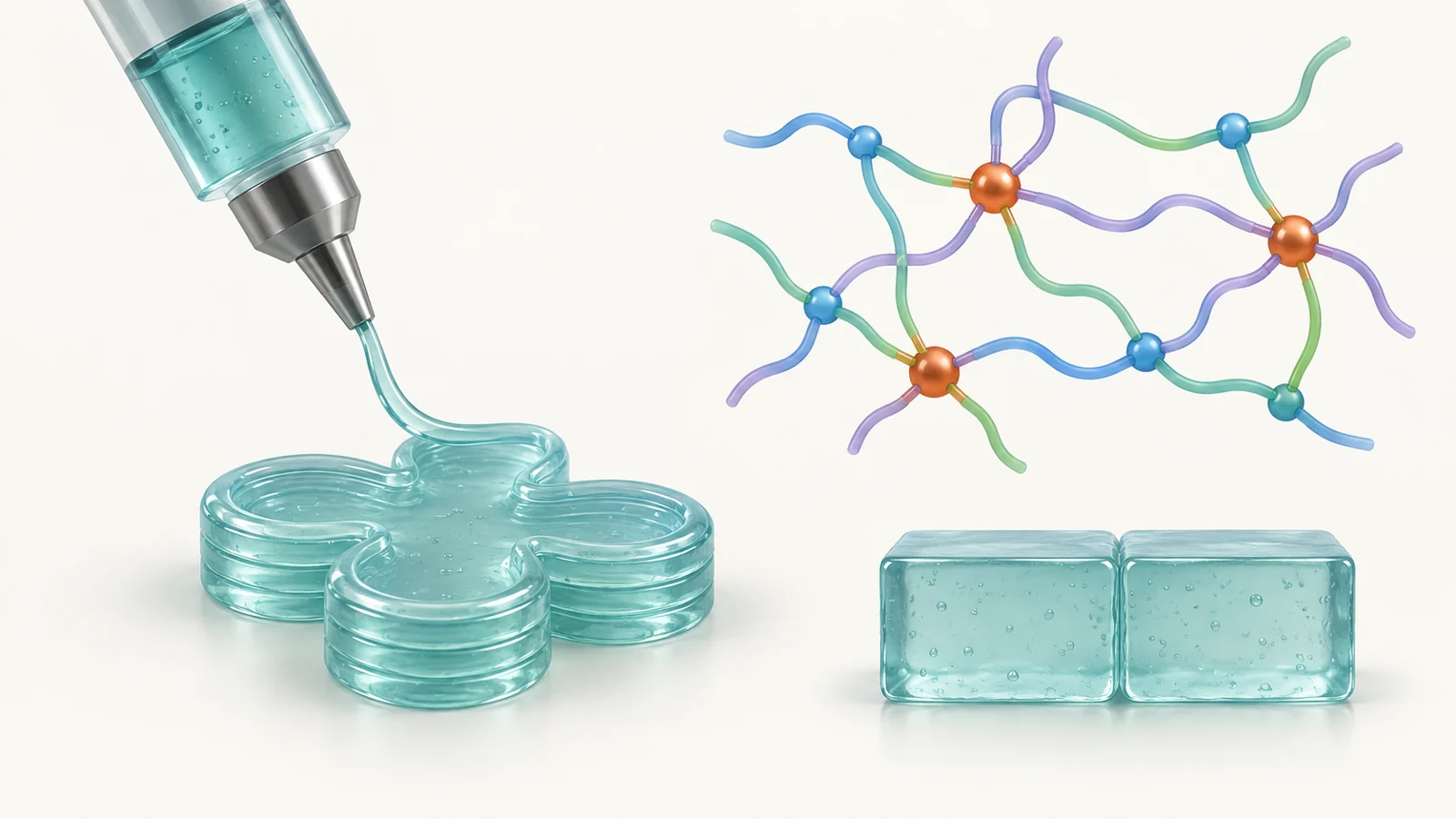
In an experimental study published on March 3, 2023, researchers made a self-healing gel that could be printed into heart and clover shapes at room temperature, without support material or an extra hardening step. They also demonstrated two forms of recovery: cut pieces rejoined after contact, and a mechanically disturbed sample rapidly regained its measured elastic and viscous properties. Those observations help explain the material’s promise, but they involve different experiments and different clocks.
Building a network with two kinds of connections
The gel’s main polymer was poly(acrylic acid), or PAA. Its chains were connected in two ways. Polyethylene glycol diacrylate, abbreviated PEGDA, supplied covalent crosslinks: chemical connections that formed part of the permanent network. Iron ions supplied a second set of reversible connections through interactions with carboxylate groups on the polymer chains.
These iron-mediated connections can reform after disruption. When freshly cut surfaces are brought together, interactions across the interface can reconnect the material. That mechanism does not require the severed permanent network to rebuild itself in the same way. The distinction matters because “self-healing” describes an observed recovery of the gel, rather than every kind of bond returning to its original condition.
The study’s particular design move was to adjust both kinds of crosslinking together. The formulation used 1 mol% PEGDA and 2 mol% iron-mediated dynamic crosslinker, each relative to the acrylic acid monomer. These are molecular proportions, not percentages of the finished gel’s weight. The researchers prepared the network by free-radical polymerization.
As the paper explains, changing permanent connections affects the gel’s physical properties, while changing dynamic connections affects both self-healing and its response to deformation. Adjusting one ingredient for a desired function can therefore alter other properties that matter during fabrication.
Why stiffness alone is not the answer
To characterize that response, the team used rheology, the measurement of how materials deform and flow. One quantity, the storage modulus, written G′, describes the elastic part of the response: how much energy the gel stores during deformation. The loss modulus, G″, describes energy dissipated during that motion. Their ratio, tan δ = G″/G′, indicates how large the dissipative response is relative to the elastic one.
The prepared gel had a reported G′ of about 1,075 pascals and a tan δ of about 0.12. Under the low-frequency conditions discussed in the paper, its elastic response dominated. Those values fell within a printing window that the authors attributed to their earlier work: G′ below 2,500 pascals and tan δ below 0.2.
The earlier observations, as recounted in this paper, explain why simply maximizing one property would be unhelpful. Above the stiffness threshold, gels had produced disconnected deposits. When the loss-to-storage ratio was too high, printed structures rapidly collapsed. The new formulation was designed to avoid both behaviors. These thresholds are a guide derived from the authors’ work, not universal limits for every hydrogel and printer.
The frequency tests added another clue. As the oscillation frequency increased, the measured complex viscosity decreased, a behavior the authors interpreted as favorable for extrusion. Such measurements help explain the material’s response, while the actual printing experiment tests whether that response is useful in fabrication.
Two recovery tests with different clocks
The cut-and-contact demonstration began with a physical separation. Researchers cut the gel into two pieces, placed the cut faces together, and left them at room temperature for 30 minutes. The pieces rejoined. When the healed sample was stretched, it tore away from the original interface.
That observation supports the idea that reversible iron-mediated interactions restored a mechanically useful connection across the cut. Tearing elsewhere is stronger evidence than the two surfaces merely appearing to touch. It does not, by itself, assign a percentage to the recovered tensile strength or establish how many damage-and-repair cycles the material could withstand.
The faster recovery result came from a rheometer, which applied controlled back-and-forth deformation to a sample between plates. The test began at 5% shear strain for two minutes, increased to 400% for one minute, and then returned to 5% while measurements continued. Strain here describes the imposed deformation; it is not a measure of how much of the sample was cut or destroyed.
During the high-strain interval, the relative sizes of the storage and loss moduli reversed, indicating a shift toward liquid-like behavior. Once the strain was reduced, the storage modulus, loss modulus, and complex viscosity recovered within about half a minute. That rapid response is relevant to a material that must regain solidity after the mechanical disturbance associated with extrusion.
The two times cannot be exchanged. The roughly 30-second result concerns recovery of measured properties after a high-strain interval. The 30-minute observation concerns rejoining cut surfaces held in contact. Neither experiment establishes that a cut printed clover would repair itself in 30 seconds. The rheometer provides a controlled test related to the demands of printing, rather than a direct measurement of everything happening inside the nozzle.
From a syringe to a measured shape
For printing, the researchers loaded the prepared gel into a 10-milliliter syringe and centrifuged it at 2,000 revolutions per minute for two to four minutes to remove air bubbles. They fitted the syringe with a metal nozzle whose internal diameter was 0.60 millimeters, then mounted it in a custom extrusion printer.
The reported fabrication conditions included extrusion pressures of 150–300 kilopascals and infill settings of 10–30%, with a printing speed optimized at about 2 millimeters per second. These details give the successful shapes a concrete experimental setting. A printable formulation and the settings used to deposit it belong together when interpreting the result.
Printing took place at room temperature. The heart and clover structures were made without support materials, ultraviolet post-curing, or hardening in a solution bath. This refers to the printing stage; the polymer network had already been prepared before the syringe was loaded.
Measurements showed that width and depth closely matched the designs, while height was slightly greater. The authors suggested that expansion of the viscoelastic gel after it emerged from the narrow nozzle could explain the difference. That is a proposed explanation for the deviation, rather than a separately established cause.
The dimensional comparison gives “successful printing” a more useful meaning than a photograph alone. It also shows why the result should not be described as perfect geometric accuracy. Agreement differed by direction, and the measured shapes do not establish how their dimensions would hold up over prolonged use.
A printed shape is only part of a device
The March 2023 study connects a specific formulation, two recovery behaviors, and fabrication of three-dimensional objects. Extending that result to other gel chemistries, larger structures, or different printers would require checking how those changes affect the material and the process. Meeting the reported rheological window is a useful starting point, but it cannot certify every new combination.
A functional component also has to do something beyond retaining its initial geometry. For a wearable sensing component, for example, useful sensing performance, suitability for the intended contact, and durability under repeated deformation would all matter. The laboratory recovery and printing results do not establish those capabilities, biological safety, or commercial readiness for this formulation. Evidence for those claims would have to come from tests matched to the proposed use.
What this could change
If this approach transfers to gels with useful functions while preserving their durability, developers could fabricate custom three-dimensional soft components with fewer support and post-hardening steps. That could allow components to be shaped for the space they must occupy or the surface they must fit.
A wearable sensing element tailored to a curved surface is one possible destination, provided the material also delivers the required sensing and contact performance. The causal path runs from adjustable polymer connections to a workable fabrication process, then to a component whose shape and function serve a particular task. This study supplies an experimental basis for the fabrication step; the downstream value depends on carrying useful properties into that printed geometry.
Key Sources
- Primary source: Preparation and Characterization of Poly(Acrylic Acid)-Based Self-Healing Hydrogel for 3D Shape Fabrication via Extrusion-Based 3D Printing.
DOI or Journal Page · Peer-Reviewed Paper · 2023-03-03
Keep exploring