
Research Signal – Source date 2021-08-10
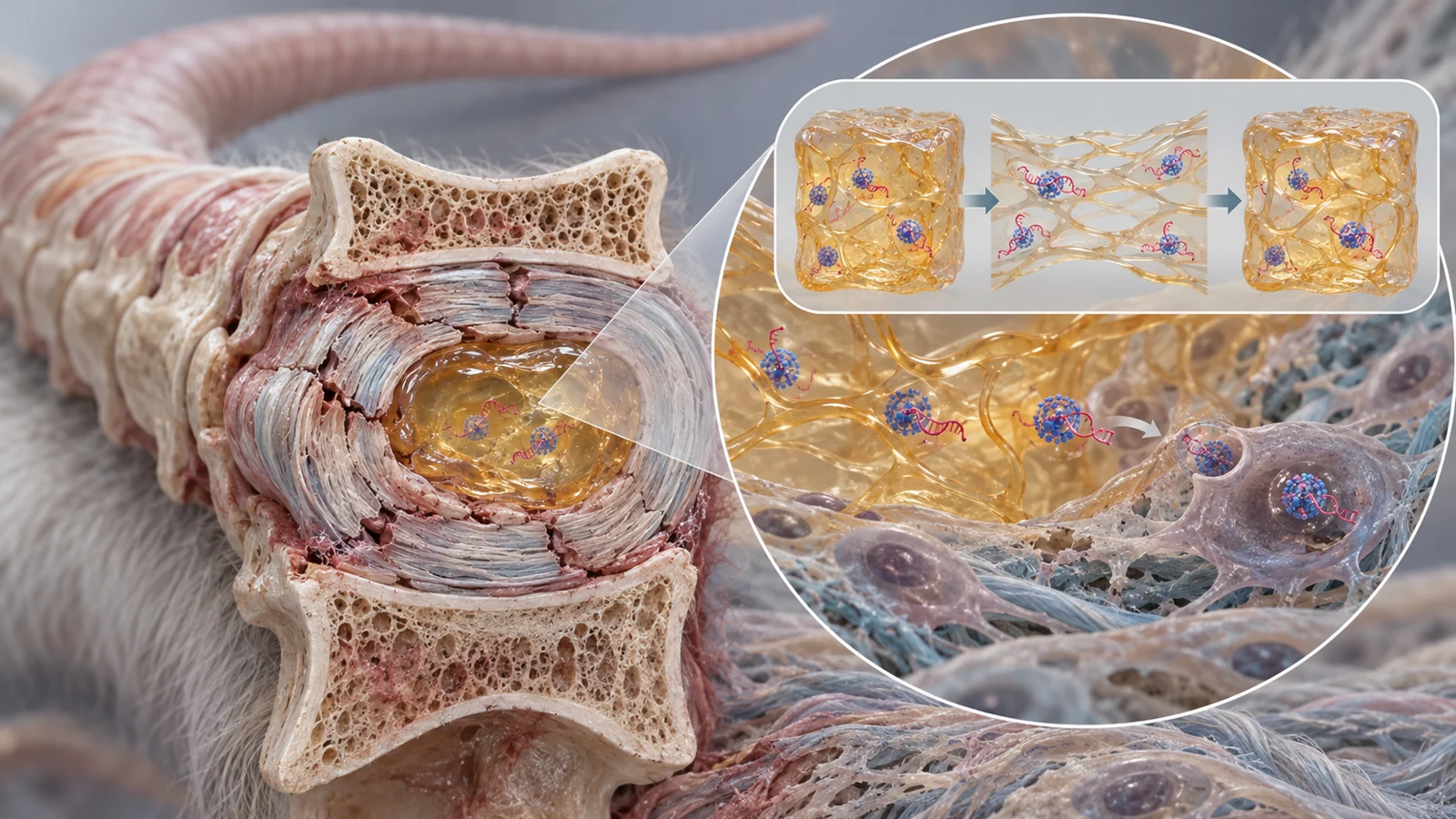
A small injection cannot be judged only by whether it enters a damaged disc. It also has to keep its active treatment in the right place long enough to matter. In a study published on 10 August 2021, researchers tested an injectable, self-healing hydrogel designed to carry gene-silencing RNA into injured rat discs. The treatment slowed several signs of disc deterioration after a single injection.
The result is more specific than a claim that the gel repaired a spinal disc. The experiment tested whether a local material could extend the action of an anti-inflammatory treatment and preserve tissue in an animal model. The prospect of fewer repeat injections motivated the delivery design. Human tissue samples and cultured human cells helped establish the biological rationale, but the treatment outcome came from rats.
The biological target came before the delivery system
The disc’s central tissue is called the nucleus pulposus, or NP. It helps the disc withstand load, and its deterioration is associated with changes in the surrounding extracellular matrix. The researchers focused on STING, a protein involved in inflammatory signaling when DNA appears in the cell’s cytosol, the fluid outside the nucleus.
In human surgical samples, degenerated NP tissue had higher STING messenger RNA than comparison tissue. The reported difference was about 2.89-fold across 28 degenerated samples and 16 controls. Protein measurements also showed increased STING and activation of related TBK1 and NF-κB signaling, alongside more cytosolic double-stranded DNA. These observations linked STING pathway activity with degeneration, but they were associative observations in tissue rather than a test of treatment in people.
The researchers then used cultured human NP cells exposed to hydrogen peroxide as an oxidative stress model. When STING was silenced with siRNA, the cells had lower levels of messenger RNA encoding the inflammatory signals TNF-α, IL-1β, and IL-6. The intervention also countered a pattern associated with matrix breakdown: collagen II and aggrecan were reduced by the stress treatment, while MMP3 and MMP13 increased; STING silencing shifted those measurements back toward a more balanced profile.
siRNA is a short RNA molecule used here to reduce production of a chosen protein by directing the degradation of its messenger RNA. It does not edit the cell’s DNA. The challenge is practical: RNA is vulnerable to breakdown and does not readily cross cell membranes. A disc is also poorly supplied by blood, so simply circulating a drug through the body may leave little of it at the target. A local injection can place treatment near the cells, but a short-lived payload may require repeat punctures.
A water-rich gel gave the RNA a temporary home
The formulation, called siSTING@HPgel in the study, combined aldehyde-modified hyaluronic acid with a branched polymer known as PAMAM. Hyaluronic acid supplied the natural polymer backbone after chemical modification. PAMAM performed two jobs: it formed an electrostatic complex with the negatively charged siRNA, helping package the cargo, and it helped connect the gel’s network.
The network was held together by dynamic Schiff base bonds between aldehyde groups on the modified hyaluronic acid and amino groups on PAMAM. These bonds can form and rearrange, which explains two material behaviors important for an injection. Under shear, the gel became easier to move through a needle. After the material was disrupted, the network could form again.
The bench tests made that behavior concrete. The hydrogel passed through a 26-gauge needle without clogging, and its viscosity fell as the applied shear rate increased. Two separated pieces joined into one gel within about 15 minutes. In rheology tests, the gel’s network recovered within seconds after repeated cycles of very high strain followed by low strain. “Self-healing” therefore described recovery of the material’s structure, not healing of disc tissue.
Laboratory release measurements showed that about 22.63% of the labeled siRNA had been released after one day, 48.40% after three days, and 80.03% after five days. The slow release was attributed to the RNA’s interaction with PAMAM and its retention within the gel. Those percentages describe RNA leaving a laboratory gel under test conditions; they are not a direct measure of how long a therapeutic effect lasts in a disc.
Several measurements described different kinds of persistence
The study separated delivery from biological action through a sequence of tests. In cultured NP cells, fluorescently labeled RNA delivered with the hydrogel showed greater uptake at day 3 than at day 1 and remained high at day 5. The same formulation produced sustained STING knockdown across the measured period, while RNA delivered with Lipofectamine 3000 or PAMAM alone produced more transient suppression in the reported comparison.
The animal imaging experiment measured something different. Researchers injected fluorescently labeled siRNA into rat tail discs either in the hydrogel or with PAMAM in solution. The PAMAM formulation dispersed and cleared more rapidly, with a reported half-life of about 1.9 days at the disc site. The fluorescent signal from the hydrogel formulation persisted through the 21-day imaging schedule, with a reported half-life of about 6.3 days.
A fluorescent label staying near the injection site is useful evidence that the delivery material changes local residence time. It is not proof that intact, biologically active siRNA remained there throughout the full interval, nor that STING stayed suppressed for all 21 days. The cell experiments provided the direct measurements of uptake and target suppression; the rat imaging provided a location-and-persistence measurement. Keeping those readouts separate prevents “longer fluorescence” from being treated as a complete measure of therapeutic duration.
One injection preserved more structure after a puncture injury
To test treatment, the researchers punctured a rat tail disc to induce degeneration. One week later, they injected 50 microliters of one of several materials with a 26-gauge needle. The comparison included the full siSTING@HPgel formulation, siSTING with PAMAM, modified hyaluronic acid alone, siSTING alone, and an injured group without injection; uninjured discs served as controls. The reported postoperative assessments were at four and eight weeks.
The full hydrogel formulation performed better than the other puncture groups on several structural measures. X-ray measurements showed less loss of disc height at four weeks, and the advantage remained at eight weeks. MRI signal measurements, used as an indicator related to disc water content, followed a similar pattern. The complete formulation also showed less loss of NP tissue and proteoglycan staining, with clearer tissue organization than in the other injured groups.
The histological scores reflected relative preservation rather than a return to normal. For the hydrogel group, the reported scores were 4.75 ± 0.50 at four weeks and 7.00 ± 0.82 at eight weeks, compared with higher scores in the other puncture groups. Molecular staining also supported reduced STING pathway activity and lower inflammatory markers in the treated discs, while matrix-related measurements were better preserved.
The comparison matters because the result was not attributed simply to injecting any gel or any RNA. The formulation that combined the siSTING cargo, PAMAM, and modified hyaluronic acid produced the strongest overall preservation in this experiment. The supplied comparisons do not, however, isolate every material contribution independently or show that the formulation would outperform a schedule of repeated injections.
The model answers a delivery question, not the whole disease question
The rat model used a controlled needle injury in young adult male animals and began treatment one week later. That design is useful for testing whether a local formulation can influence an induced degeneration process. It does not reproduce every feature of longstanding human disc degeneration, which can develop over a much longer period and involve varied causes and tissue states.
The human part of the study was observational tissue work, and the intervention work in human NP cells was performed in culture. Neither establishes that an injection of siSTING@HPgel benefits patients. The animal results also do not show regeneration of a normal disc, reversal of established human damage, pain relief, improved movement, or a reduced need for surgery. Disc height, MRI signal, histology, inflammatory markers, and matrix proteins are important research measurements, but they are not interchangeable with how a person feels or functions.
Safety remains a separate question. NP cells kept their viability in the short cell-culture tests, and the material appeared compatible in those observations. That is encouraging for continued investigation of the formulation, but it does not establish the local, systemic, procedural, or long-term safety requirements of a human injection. A clinical treatment would also need to show that the material and RNA act predictably in diseased human tissue without causing unacceptable inflammation or other harms; this study did not provide that evidence.
What this could mean for treating damaged discs
At the time of the 2021 publication, the most plausible practical promise was a local treatment that could remain near disc cells longer and preserve tissue with fewer repeat injections. The causal path is conditional: the hydrogel would need to deliver biologically active siRNA safely, maintain useful STING suppression, preserve disc structure over a meaningful period, and produce a benefit that matters to patients with degenerating discs.
If those steps hold up in further human-relevant testing, a self-healing injection could reduce the burden of repeatedly puncturing a vulnerable disc while helping retain tissue rather than promising that established damage will disappear. The rat findings support that possibility as a delivery-and-preservation concept. They do not yet establish pain relief, regeneration, avoidance of surgery, or a human therapeutic effect.
Key Sources
- Primary source: Injectable self-healing hydrogel with siRNA delivery property for sustained STING silencing and enhanced therapy of intervertebral disc degeneration.
DOI or Journal Page · Peer-Reviewed Paper · 2021-08-10
Keep exploring