
Research Signal – Source date 2026-06-29
A flexible sensor can stretch with a bending finger, but damage creates several different repair problems. A split polymer must regain connections across the break. A conductive component must carry electricity again. The assembled device must also produce a useful response to movement or pressure. Calling the material “self-healing” does not, by itself, tell us which of those functions has recovered.
A review published on June 29, 2026, brings together studies of polymers with reversible molecular connections and their use in flexible sensors, particularly capacitive devices. It examines how repair works, the conditions it requires, and how researchers combine healing with strength, stretchability, and electrical performance. The individual demonstrations come from earlier studies discussed in the review; the paper does not introduce a single new sensor with all their capabilities.
The findings make repairable sensing a concrete engineering possibility. They also show why a healing result needs its conditions attached. Fifteen seconds, 24 hours, and a day of heating describe very different routes back from damage—and may refer to different things being restored.
Connections that can rearrange and hold together
Polymers consist of long molecular chains. Connections within and between those chains help determine whether a material behaves like a soft gel, a stretchable rubber, or a more rigid solid. For intrinsic self-healing, the repair mechanism is built into this molecular network, allowing connections to reform instead of depending on a separate supply of glue released from embedded capsules.
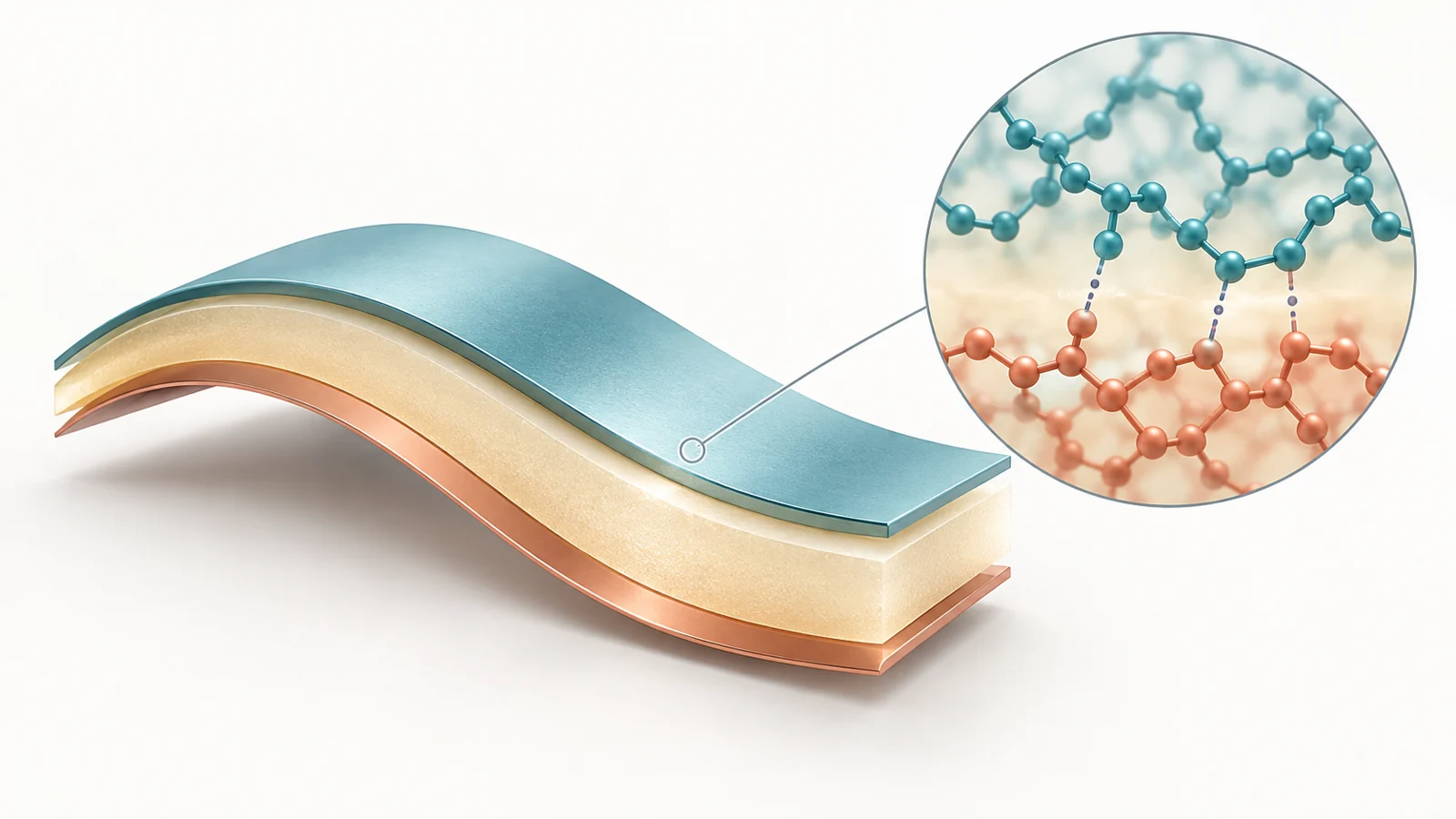
The review describes two broad kinds of reversible connection. Supramolecular interactions are attractions between molecular groups, including hydrogen bonds, electrical attractions, and coordination with metal ions. These can separate and reconnect as the surroundings or positions of the chains change. Dynamic covalent bonds are chemical bonds that can exchange or reverse under suitable conditions while supporting a strongly connected network.
Their cooperation matters because repair requires movement. Chains and reactive groups near a damaged interface need enough freedom to meet and reconnect. Yet those same chains must resist being pulled apart during use. Adding more connections can strengthen a material while slowing the rearrangements that help it heal. Molecular architecture therefore matters as much as the presence of a reversible bond.
One study described in the review makes this cooperation tangible. Researchers combined hydrogen bonds and dynamic imine bonds in a silicone-based composite containing modified MXene flakes, a conductive material. After cutting, the composite recovered strength and electrical conductivity under ambient conditions within 24 hours. Its network brought together two kinds of reversible connection, while the conductive component gave the repair an electrical endpoint as well as a mechanical one.
This example illustrates why researchers combine mechanisms. Different connections can contribute to flexibility, resistance to damage, and rearrangement at an interface. The useful balance depends on their placement and concentration, along with the mobility of the surrounding polymer chains.
How a repaired material becomes a working sensor
A capacitive sensor detects changes in its ability to store electrical charge. A basic design places two conductive electrodes on either side of a dielectric, an electrically insulating layer. Pressure or stretching can change the layers’ spacing or geometry, altering capacitance. Electronics read that change as a response to the applied force or movement.
This layered arrangement gives each component a distinct job. The electrodes distribute charge; the dielectric separates them and contributes to charge storage. The way the layers deform together determines how the assembled device responds. Restoring conductivity in an electrode is therefore a different achievement from restoring the relationship between pressure and capacitance that makes the sensor useful.
The review describes a hydrogel made from polyvinyl alcohol and cellulose nanofibrils, with reversible connections involving calcium ions and borate. The material healed within 15 seconds under ambient conditions. Researchers incorporated the hydrogel into a capacitive sensor using a polyethylene dielectric and adhesive tape.
The assembled sensor showed a linear capacitance response over a pressure range of 0–4 kilopascals. It also detected signals associated with finger bending, pulse, and throat movement after damage and healing. Those observations connect material repair to a functioning sensing device. The 15-second figure belongs to the hydrogel’s healing result; it does not establish that every layer and function of the assembled sensor recovered within that time. Detecting pulse-related movement also should not be read as a claim of clinical measurement accuracy.
Another study approached the layered problem by using related repairable polymer formulations for both the dielectric and the electrodes. Its polyurethane dielectric combined hydrogen bonding with metal coordination, while silver flakes made the electrode formulation conductive. The review reports 98% healing efficiency for the dielectric material after 48 hours under ambient conditions and conductive performance in the repaired electrodes. The assembled pressure sensor produced stable outputs and responded to gentle finger touch after healing.
Here, the architectural contribution is the coordination of repairable components with different electrical roles. The gel and polyurethane examples show distinct ways to build that coordination. Their times and performance figures describe their own materials and tests, rather than interchangeable specifications for a general-purpose self-healing sensor.
A scratch and a complete break demand different repairs
Damage severity can change the outcome even when the material and healing environment stay the same. In one dynamic polyurethane discussed in the review, surface microcracks progressively disappeared over 24 hours under ambient conditions. Fully fractured specimens achieved only partial reconstruction of their shape over the same period.
That within-material contrast is especially informative. A small crack leaves much of the surrounding structure intact, whereas a complete fracture creates separated surfaces that must reconnect across a much larger interruption. The reported disappearance of microcracks is an observation about surface restoration. It does not turn the partial reconstruction of a fractured specimen into complete recovery.
Treatment can also change what is possible. A separate silicone-based polymer used cobalt–triazole coordination to create reversible connections between chains. Complete scratch recovery was achieved after heating at 120°C for 24 hours in the reported example. The study also explored healing through immersion in methanol. These are controlled treatment conditions, with very different practical implications from leaving a wearable material at room temperature.
There was a cost to prolonged heating in that system. Although raising the temperature and extending treatment improved healing efficiency, continued heating reduced toughness as uncoordinated cobalt ion clusters formed. The process used to encourage repair could therefore alter the material’s resistance to subsequent damage. Healing conditions are part of the material’s performance, not simply instructions added after its design is finished.
The difficulty of making the whole recipe practical
Combining reversible interactions offers more ways to adjust a polymer, but it also adds variables that must be controlled. The review identifies a persistent challenge in obtaining useful mechanical properties, efficient healing, and manageable processing within the same formulation.
Increasing the amount of a dynamic component can change strength, viscosity, or solvent resistance. Connections that constrain the chains may improve load-bearing behavior while reducing their freedom to move. Adding further ingredients to compensate introduces another round of choices about concentration and arrangement. A successful laboratory formulation can consequently depend on a balance that is difficult to reproduce at larger scale.
The sequence of molecular building blocks can matter, too. In one study covered by the review, an alternating arrangement of two building blocks supported faster repair than other arrangements investigated in that work. But achieving that precise sequence involved delicate, costly synthesis, and the material also paid a price in mechanical strength. Control at the molecular scale offered an advantage with a manufacturing burden attached.
These obstacles help locate the remaining uncertainty. The studies demonstrate particular recovery behaviors under particular tests, using different formulations, damage modes, and endpoints. They do not constitute a standardized comparison from which to select the fastest, strongest, and most sensitive features and combine them into one imagined device. Extending the results to dependable long-term use requires both repeatable sensing through damage-and-repair cycles and a practical way to manufacture the chosen architecture.
What this could change
If flexible sensors can retain useful motion or pressure responses through repeated damage and recovery under usable conditions, repairable polymers could extend the service life of wearable monitoring devices. Someone using a sensor to follow body movement could keep using the same sensing component after damage that would otherwise require its replacement.
The route to that benefit runs through both chemistry and fabrication. Reversible networks must support recovery, the device layers must continue working together, and the formulation must be practical to produce. Solving those problems could mean fewer replacement components and less disruption for people who rely on wearable motion monitoring. Longer useful service could also reduce discarded material, though the size of that benefit would depend on manufacturing, repair treatments, and actual use.
Key Sources
- Primary source: Dynamic Self-Healing Polymer Architectures for High-Performance Flexible Sensing.
DOI or Journal Page · Review or Meta-Analysis · 2026-06-29
Keep exploring