
Research Signal – Source date 2024-05-10
Concrete’s environmental burden begins well before a building or bridge opens. Producing its cement requires manufacturing that releases carbon emissions. Could a material that repairs its own small cracks reduce some of that burden by keeping structures useful for longer?
A preprint published on May 10, 2024, titled Sustainable and Innovative Self-Healing Concrete Technologies to Mitigate Environmental Impacts in Construction examines that possibility through existing literature and available case studies. It brings together several approaches to crack healing and their potential construction applications. The proposition is appealing, but three steps need to be distinguished: repairing a crack, extending a structure’s useful life, and achieving an overall environmental benefit.
Why a small crack matters
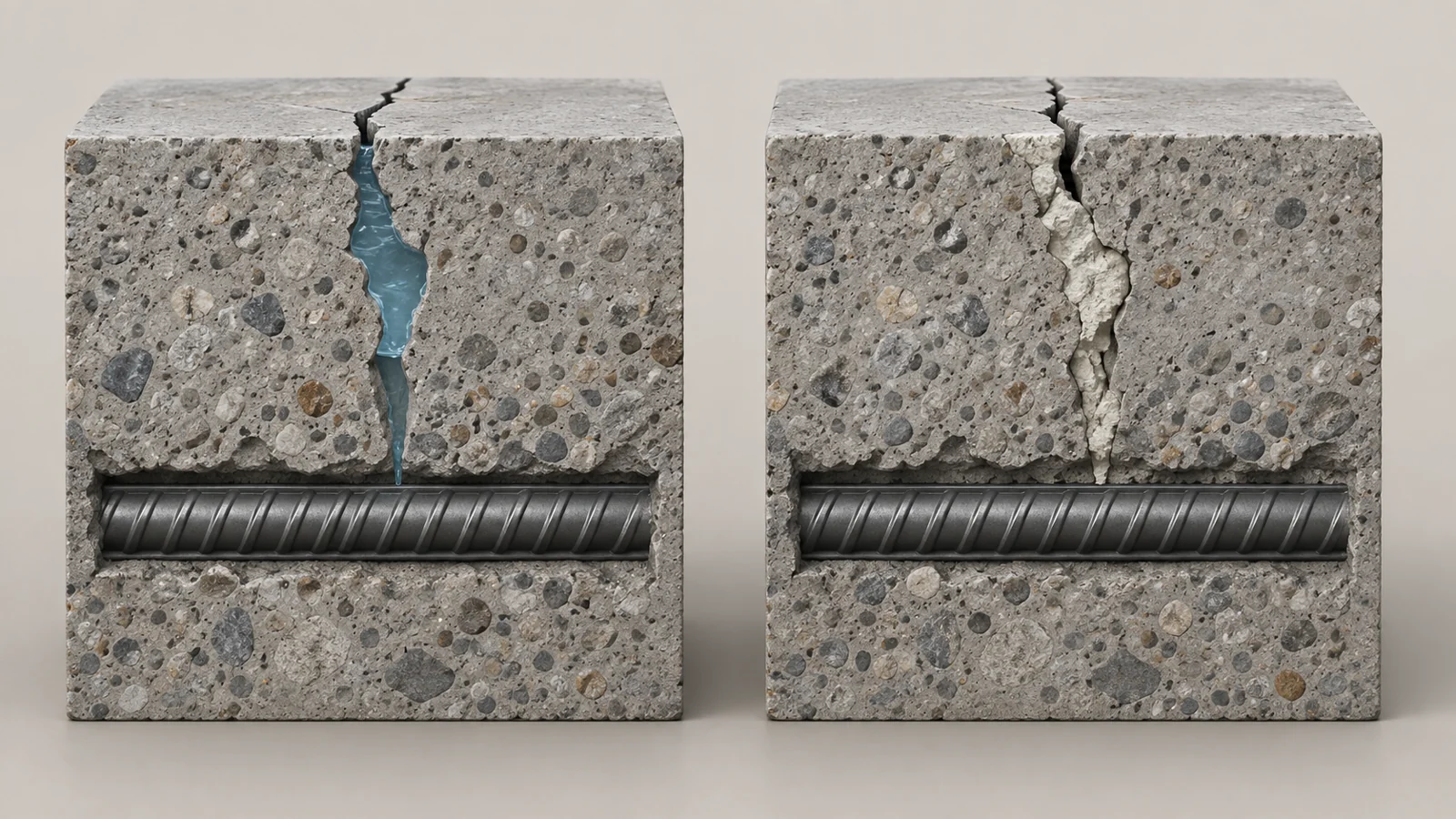
A crack can provide an entry route into concrete. Water and chloride ions can penetrate through these openings, contributing to deterioration and corrosion of embedded steel reinforcement. The concern extends beyond the appearance of a surface: an opening can give damaging substances access to parts of a structure that concrete is meant to protect.
That makes crack repair a question of transport as well as geometry. A narrower or filled opening matters if it limits further penetration. Yet closing a visible gap does not, by itself, establish that the material has recovered its load-bearing capacity. Surface appearance, resistance to water entry, and structural performance are different things to assess. Self-healing should not be read as a guarantee that damaged infrastructure becomes safe again.
Several ways to give concrete healing capacity
“Self-healing concrete” describes a family of approaches rather than one material. The preprint describes concrete repairing cracks autogenously or autonomously and surveys several technologies with potential construction applications.
The approaches named in the abstract include hydration and swelling agents, microbial calcium carbonate precipitation, encapsulation, and shape-memory polymers. They should not be treated as interchangeable ingredients with a common level of performance.
The preprint’s scope is therefore useful for understanding the diversity of the research. Its discussion of literature and case studies should not be mistaken for a single experiment demonstrating a universally effective concrete mixture.
A repaired crack is only part of the carbon calculation
For the environmental argument to work, healing must produce a useful change in service. The relevant question is whether the repair limits deterioration enough to affect maintenance or replacement over time. A crack that appears to close provides a different kind of evidence from a structure that needs fewer interventions throughout its life.
An overall environmental balance must then account for the healing system itself. Producing and incorporating extra materials can carry burdens of its own. Those burdens would need to be weighed against any avoided repair work and replacement concrete. The presence of a healing mechanism alone cannot settle that calculation, even when the mechanism performs its immediate task.
The basis for this account is the preprint’s abstract. From that alone, readers cannot assess the individual studies’ methods, the conditions behind reported performance, or the assumptions used in environmental comparisons. This limits the conclusions that can be drawn here; it does not establish what the full paper does or does not contain. No numerical carbon saving, service-life extension, or cost reduction can responsibly be assigned from this basis.
The May 2024 publication consequently supports a research direction with plausible benefits. It does not establish broad commercial readiness or show that self-healing concrete delivers net-zero construction. Its status as a preprint also matters when interpreting its conclusions as an account of developing research.
What this could change
If healing reliably slows deterioration under real service conditions, and its added environmental costs are outweighed by the work it avoids, infrastructure owners could gain more flexibility in maintaining buildings, bridges, roads, and tunnels. Some repairs or replacements could become less frequent, reducing disruption as well as demand for replacement material.
That is the practical possibility from the May 2024 perspective: small-scale crack repair could help preserve large structures. The carbon benefit would arise through the concrete and construction work no longer needed over their useful lives, provided those avoided burdens exceed the cost of supplying the healing capability.
Key Sources
- Primary source: Sustainable and Innovative Self-Healing Concrete Technologies to Mitigate Environmental Impacts in Construction
DOI or Journal Page · Peer-Reviewed Paper · 2024-05-10
Keep exploring