
Research Signal – Source date 2022-04-29
A crack in concrete can become less visible and let through less water without the material recovering its former strength. Both outcomes matter, but they solve different problems. Closing a route for water and dissolved salts may help protect embedded steel from corrosion. Restoring the ability to withstand mechanical loads requires evidence about how the damaged material performs under force.
A review published on April 29, 2022, Self-Healing Concrete as a Prospective Construction Material, brings these questions together across several approaches to concrete that repairs its own cracks. Its contribution is to explain how the repair mechanisms work, what influences their performance and why different demonstrations of “healing” can be difficult to compare. It synthesizes earlier research rather than reporting a single new experimental breakthrough.
The practical question begins with the job a structure must do. A water-retaining wall needs to resist leakage; a structural element must meet its mechanical demands. A useful repair must recover the relevant property under the conditions that the concrete will actually encounter.
Where the crack-filling material comes from
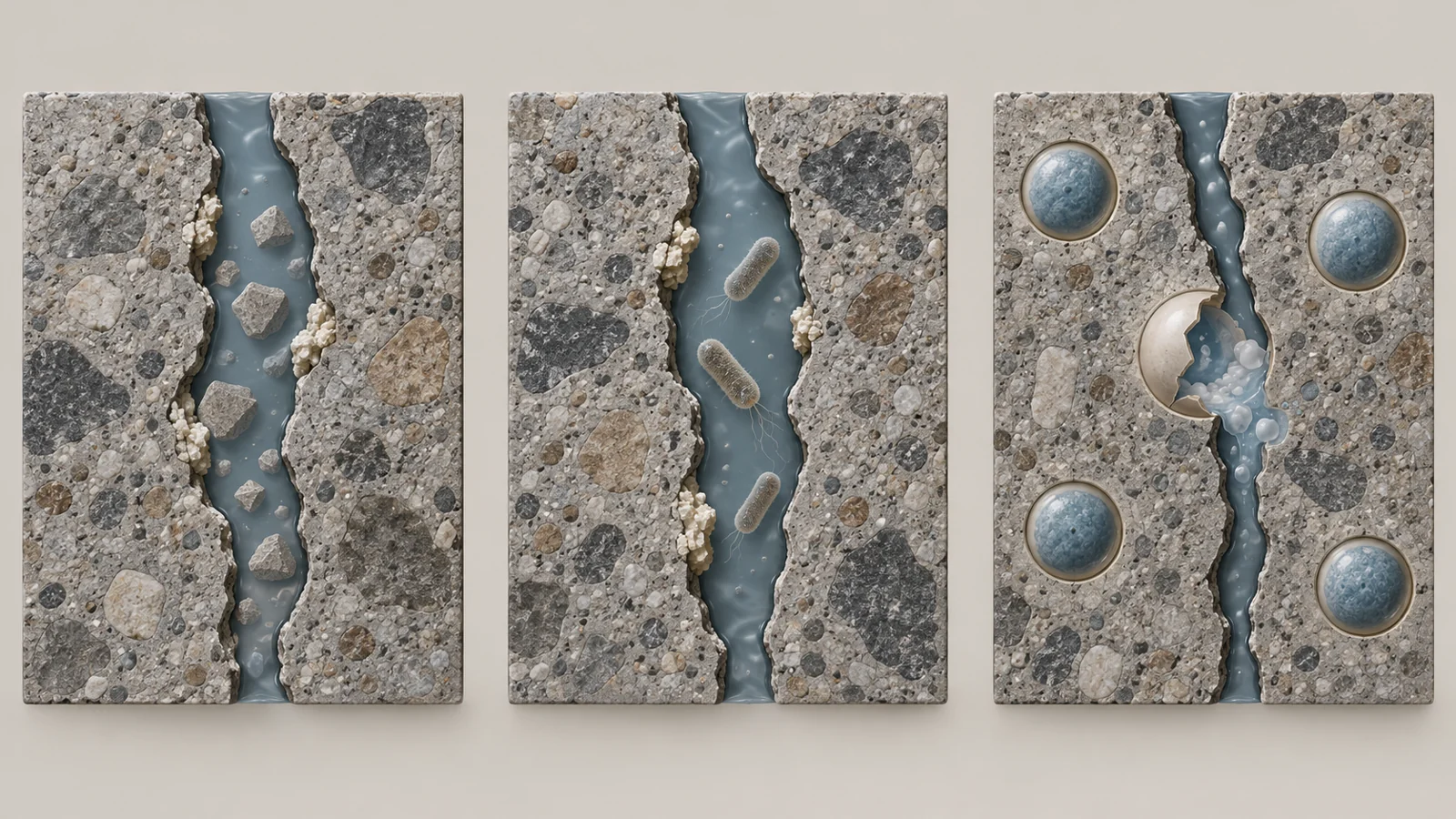
Concrete already has a limited capacity to fill small cracks through reactions involving its original ingredients. Some cement remains unreacted after the material has hardened. When a crack allows water to reach it, further hydration—the reaction between cement and water—can produce additional solid material. Calcium carbonate can also form and contribute to filling the opening. This natural healing depends on access to water and is generally restricted to minor cracks.
The available supply matters. The review explains that changing the water-to-cement ratio can leave different amounts of unreacted cement inside the hardened material. Supplementary cementitious ingredients can also change the reactions that remain possible. A crack therefore exposes a particular chemical reservoir, whose ability to fill the gap depends on the mixture and its surroundings.
Bacterial approaches introduce another source of solid material. Selected bacterial spores are incorporated with the ingredients needed to support their later activity. Water entering a crack can activate the spores, and bacterial processes can lead to the production of calcium carbonate. The mineral accumulates within the damaged region. Water, suitable nutrients and conditions that sustain bacterial activity all participate in this process; adding bacteria alone does not provide the whole repair system.
Capsule approaches store a healing substance until damage releases it. A growing crack must intersect a capsule and break its shell, allowing the contents to enter the opening. The review discusses agents including epoxy resin and polyurethane, among others. Here, the supply is a stored payload whose usefulness depends on reaching the crack at the right time and in sufficient quantity.
These approaches draw on different resources: remaining reactive cement, biologically produced minerals or a substance placed in storage during manufacture. That difference helps explain why a condition that favors one recipe may do little for another.
Water can reverse which mixture performs better
Water does more than switch healing on. Its composition can change the products that form inside a crack and alter the relative performance of different cement mixtures.
One laboratory mortar comparison reported by the review makes the interaction particularly clear. After 56 days in seawater, an ordinary Portland cement specimen sealed cracks up to 592 micrometers wide, while a specimen containing blast-furnace slag sealed cracks up to 104 micrometers. In freshwater, the reported widths were 168 and 408 micrometers, respectively. The relative performance reversed when the water changed.
Those figures describe particular specimens and exposure conditions, not universal crack sizes that these materials can repair. Their value is in showing how strongly the surroundings can influence the result. The review describes contributions from minerals including brucite and aragonite in marine conditions, alongside the effects of the cement composition itself.
Bacterial systems have their own environmental requirements. The review reports better healing in freshwater and at room temperature for the bacteria-based systems it discusses, making transfer to colder marine environments a further challenge. A recipe intended for a wet tunnel lining and one intended for a marine structure therefore need evidence matched to their respective exposure conditions.
A capsule must survive until it needs to break
An embedded capsule faces competing demands throughout its life. During concrete preparation, it must withstand collisions and the forces imposed by mixing. If it releases its contents then, the healing substance is spent before a crack needs it. A thicker or stronger shell can improve survival, but may make the capsule harder to rupture later.
The later encounter is equally demanding. A crack must actually reach the capsule, and the forces at the crack tip must break its shell. The review explains that a capsule’s stiffness and its bond with the surrounding cement affect the crack’s path. A poorly bonded capsule may separate from the surrounding material instead of opening. Some combinations of material properties can also divert a crack away from the inclusion.
Geometry changes the odds. Elongated capsules can increase the chance of intersecting a crack and carry more agent along it, but their orientation matters. Increasing storage capacity with a relatively thin shell creates another compromise because it can increase vulnerability during mixing. Designing the container consequently involves the whole sequence from preparation to damage, rather than simply choosing a substance capable of filling a gap.
What a healing demonstration actually measures
A photograph of a narrowing crack answers a useful but limited question about its visible opening. Imaging inside a specimen can reveal where filling material has accumulated. In one study discussed in the review, three-dimensional X-ray imaging found that much of the mineral precipitation associated with hydrogel-encapsulated bacteria was concentrated near the surface. The distribution matters because a filled surface and a filled crack interior are different physical results.
Water-transport tests ask whether the damaged region still provides an easy passage for liquid. The review describes measuring water uptake and comparing a healed specimen with both an intact specimen and a cracked, unhealed one. It also describes tests that force water through a crack under pressure. These comparisons show how much resistance to water entry has returned and whether the filling withstands the test conditions.
Mechanical tests apply loads through compression, tension or bending to assess the relevant performance. They address the opening question about strength directly. A reduction in leakage, even a large one, cannot substitute for these measurements or certify that a structure is safe.
This is why a reported “healing efficiency” percentage needs a defined outcome. A percentage based on visible crack closure measures something different from one based on water flow or recovered mechanical performance. Initial crack width, exposure, healing time and the reference specimen also affect the interpretation. The review identifies inconsistent reporting and testing criteria as an obstacle to comparing results across research groups. Without those details, a league table of healing percentages can rank unlike achievements as though they were interchangeable.
From a laboratory specimen to a working structure
As described in the 2022 review, much of the research is concentrated in laboratory specimens, with extensive use of mortar and relatively few outdoor-scale trials. Mortar experiments help researchers isolate reactions and test formulations. Moving to concrete introduces the influence of larger aggregates and different crack patterns, so the same ingredients may encounter a different arrangement of openings and obstacles.
A structure also ages while carrying loads and experiencing changing exposure. The review calls for investigation of bacterial systems in older concrete, with multiple cracks and under varied sustained loads. These conditions test whether the healing system remains available when damage develops and whether it can function across the damaged region. Successful filling during one laboratory exposure does not settle performance over a structure’s service life.
The healing ingredients can also change the original material. The review reports inconsistent effects of bacterial formulations on compressive strength: some systems reduced it, while particular combinations of bacteria and protective carriers produced small improvements. Culture media, nutrients, carriers and environmental conditions can all influence the result. Those measurements concern how the formulation performs as a material; they must be kept separate from measurements of strength recovered after cracking.
Economics adds a further constraint. Bacteria, nutrients, capsule production and the work needed to incorporate them have costs. The review argues that an attractive system would keep its added expense below the direct and indirect repair costs avoided during service. That balance depends on where the material is used, how difficult repairs are and whether the healing remains effective long enough to prevent interventions. A promising specimen establishes only part of that calculation.
What this could change
If reliable crack sealing could be made affordable and effective under service conditions, tunnel linings and water-retaining structures could need fewer interventions to control leakage. Difficult-to-access locations are especially relevant because reaching the damage can be a substantial part of the repair effort. The review identifies these as potential applications, reflecting the practical value of limiting water entry where maintenance is disruptive.
From the perspective of April 2022, the useful prospect is concrete that deals with some small cracks early enough to reduce later repair work. If that capability persists as structures age, infrastructure operators could spend less time locating and treating leaks, while users could experience fewer maintenance interruptions. Achieving that benefit depends on matching the healing system to the structure and its environment, and on the avoided repairs justifying the added construction cost.
Key Sources
- Primary source: Self-Healing Concrete as a Prospective Construction Material: A Review.
DOI or Journal Page · Review or Meta-Analysis · 2022-04-29
Keep exploring