
Research Signal – Source date 2024-07-25
A tiny crack can begin a much larger failure in a composite material. It can separate layers, weaken the connection between reinforcing fibers and their surroundings, or admit moisture that accelerates deterioration. Self-healing materials aim to interrupt that sequence by building a repair mechanism into the material itself.
A review published in Polymers on July 25, 2024, brings together ways to do this, particularly in polymer composites. Some designs store a repair liquid inside capsules or channels. Others rely on bonds within the polymer that can reconnect. The paper synthesizes earlier research rather than introducing one newly validated material, and its application examples describe possibilities across industries rather than establishing readiness for widespread use.
The useful question is what a particular material can recover after damage, under which conditions, and at what cost to its other properties.
Why a small crack matters
A polymer composite combines a polymer matrix—the surrounding material—with reinforcement such as fibers. Damage can affect the matrix, the reinforcement, or the interface where they meet. Repairing one of those regions does not automatically repair the others.
The review describes microcracks arising during fabrication, storage, and service. Tension, compression, and shear can contribute, as can changes in temperature, moisture, chemical exposure, and radiation. Mechanical stress and environmental exposure together can make crack formation and growth more likely.
Once present, microcracks can become starting points for delamination, where layers separate, or for debonding between fibers and the matrix. They also create entry routes for oxygen, moisture, and corrosive liquids. This gives early repair a specific purpose: sealing or reconnecting a damaged region before it becomes a pathway for further deterioration.
Two ways to build repair into a material
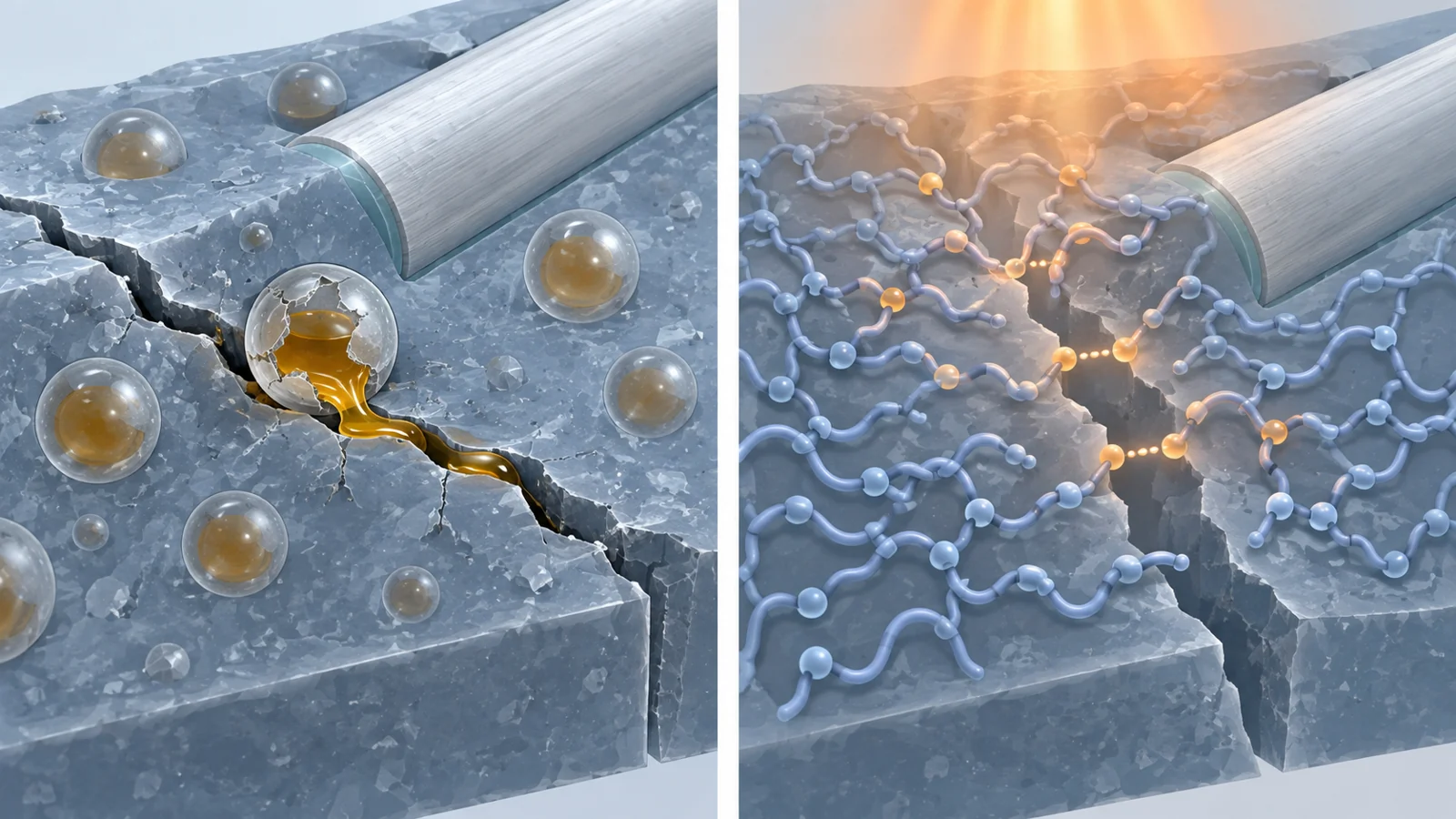
Extrinsic healing uses a repair agent carried within the composite. In a capsule-based design, a growing crack breaks a capsule and releases its contents into the damaged region. The liquid then reacts to form material that can bridge or seal the crack. Vascular designs use internal channels to carry healing fluids. The review also includes nanoparticle-based approaches within its discussion of extrinsic mechanisms.
Intrinsic healing depends on the polymer’s own molecular connections. These may be reversible covalent bonds, including those involved in Diels–Alder chemistry or disulfide bonding, or non-covalent interactions such as hydrogen bonds and ionic attractions. Under suitable conditions, connections disrupted by damage can form again.
A separate distinction concerns what starts the process. Autonomous healing is triggered by the damage itself. A crack rupturing a capsule is a straightforward example. Non-autonomous healing requires an applied stimulus, often heat or light, to initiate repair.
These classifications answer different questions. Intrinsic and extrinsic describe where the repair capability resides; autonomous and non-autonomous describe how it is activated. Neither label alone tells a reader how many repair cycles are possible. That depends on the particular chemistry and architecture, including whether repair agents remain available and whether the molecular network can reconnect repeatedly.
For an externally triggered coating, timing matters too. The damaged area remains exposed until the stimulus is applied. A material designed to heal with heat therefore carries an operational requirement: the necessary heating must be feasible where and when the damage occurs.
Getting the repair agent to the right place
Adding a healing chemical is only one part of the design. A capsule shell needs enough thermal stability and mechanical integrity to survive processing, yet it must release its contents when damage reaches it. Where a catalyst is needed, its stability and compatibility with the repair liquid also matter.
The capsule must interact appropriately with the surrounding matrix. If a crack passes around it without releasing the liquid, the stored chemistry cannot do its job. After release, the agent must reach the damaged interface and adhere to the opposing surfaces. The review emphasizes that healing can be minimal or absent when the fluid sticks to only one side. Surface contact and the movement of the liquid are therefore as consequential as the reaction itself.
Intrinsic systems face their own physical constraint. Rigid polymer matrices can resist the molecular movement needed for repair, especially below their glass transition temperature—the region associated with a change from glassy behavior toward greater molecular mobility. Highly cross-linked networks, whose chains are extensively connected, make this design problem particularly demanding.
One example summarized in the paper used separate hollow fibers containing an epoxy component and a cross-linking agent. Released fluids reached a damaged polymer–metal interface and increased the force needed to pull the metal fiber out. The detail matters because the recovered property was adhesion at an interface, a different repair task from closing a crack in the bulk polymer.
What recovery percentages actually describe
The review reports an epoxy system containing capsules filled with epoxy and a hardener dispersed through the surrounding matrix. Cracking broke the capsules, allowing the released resin to contact the hardener. A formulation with 10% capsules and 2% hardener by weight reached 111% of its original fracture toughness. A woven-glass-fiber composite in the same summarized study achieved a reported healing efficiency of 68%.
Fracture toughness concerns resistance to crack growth. The 111% result means the measured value exceeded its original reference value in that test; it does not mean every aspect of the material became better than new. The lower result in the reinforced composite also shows why the architecture around the healing chemistry matters. These figures cannot serve as a universal score for self-healing materials.
A different example makes crack size tangible. In work using polyurethane-filled macrocapsules, 67% of specimens with cracks 0.10 millimeters wide nearly fully recovered resistance to chloride penetration. At a crack width of 0.33 millimeters, only 33% showed no chloride penetration. The reported endpoints differ, but both results connect barrier recovery to the geometry of the damage. They do not define a crack-width limit that applies to every system.
There can also be a cost before damage occurs. In a polyester capsule system discussed in the review, fracture resistance improved relative to plain polyester resin while rigidity decreased. Short shelf life of the healing chemicals limited practical usefulness. A formulation can therefore perform well in a repair test while making a different property less suitable for the intended component.
A closed crack is only one measurement
Visible crack closure is useful evidence that the damaged geometry has changed. It cannot, by itself, establish recovery of load-bearing capacity, electrical conduction, thermal behavior, and resistance to corrosive liquids. Each function needs a measurement that matches it.
For a structural composite, the relevant test might examine fracture toughness or adhesion between reinforcement and matrix. For a protective coating, resistance to penetration may be more informative. For an electrically functional material, the question becomes whether a broken conducting path has recovered. The review describes electrical monitoring during bending tests as one way to follow that process.
Material characterization adds another layer. Mechanical testing can track stiffness and energy dissipation; thermal methods can assess temperature-dependent behavior and degradation; spectroscopy can follow chemical changes involved in healing. Together, such measurements help connect an apparent repair to changes inside the material.
The reference material matters just as much as the instrument. Comparing a healed specimen with its own undamaged state asks how much performance returned. Comparing the modified formulation with the original, unmodified material asks what incorporating the healing system cost or gained. Both comparisons are needed to understand a claim such as “high healing efficiency.” Otherwise, a strong recovery percentage can obscure a weaker starting material.
What a usable component would demand
The attraction is especially clear in places where inspection and repair are difficult. The paper discusses aerospace, automotive, marine, energy, healthcare, military, and construction applications. In fiber-reinforced structures, for example, microscopic impact damage and internal separation create a strong reason to investigate repair mechanisms that operate within the material.
Turning that rationale into a usable component requires the healing process to fit manufacturing and service conditions. The review identifies scale-up, environmental compatibility of chemicals and nanomaterials, and the balance between mechanical performance and healing efficiency as unresolved challenges. A capsule system must retain usable chemistry through processing and storage. A stimulus-dependent system must receive its trigger without making maintenance impractical.
Repeated damage introduces a further demand. Reversible bonding offers a route to repeated repair, but the possibility of reconnecting bonds does not establish an unlimited service life. Performance needs to remain useful after repeated damage under relevant loads and environmental exposure. Likewise, a successful laboratory specimen cannot alone establish reliability in a large structure or clinical benefit in an implant. Those are component-specific validation questions.
What this could change
If repair mechanisms can remain active through manufacturing, aging, and repeated service damage, they could make it possible to intervene inside a component before small defects require major repairs. Restoring a barrier could slow the entry of corrosive liquids; recovering adhesion or resistance to crack growth could help preserve structural function. In hard-to-access equipment, that could reduce some repair visits and premature replacements.
The larger payoff would be longer useful service from materials already in place. For transport structures or energy equipment, preserving performance could reduce replacement material, maintenance effort, and associated resource use. That benefit depends on repair restoring the function the component actually needs—the connection between a microscopic chemical response and a practical gain in durability.
Key Sources
- Primary source: Smart Composite Materials with Self-Healing Properties: A Review on Design and Applications.
DOI or Journal Page · Review or Meta-Analysis · 2024-07-25
Keep exploring