
Research Signal – Source date 2026-01-12
A free-standing film that changes its response to light when stretched could help turn mechanical strain into an optical signal. But such a material faces a paired challenge: it must interact strongly with light while remaining sturdy enough to handle, and it must do so in a form that can be made and used beyond a delicate laboratory coating.
In a paper published January 12, 2026, researchers describe a chiral polymer film built into a vitrimer matrix. They report that the film’s optical response changed under a 5% stretch and returned after release. Separately, they report self-healing that restored optical function and mechanical integrity. Those are two different behaviors, measured or claimed in different contexts.
A small chiral ingredient changes the film’s optical response
The films combine a fluorene-thiophene chiral polymer additive with a vitrimer-based material. “Chiral” describes a structure whose handedness can affect how it interacts with light. The authors report that the matrix confines hierarchically ordered helical domains, which strengthens circular dichroism while suppressing linear anisotropy.
Circular dichroism is a difference in how much left- and right-circularly polarized light a material absorbs. Linear anisotropy, by contrast, can make a material’s measured optical response depend on direction or alignment. The researchers used circular-dichroism spectroscopy and Mueller matrix ellipsometry to assess the film’s optical properties, including whether its response reflected chirality rather than simply directional alignment.
The additive loading was low: at roughly 1% by weight in a hard-soft polymer/vitrimer composite, the reported circular-dichroism response was threefold higher in the stated comparison and exceeded the response of the pure polymer. The abstract does not make clear what value the threefold figure uses as its denominator, so the comparison should not be assigned a more specific baseline.
Stretching changes ellipticity; release brings it back
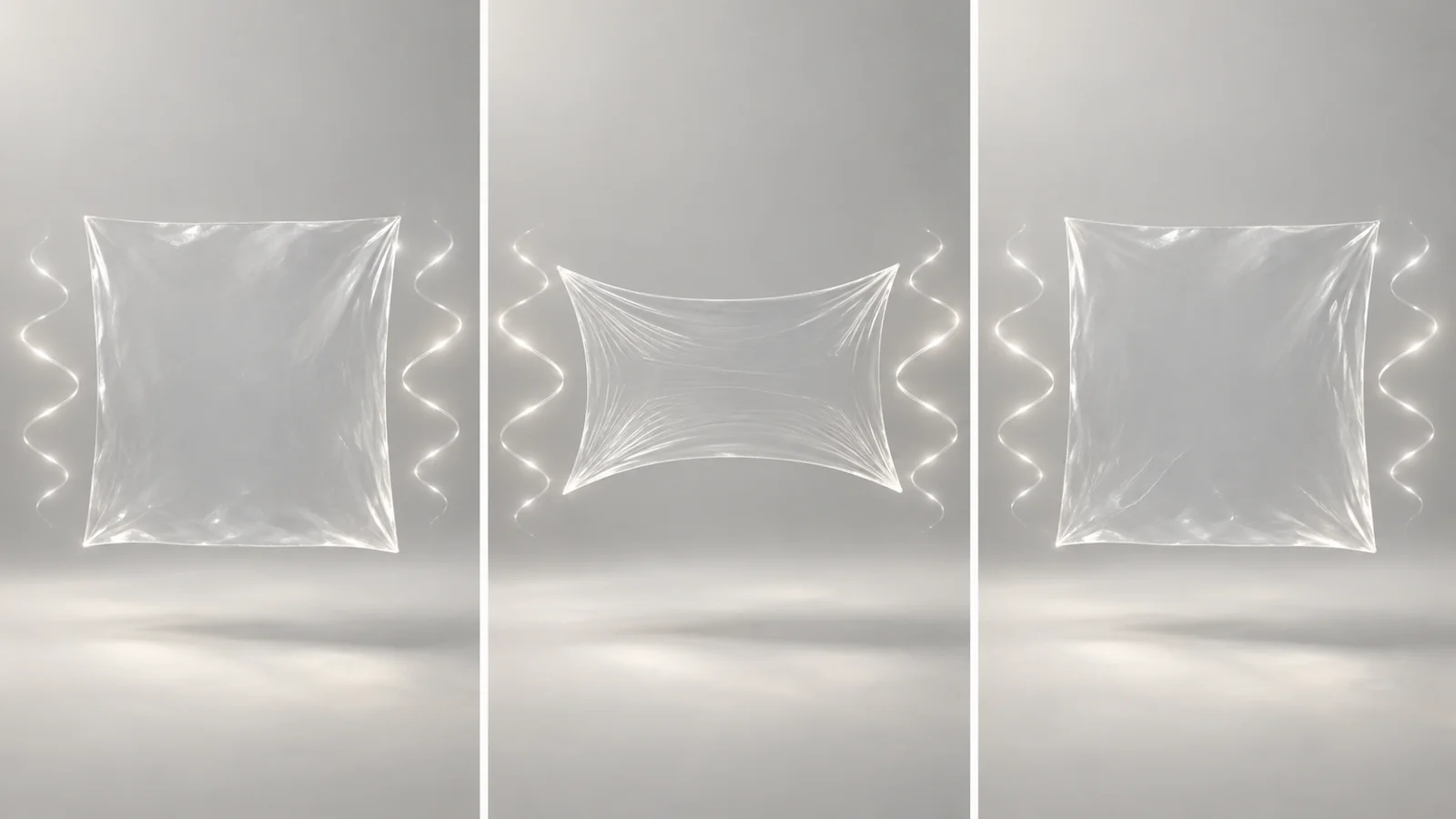
When the researchers stretched the film to 5% strain, its ellipticity decreased. Ellipticity describes the shape of polarized light after it passes through a material, so this change indicates that the film’s chiroptical response shifted under strain. After the stress was released, the ellipticity recovered across multiple cycles.
This is a reversible response to deformation: stretch the film, observe a lower ellipticity, then release it and observe recovery. It shows that the measured optical signal tracked the strain and returned afterward under the reported conditions. The available evidence does not establish how many cycles the film can withstand over its lifetime or how it would behave in a working device.
Repair after damage is a separate claim
The authors also report mechanochromic self-healing, with both optical functionality and mechanical integrity restored. This goes beyond the stretch-and-release observation: elastic or otherwise reversible recovery after strain does not by itself show that a damaged material can repair. The two findings therefore support distinct capabilities—one response to repeated stretching and release, and another involving repair after damage.
The abstract provides limited detail about the damage, healing conditions, time required, and the extent of repair. It supports the reported restoration claim, but not a quantified repair rate or a conclusion about performance under particular temperatures, environments, or repeated damage.
From self-standing film to a useful component
The study addresses a difficult materials combination. A coating made by spin-coating a chiral polymer may show optical activity, but a free-standing film also needs enough mechanical robustness to be handled and integrated. The reported vitrimer composite is intended to bring optical activity together with stability, reprocessability, and self-repair, while its small chiral-polymer loading produces a stronger reported response in the stated comparison.
Those laboratory results do not yet establish scalable production or performance in a deployed optical component. The evidence available here does not specify quantified cycle lifetime, healing time, or device operating performance. Nor does recovery in circular dichroism necessarily mean the film visibly changes color. A practical stress-sensing or adaptive-optics component would need to work reliably in its intended geometry and conditions, with its optical and mechanical behavior characterized there.
What repairable light-control films could enable
If the film’s strain-sensitive optical response and damage repair prove reliable in practical components, engineers could use thin, self-standing materials to sense deformation or adjust how a device handles polarized light, while reducing the need to replace a damaged film. The path to that capability depends on showing that the response persists under real operating conditions and that production can deliver consistent films; the current report establishes a laboratory materials result, not a finished sensor or optical device.
Key Sources
- Primary source: Strain-Responsive and Self-Healing Chiral Polymer Vitrimer Composites: Tunable Circular Dichroism and Mechanochromic Recovery in Self-Standing Films.
DOI or Journal Page · Peer-Reviewed Paper · 2026-01-12
Keep exploring