
Research Signal – Source date 2024-06-26
Calling asphalt “self-healing” invites an appealing assumption: a material that recovers more should also withstand repeated loading better. A preprint posted on June 26, 2024, challenges that assumption in laboratory tests of asphalt binders. Among the materials studied, greater self-restoration did not correspond to better fatigue performance—the ability to resist damage from repeated loading.
The researchers propose a way to assess both properties together. Their comparison also highlights a detail that can change the result: how much damage a binder has accumulated before loading pauses. A rest period is part of the experimental conditions, and its placement matters when interpreting what happens afterward.
Building recovery into the comparison
Binder is the binding material in asphalt. Studying it lets researchers examine material behavior at a smaller scale than a road, where the binder is combined with mineral particles into a pavement mixture.
The study compared four binder types. One was unmodified, or neat, asphalt binder. Two contained polymers described as self-healing: a thermoplastic polyurethane and a silicone-based polymer called poly(dimethyl siloxane), crosslinked with urea bonds. The fourth contained styrene–butadiene–styrene, commonly abbreviated SBS. All the materials underwent short-term and long-term aging before testing, so the comparison addressed binders after aging treatments rather than only in their freshly prepared state.
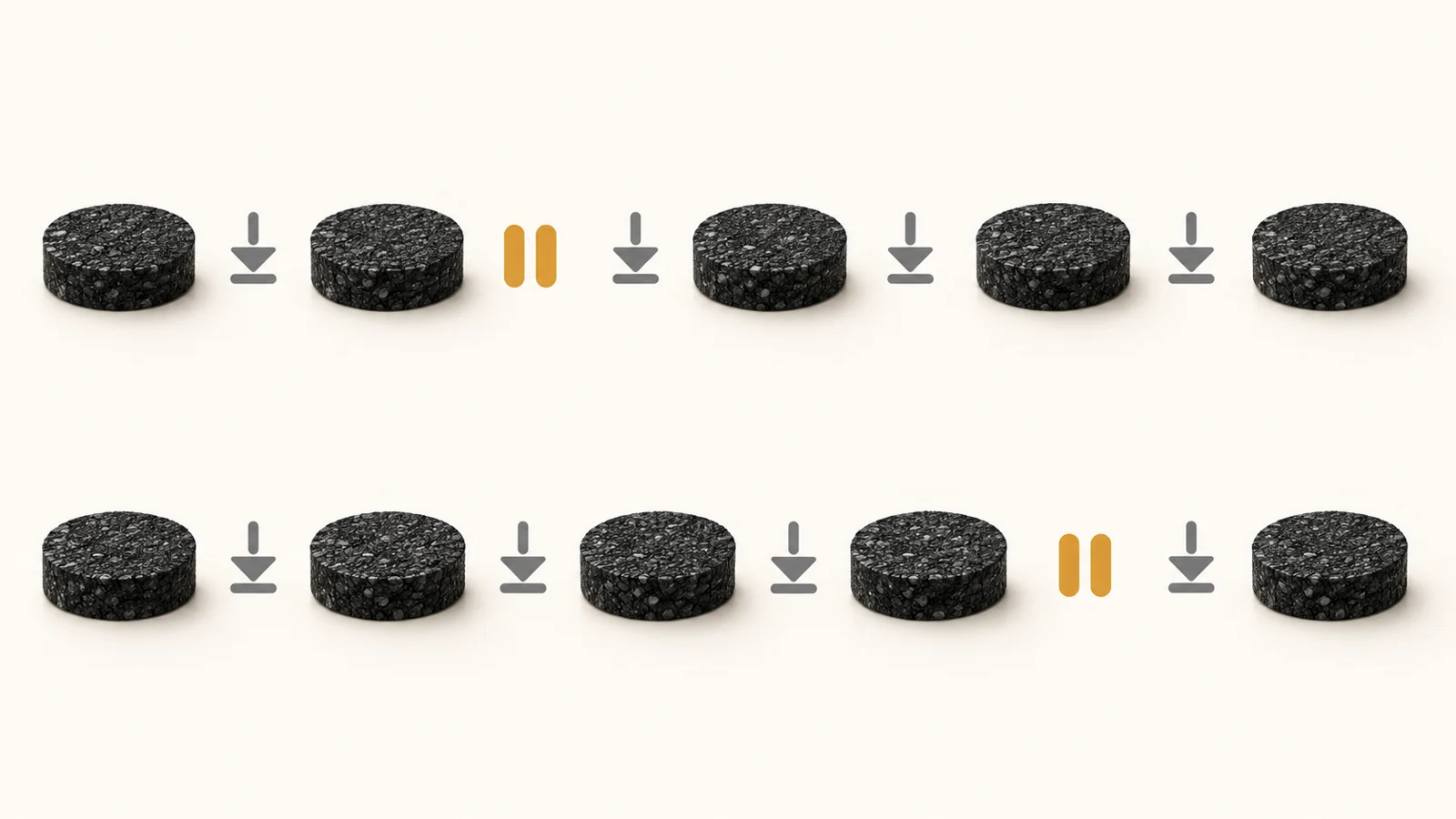
The proposed procedure brings together three components. The linear amplitude sweep test assesses fatigue behavior under loading. A version of that test incorporates a rest period, allowing recovery to enter the assessment. The simplified viscoelastic continuum damage model provides a way to interpret the material’s response as damage develops.
Connecting those components lets the authors examine fatigue performance alongside self-repairing activity through damage characteristic curves. These curves describe the relationship between material response and damage. The authors report that their procedure accommodates the tested binders’ behavior better than the existing method they compared it with. That is their assessment of the procedure’s performance; it should not be read as independently established superiority.
The damage reached before a pause matters
The timing finding concerns the binder’s condition when rest begins. The authors report an increased fatigue response when they introduced the rest period at a higher damage-intensity value. In other words, the response after the pause depended on how far damage had progressed beforehand.
That makes “tested with rest” an incomplete description of the comparison. Two tests can both include a pause yet interrupt loading at different material states. Knowing that a rest occurred does not, by itself, tell the reader what recovery opportunity was being assessed. The damage state at interruption helps explain why the subsequent response can differ.
The reported direction of this effect does not establish a universally best damage level for introducing rest. Nor does a laboratory pause translate into advice to delay road maintenance. Here, rest is a controlled testing condition used to investigate binder behavior.
How far the laboratory result reaches
The evidence comes from a single preprint describing comparative binder experiments. This account is based on its abstract, which supports the broad comparison and the reported timing result. It does not provide a basis here for a detailed appraisal of the protocol or statistics, or for deciding whether the procedure’s advantage would be reproduced independently across other materials and conditions.
There is also a scale change between a binder sample and a pavement carrying traffic. A road’s performance depends on the assembled mixture and the conditions it encounters. Establishing a useful distinction in binder tests is therefore an earlier step than demonstrating longer pavement service life. Fewer potholes, lower repair costs and successful road deployment cannot be inferred from these reported results.
The contribution is a proposed assessment procedure and an experimental finding about the importance of damage before rest. Whether those distinctions predict useful differences in pavement behavior remains the link needed for practical material selection.
What this could change
If the procedure proves reproducible and its measurements predict pavement behavior, it could help engineers develop or choose asphalt materials that withstand repeated loading more effectively. Accounting for the damage state before rest could make laboratory comparisons more informative when deciding which formulations deserve further development. If those choices ultimately produce pavements that resist fatigue cracking better, road users could face fewer fatigue-related repairs and less disruption from maintenance work.
Key Sources
- Primary source: Proposal of a New Procedure for Assessing the Performance of the Self-Healing Polymer-Modified Asphalt Binders with an Integral Vision of the Damage Characteristic Curves
DOI or Journal Page · Peer-Reviewed Paper · 2024-06-26
Keep exploring