
Research Signal – Source date 2023-03-21
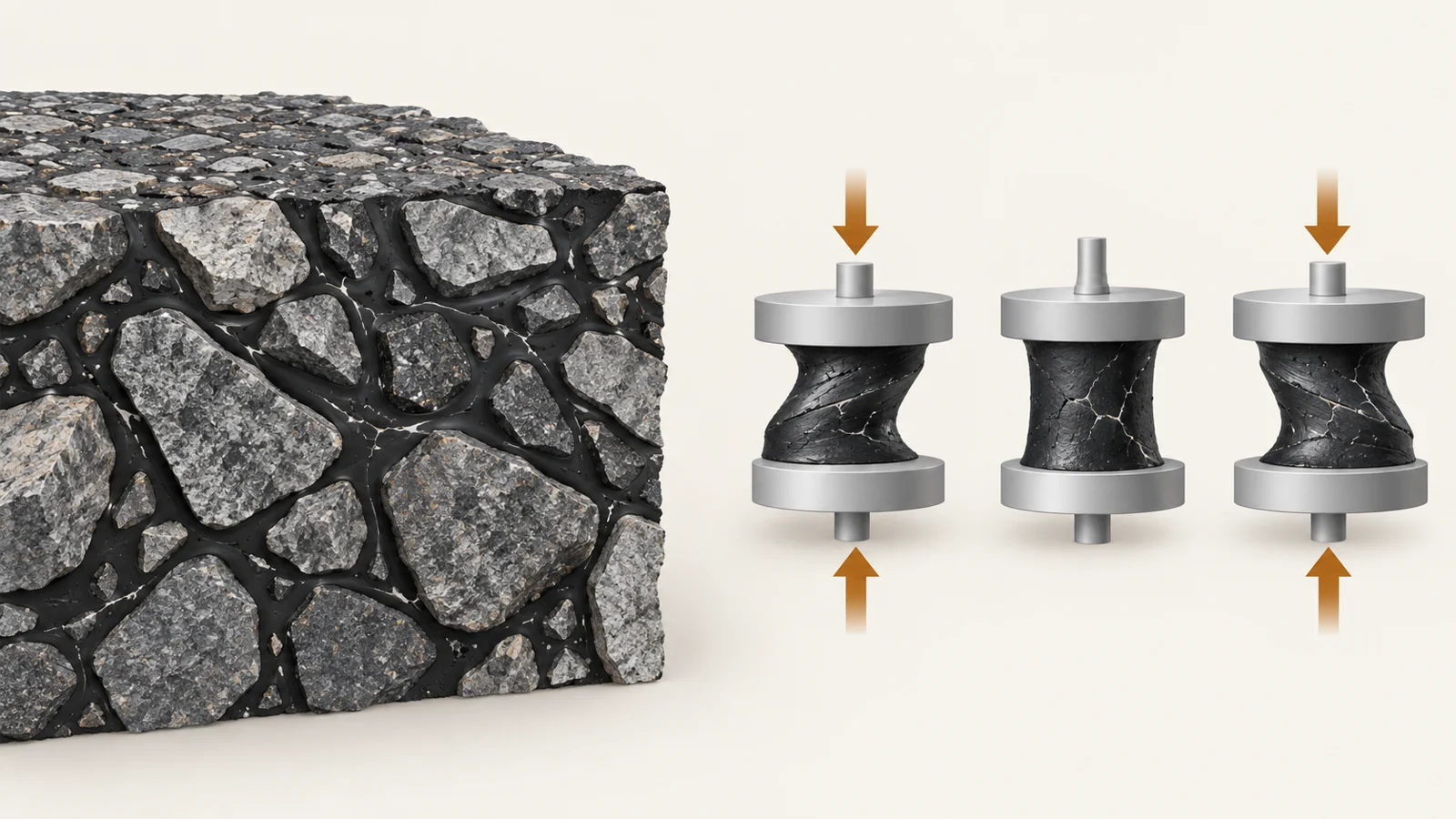
Repeated traffic loading can start fatigue cracks in bitumen, the binding material that holds an asphalt pavement’s mineral particles together. Giving that binder some ability to recover between loads is an appealing route toward resisting damage. In a laboratory study published on March 21, 2023, the smallest tested addition of a self-healing polymer produced the strongest fatigue performance among the formulations compared.
The researchers blended an unmodified binder with 1%, 3%, or 5% polyurethane by weight. Under two selected definitions of failure, the 1% formulation tolerated 67.1% more model-derived damage intensity before reaching the failure point than the unmodified binder. The higher concentrations produced smaller gains. That percentage describes a laboratory comparison of binders; it does not mean a road would last 67.1% longer.
The experiment also followed the materials through loading, a pause, and renewed loading. That sequence let the researchers investigate a practical question behind the promise of self-healing asphalt, meaning asphalt designed to repair small cracks. When a binder recovers during a rest, how does that recovery affect its ability to withstand further damage?
A small addition to the binding material
The starting material was a specific 70-grade neat asphalt binder from Jiangsu province in China. “Neat” means unmodified. Using the same base binder for all four formulations allowed the researchers to compare the effects of adding different amounts of one polymer.
Their modifier was a developing thermoplastic polyurethane with self-healing and reversible self-reinforcing properties at room temperature, around 25 °C. Its design uses crystallization induced by stretching to create a delayed, reversible reinforcing effect. The researchers wanted to investigate whether those properties could improve the behavior of bitumen under repeated loading and during recovery.
The polymer’s ability to restore itself without an added microwave or induction-heating stimulus was part of its appeal. Preparing the modified binder still required substantial heat and mixing. The team heated the base binder to 170 °C, added the polymer, stirred it manually for 10 minutes, and then mixed it at high speed for an hour to distribute the modifier throughout the material.
All four binders underwent both short-term oven aging and long-term aging in a pressurized vessel before testing. The comparison therefore concerned laboratory-aged materials, rather than only freshly prepared blends. The researchers subjected these specimens to a linear amplitude sweep, a test that repeatedly deforms the binder while increasing the deformation amplitude. A companion test interrupted loading with a rest period before loading resumed.
The concentrations were discrete experimental choices. The result identifies 1% as the best of the three additions tested for this binder and polymer. It does not locate an optimum across every possible concentration, and the comparison does not establish the molecular reason why the lowest addition performed best.
What counts as failure
A binder under repeated deformation gradually loses integrity. To compare formulations, researchers need to decide where along that process to call the material failed. That decision is the study’s “failure definition.” A “failure criterion” serves a different purpose: it relates a measure of the material’s response to the loading history, allowing fatigue behavior to be described across test conditions.
These choices matter because bitumen responds both elastically and through time-dependent deformation. The researchers used a viscoelastic damage model to separate aspects of that response and construct curves relating remaining material integrity to accumulated damage intensity. Both quantities are derived from the test and model; damage intensity is not a direct count of visible cracks.
Several candidate failure definitions were examined. Two accommodated the tested binders particularly well. One located the peak in stored pseudo-strain energy. This is a model-derived measure used to analyze how the binder carries loading as damage develops, rather than a direct measurement of energy available to repair cracks. The other located the peak in shear stress multiplied by the number of loading cycles.
Both definitions placed the 1% formulation’s improvement in damage intensity tolerated up to failure at the same value reported above. The 5% blend, however, could reach its selected failure point after more cycles than the 1% blend. Looking at cycle count alone would therefore have favored a different material. The energy and damage analysis showed that the 1% blend retained a greater capacity to accommodate loading even when the 5% blend reached its peak stored-energy point. For these formulations, counting cycles did not capture the whole comparison.
For the separate task of fitting fatigue behavior, the strongest results came from a criterion based on the area under the released pseudo-strain-energy curve up to failure. Its relationships with cycles to failure had R² values above 0.97 across the binders and selected conditions. Values close to 1 indicate a close fit between the relationship and the analyzed data. Here, they support the usefulness of that mathematical description within the experiment; they do not measure the accuracy of a road-lifespan forecast.
What happens during a pause
Imagine following one specimen through the interrupted test. Loading first pushes it to a chosen damage level. The apparatus then allows it to rest for 1, 5, 15, or 30 minutes. Loading resumes, and the researchers compare its modeled damage state immediately before and after the pause, then follow its subsequent response.
The interruption could come early or late. The team selected damage levels equal to 25%, 50%, 75%, 100%, or 150% of the damage intensity associated with failure. This covered conditions before, at, and beyond the selected failure threshold. The tests with rest periods were conducted at 25 °C.
Restoration generally increased with longer pauses and less damage before the interruption. Beyond the failure threshold, it dropped sharply. The timing of the pause thus changed what the material could recover: a specimen rested during an earlier stage of damage behaved differently from one already driven past its selected failure point.
The word “restoration” is deliberate. The test captures actual self-healing together with thixotropy, the reversible changes in a material’s internal structure and mechanical response associated with loading and rest. A change in the measured response after a pause cannot, by itself, tell the researchers how much came from each process. It is a combined recovery measurement, not a direct measurement of crack closure alone.
That distinction also helps explain why a rest period is an experimental variable in its own right. Its duration and position in the damage sequence shape the response recorded when loading restarts. A single recovery percentage needs those conditions attached to it to be interpretable.
Following recovery through further loading
The conventional restoration percentage focuses on the drop in modeled damage intensity across the pause. In many of the comparisons, the 3% formulation recorded the largest or nearly largest restoration percentage. Yet the 1% formulation performed better in the researchers’ subsequent fatigue analysis. Immediate recovery at restart and performance through further loading were answering different questions.
To connect them, the authors proposed measuring areas under curves of material integrity against damage intensity. For uninterrupted loading, they calculated the area up to the selected failure point. For loading interrupted by rest, they combined the areas from the portions before and after the pause, using the corresponding endpoint for the interrupted test.
This approach gives weight to how much integrity the binder maintains as damage accumulates. It follows the course of the test instead of taking only a before-and-after snapshot at the pause. The authors called these areas measures of fatigue-potential performance and used their percentage change to describe restoration efficiency. They also developed related comparisons for pauses applied beyond the original failure threshold.
The revised analysis brought recovery and fatigue performance into the same calculation and supported the stronger performance of the 1% formulation. Its value is that it asks what the recovered response contributes during continued loading. The areas remain analytical quantities derived from fitted laboratory curves, rather than measurements of repaired road surface or added years of use.
From a binder specimen to a road
In pavement, bitumen works together with mineral aggregate. The bond between the binder and those particles is another important contributor to fatigue performance, and the authors explicitly placed that bonding behavior outside this study’s scope. Incorporating the modified binder into an asphalt mixture introduces a physical relationship that the binder specimens alone cannot resolve.
The starting binder also matters. These results concern one base material, one polyurethane, three tested additions, and selected aging and loading conditions. Establishing whether the benefit transfers to other binders or survives realistic traffic and environmental conditions requires evidence at those levels. The study supports a candidate material and a way to examine its behavior, without establishing pavement service-life extension or maintenance savings.
There are unresolved questions within the laboratory analysis as well. The authors identified stored pseudo-strain energy as influential but called for further experiments to clarify its actual role in fatigue performance. They also could not decisively choose between the two successful failure definitions when each was paired with the area-based released-energy criterion. Both fitted the selected data well, with small differences between them.
The proposed restoration measures likewise need testing beyond the comparisons used to develop them. Agreement within this experiment provides a reason to investigate them further; independent performance in other materials and conditions would establish how broadly they can be used.
What this could change
If the binder’s improved damage tolerance carries through to its bonds with aggregate and then to pavement under realistic traffic and weather, it could help roads resist the repeated loading that initiates and spreads fatigue cracks. Slower accumulation of that damage could mean fewer repair interruptions for road users and less frequent intervention by maintenance teams.
Restoration without an added microwave or induction-heating stimulus offers a specific possible advantage along that path. If the behavior persists in pavement, periods of reduced loading could provide opportunities for some recovery without dedicated heating equipment. The March 2023 results make that possibility worth pursuing through the material-to-pavement gap, with the 1% formulation providing the strongest starting point among the additions tested.
Key Sources
- Primary source: Performance Assessment of Self-Healing Polymer-Modified Bitumens by Evaluating the Suitability of Current Failure Definition, Failure Criterion, and Fatigue-Restoration Criteria.
DOI or Journal Page · Peer-Reviewed Paper · 2023-03-21
Keep exploring