
Research Signal – Source date 2022-11-29
A small crack inside a material can be difficult to reach with any repair tool. In a composite, which combines different constituents within a surrounding material called the matrix, that crack may open a path through the matrix while reinforcing fibers remain intact. Building a repair mechanism into the material offers a way to act where the damage begins.
A review published on November 29, 2022, brings together approaches across polymer, metal, and ceramic matrices, with aerospace applications in view. Its examples describe several meanings of “self-healing,” from releasing a liquid into a fissure to forming a protective seal at high temperature. They show how local repair can work under particular conditions; they do not establish a general recipe for an aircraft-ready material.
The useful questions are physical ones. Where does the repair material come from? What makes it move or react? And after one crack has been treated, what remains available for the next?
A crack can release its own repair liquid
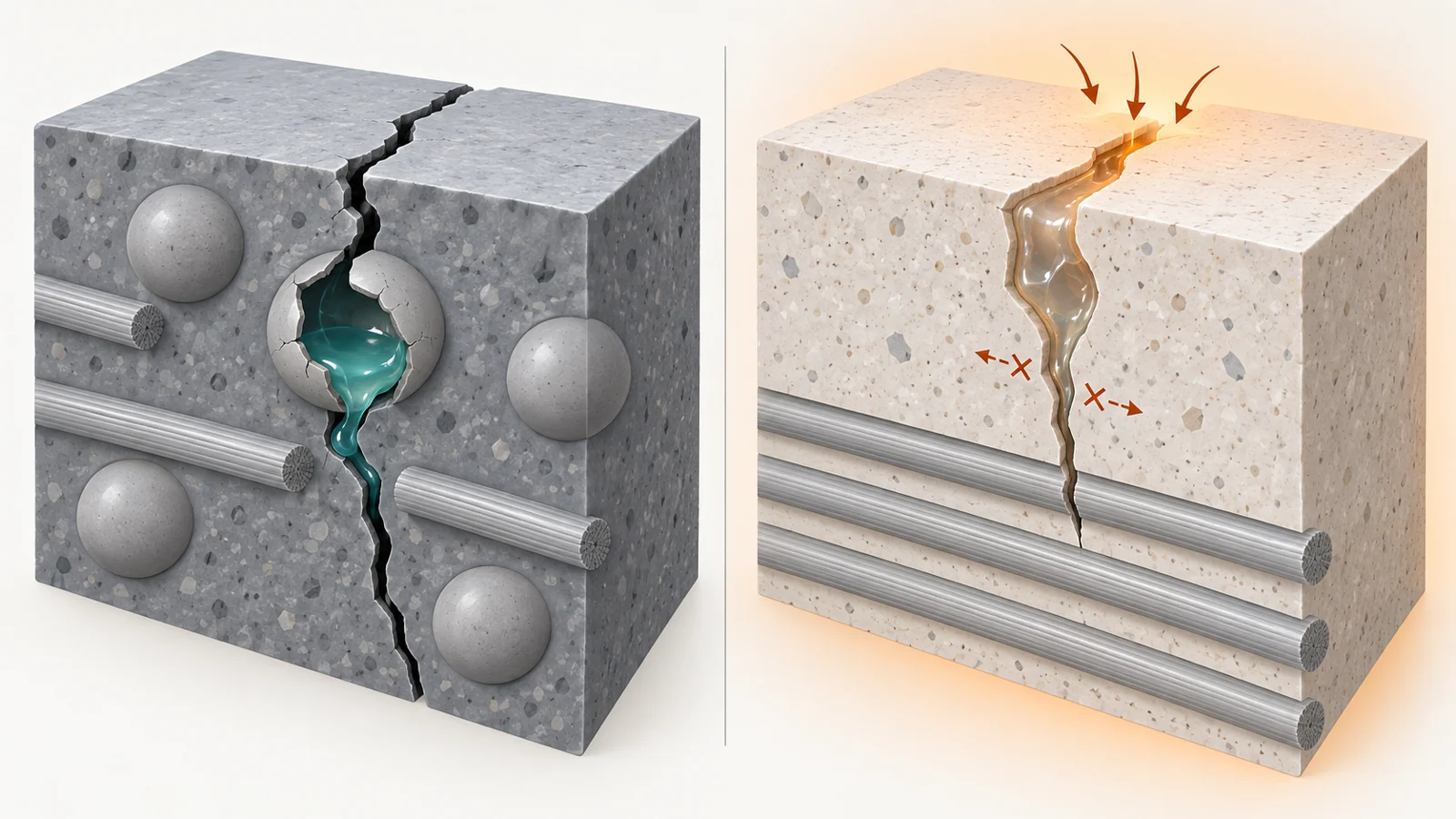
One polymer approach puts small capsules of liquid healing agent inside a solid matrix. As a crack advances, it ruptures capsules in its path. Their contents enter the narrow opening through capillary action, the movement of liquid through small spaces. In systems described in the review, the released material encounters a catalyst already distributed through the polymer and cures into a solid that fills the fissure.
This sequence makes the crack both the damage and the trigger. The material does not need to recognize a fault in the way an electronic sensor would. Breaking a capsule provides a direct physical connection between the opening of a crack and the release of a substance that can repair it. Delivery and curing still have to work together: liquid must reach the damaged region and then solidify there.
A different polymer strategy builds repair into the molecular connections themselves. Cross-links join polymer chains into a network and help give the material its mechanical properties. If selected connections can be broken and re-formed, the network has a route to reconnect after damage. The review discusses reversible links that need heat, light, or a chemical stimulus to activate this behavior.
These approaches separate two questions that the term “self-healing” can blur. An extrinsic system uses an added healing agent; an intrinsic system relies on the material’s own reversible chemistry. Whether repair starts autonomously is a separate issue. A capsule can release its contents when a crack breaks it, while reversible molecular links may require an externally supplied trigger. Built-in repair does not always mean repair without intervention.
The next crack needs a supply
Capsules carry a finite amount of liquid. Once a capsule has emptied, it cannot supply another dose at the same location. Further healing depends on whether usable agent remains nearby and whether a later crack can reach it. A successful first repair therefore leaves a practical question about the material’s remaining supply.
Hollow fibers and larger internal reservoirs offer ways to store and deliver more liquid. But extra capacity alone does not ensure that it reaches a fissure. The review recounts early difficulties with hollow-fiber approaches, including resins that were too viscous and poor curing. A reservoir is useful only when its contents can flow through the available opening and form a suitable repair.
Connected channels take this idea further. A vascular system distributes healing agent through a network rather than isolating it in individual capsules. With an available supply and a working delivery path, such a network can support repeated repair. The review includes polymer networks developed to heal multiple fractures, while also describing the difficulty of manufacturing the channels.
One fabrication approach creates a three-dimensional pattern of sacrificial material, surrounds it with epoxy, and removes the temporary pattern to leave passages behind. This adds a manufacturing task inside the composite itself. The design must accommodate a delivery network as well as the solid material around it. Moving from capsules to connected channels changes the engineering problem from storing a dose to building and maintaining access to the damaged region.
Metals repair at different scales
In metals, the material that moves into a defect can be individual atoms. The review describes precipitation-based healing in alloys containing dissolved elements that can later gather into new solid regions. Tiny voids or cracks can serve as sites for that precipitation. Heating to an appropriate aging temperature can encourage the process.
The scale matters. This mechanism addresses defects on the nanometer scale, far smaller than a readily visible fracture. Filling such voids can be relevant to how damage develops within an alloy, but atomic redistribution of this kind cannot be treated as a way to close a large break. It tackles a different damage problem from a liquid flowing into an open fissure.
Another metallic approach is closer to the capsule idea. A repair material with a lower melting temperature is enclosed in a shell and embedded in a host with a higher melting temperature. After damage and heating, the repair material can melt and enter a fracture through capillary action. Under suitable conditions, it fills the gap and forms a bond while the host remains solid.
Here, the temperature difference between the two materials provides the opportunity for repair. The heat activates the lower-melting ingredient without requiring the whole component to melt. The review’s 2022 account describes autonomous metallic healing as largely theoretical, with limited experimental results, while discussing several externally activated routes. Its metal examples span very different stages of development and should be read as distinct mechanisms, not interchangeable demonstrations of the same capability.
In hot ceramics, sealing changes oxygen’s path
For ceramic composites, a matrix crack can cause trouble by admitting oxygen. The opening gives oxygen access to reinforcing fibers and to the thin interface between those fibers and the matrix. Those interfaces help control how cracks travel through the composite. Oxidation can damage the fibers or alter their connection to the surrounding material, reducing performance over time.
Selected ingredients in a ceramic matrix can react with oxygen to form phases that seal the opening. The review describes boron- and silicon-containing systems that produce oxide materials capable of filling matrix fissures. By occupying those paths, the sealing phases restrict further oxygen penetration toward vulnerable fibers and interfaces.
This creates a useful chemical possibility: oxygen entering a crack can help generate a barrier against additional oxygen entry. The aim is localized sealing around existing reinforcement. It does not require severed fibers to grow back, and filling a matrix crack should not be understood as restoring every damaged part of the composite.
Temperature determines which sealing chemistry is useful. The review identifies boron oxide phases as advantageous at roughly 500–1,000 °C, with silica-rich phases preferred at roughly 1,000–1,500 °C. It also describes borosilicate fluid phases spreading into fissures in oxidizing conditions. These are ranges discussed for particular material systems, rather than a universal operating window for self-healing ceramics.
The connection to aerospace is especially direct in hot engine components. The review discusses layered ceramic composites containing boron-bearing constituents that form boron oxide in an oxidizing environment, linking their behavior to potential combustion-chamber use. In that setting, heat and oxygen are part of both the damage environment and the chemistry intended to limit further deterioration. A successful design has to make the protective reaction work under the conditions the component actually encounters.
A repair system also changes the starting material
Adding repair capability can alter a composite before any damage occurs. In one aircraft-oriented polymer study summarized by the review, an epoxy composite contained healing capsules and a catalyst. The catalyst addition reduced elastic modulus, a measure of stiffness. Mechanical properties improved after healing, but that improvement has to be considered alongside the change in the original material.
These are two different comparisons. One asks how the undamaged composite with a healing system performs relative to the material without it. The other asks how much a damaged specimen recovers after treatment. A material can show a useful recovery from damage while still starting with less stiffness than a designer needs. The review calls for additional evaluation using aerospace-grade glass-fiber polymer composites in this context.
The property being recovered matters just as much. Closing a fissure, restoring stiffness, improving resistance to fracture, and restoring corrosion protection describe different outcomes. A percentage obtained for one property in one material cannot rank it fairly against a different property measured in another. The polymer, metal, and ceramic examples also differ in damage size, activation conditions, and available healing supply.
For structural aircraft use, those distinctions leave substantive questions about behavior under relevant loads and environments, repeat repair, and retention of required properties. The mechanisms and cited experiments discussed here do not by themselves justify conclusions about aircraft certification, fleet reliability, reduced inspection needs, or maintenance savings. Those operational claims require evidence beyond showing that a particular repair process can occur.
What this could change
If localized repair can function in the relevant environment while preserving required material properties, aircraft operators could gain components that remain useful longer. In hot ceramic parts, sealing matrix cracks could slow oxygen access to vulnerable fibers and interfaces, helping preserve the internal structure during service. The downstream benefit would come from limiting continuing deterioration after small cracks form.
Coatings offer a different use. The review describes capsule-containing epoxy coatings intended to recover corrosion protection after damage. If a coating can close a breach and restore its barrier function, the material beneath it could remain protected for longer. That payoff concerns the recovery of surface protection, with a different job and performance requirement from repairing a load-bearing composite.
Both possibilities make repair part of how a component responds to ordinary damage. A finite reserve of liquid, a connected supply network, or a temperature-dependent sealing reaction could extend useful service in the setting it suits. The opportunity is to keep small defects from ending that service prematurely by placing the right repair process where the damage occurs.
Key Sources
- Primary source: A Comprehensive Review of Self-Healing Polymer, Metal, and Ceramic Matrix Composites and Their Modeling Aspects for Aerospace Applications.
DOI or Journal Page · Review or Meta-Analysis · 2022-11-29
Keep exploring