
Research Signal – Source date 2023-12-08
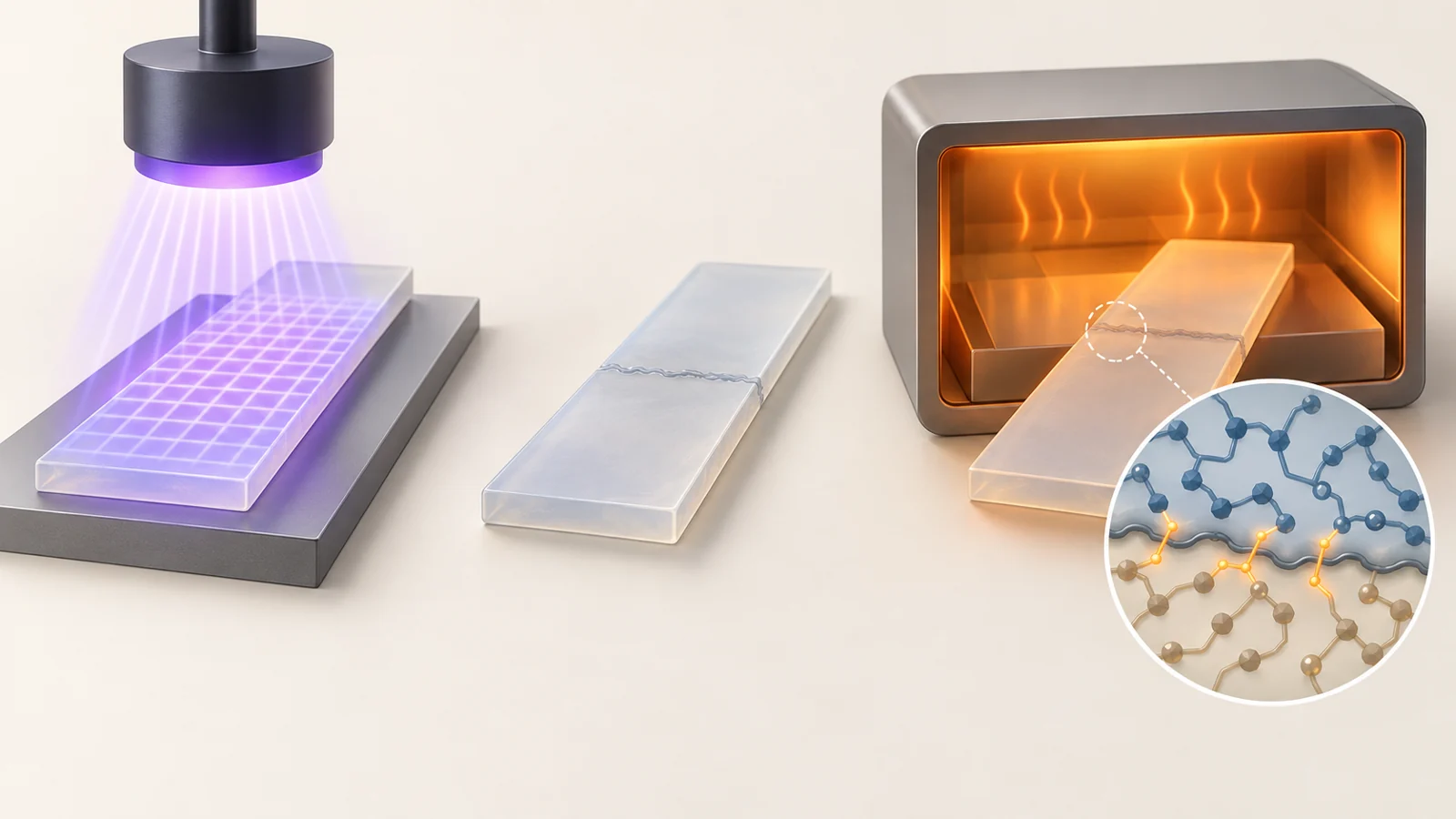
Light can turn a liquid resin into a solid object, building a finely shaped plastic part layer by layer. But the molecular network that holds the finished shape can also make damage difficult to repair. Once permanent connections lock the polymer chains together, a crack interrupts a structure that cannot readily be reworked.
A review published on December 8, 2023, examines ways to give these light-cured plastics internal connections that can rearrange or re-form. These are self-healing polymers, although many of the examples need treatment, such as heating, to activate repair. The paper brings together different materials and laboratory demonstrations rather than introducing one resin with every desirable property.
The physical question is straightforward: what reconnects across the damaged interface? Understanding the answer helps explain why a repaired sample may regain some of its strength, why that recovery takes particular conditions, and why making the material printable is a separate achievement.
Connections that can form again
Polymers consist of long molecular chains. Connections between those chains create networks that help a printed object hold its shape. In an intrinsically self-healing material, the capacity for repair resides within that molecular structure.
One approach uses dynamic covalent bonds. These chemical connections can exchange or rearrange under suitable stimulation, allowing the network to reconnect across damage. The review discusses several chemistries that provide this behavior, including disulfide and imine bonds. The essential feature is that connections within a solid network remain capable of change.
Another approach relies on reversible physical attractions. Hydrogen bonds, for example, can connect neighboring chains. Heating weakens these attractions and helps chain segments move; cooling allows the connections to form again. Other formulations combine more than one kind of interaction.
Crystallization offers a particularly tangible example. In one reviewed system, a polymer called polycaprolactone forms small crystalline regions within another network. Above about 60 °C, those regions melt, allowing its chains to move across the boundary between separated samples. On cooling, crystalline regions form again, including some that bridge the interface. Molecular movement followed by renewed connections produces the repair.
That mechanism differs from embedding capsules of a separate healing agent in a resin. Capsules provide a local supply that can be exhausted. Intrinsic systems instead reuse the material’s own reversible connections, although their repeated operation still needs to be demonstrated in the finished material.
What a recovery percentage measures
A repair percentage is meaningful only when attached to a property and a treatment. A sample’s ability to carry a pulling load is different from how far it can stretch before breaking. Neither measurement alone describes everything a working component must do.
The review describes a polyurethane acrylate resin containing disulfide bonds that could be printed using digital light processing, which cures resin with projected light patterns. After treatment at 80 °C for 12 hours, the material achieved about 60% recovery of its original tensile strength. That is a measured return of load-bearing capacity under the reported test conditions. It does not mean every aspect of the object was 60% restored, or that leaving it on a shelf would produce the same result.
A different example makes the distinction between properties explicit. A printed hydrogel held together through zinc coordination and hydrogen bonding showed reported stress recovery of 81% and strain recovery of 91%. Its recovery in resisting tension therefore differed from its recovery in stretching before failure.
These results cannot serve as a simple ranking of the two materials. They concern different formulations and experimental conditions. A high percentage also needs its original value for context: recovering a large fraction of a soft material’s strength does not automatically make it capable of carrying a demanding load. The useful question is whether the repaired material regains the particular performance its intended job requires.
Repair chemistry still has to pass through a printer
Before any of these connections can help a damaged object, the formulation must work as a liquid resin. It has to flow into place and cure where light reaches it, while preserving the intended geometric detail. A successful repair mechanism in a bulk sample does not by itself solve those manufacturing requirements.
The authors identify a tension between resin viscosity and the properties of the cured plastic. Low-molecular-weight ingredients can make a resin easier to flow but can also produce a densely cross-linked, brittle solid. Larger molecules may require substantial dilution with other monomers, changing the properties the formulation was designed to provide. Stronger dynamic connections can also make healing less efficient. Formulation choices must accommodate both printing and the behavior of the finished network.
One reviewed resin combined hydrogen bonding and ionic interactions and was compatible with commercial liquid crystal display printers. The paper reports low viscosity and printed detail at a scale of 50 micrometers. Those observations address a different question from healing efficiency: whether the material can be formed into a precise object in the first place.
The findings belong to that particular formulation. They cannot be combined with the best strength or recovery figures from other studies to describe an all-purpose printable plastic.
Repairing, reprocessing and joining do different jobs
Reversible connections can support several operations with different outcomes. Healing reconnects damaged material so the object can recover useful properties. Reprocessing reshapes or recovers material, potentially giving up the original object’s form. Joining connects pieces that were printed separately.
A vanillin-based resin in the review illustrates the distinction. Its imine bonds supported healing and thermal reprocessing. A chemical treatment also recovered smaller molecular products that could be used to make new thermosetting films. Recovering ingredients for another material is a useful capability, but it answers a different need from restoring a damaged printed component in place.
Joining extends the same molecular idea into assembly. The review describes printed elastomer components connected to form complex soft robots. Dynamic connections offered a way to unite the subcomponents without adhesives or elaborate connectors. Here, the interface begins as a deliberate boundary between parts, rather than an accidental crack.
These operations make reversibility useful at different points in an object’s life. A designer might want to assemble modules, a maintainer might need to repair an interface, and a material processor might seek to recover the polymer after the object is no longer useful.
A repaired sample is only part of the evidence
Moving from a test sample to a working component requires the material to retain useful mechanics and geometry through its repair treatment. The review describes a Diels–Alder bonding system in which adding more dynamic cross-linker did not produce a simple increase in healing; even a high concentration could fail to yield healing. Providing reversible chemistry is not sufficient to guarantee that a printed structure will repair successfully.
Repeated laboratory repairs and component demonstrations establish specific capabilities under tested conditions. They do not establish indefinite durability or dependable repair across every kind of damage. A visually reconnected interface also needs mechanical testing before it can be treated as a restored load-bearing joint.
Likewise, extending service life and recovering material are possible routes to reducing waste, but a repair demonstration alone does not establish a net environmental advantage. Treatment requirements and the performance of the recovered object remain part of that larger question.
What this could change
The soft-robot demonstrations suggest a concrete possibility: machines assembled from printed modules whose interfaces can later be repaired or reconnected. If those interfaces recover sufficient performance under treatments compatible with the components, a damaged module could be repaired or replaced while useful surrounding pieces remain in service.
For designers, that could make complex soft structures easier to assemble from separately printed parts. For maintainers, it could create ways to preserve functional components instead of discarding an entire assembly after local damage. The same ability of polymer chains to reconnect would then serve two practical purposes—building the machine and helping keep it usable.
Key Sources
- Primary source: Research Progress of Self-Healing Polymer for Ultraviolet-Curing Three-Dimensional Printing.
DOI or Journal Page · Review or Meta-Analysis · 2023-12-08
Keep exploring