
Research Signal – Source date 2026-04-09
A satellite’s monitoring software flags unusual behavior. That leaves an immediate practical question. What kind of disturbance does the data resemble, and which component should receive attention? An alarm can mark a departure from normal operation while offering little guidance about where to begin investigating.
An April 9, 2026 preprint, On-board Telemetry Monitoring in Autonomous Satellites: Challenges and Opportunities, examines that gap using reaction-wheel telemetry. Reaction wheels help control a spacecraft’s orientation. Their operating measurements give monitoring software a way to look for unexpected behavior within the spacecraft’s attitude and orbit control subsystem.
The researchers add what they call “peepholes” to a neural anomaly detector. These are compact descriptions extracted from activity inside the network and associated with human-inspectable tags. The aim is to connect an unusual reading with a recognizable disturbance pattern and the wheel whose telemetry is involved. The contribution is an experimental interpretation method, with evidence from controlled disturbances and an illustrated real anomaly.
How a peephole turns internal activity into a description
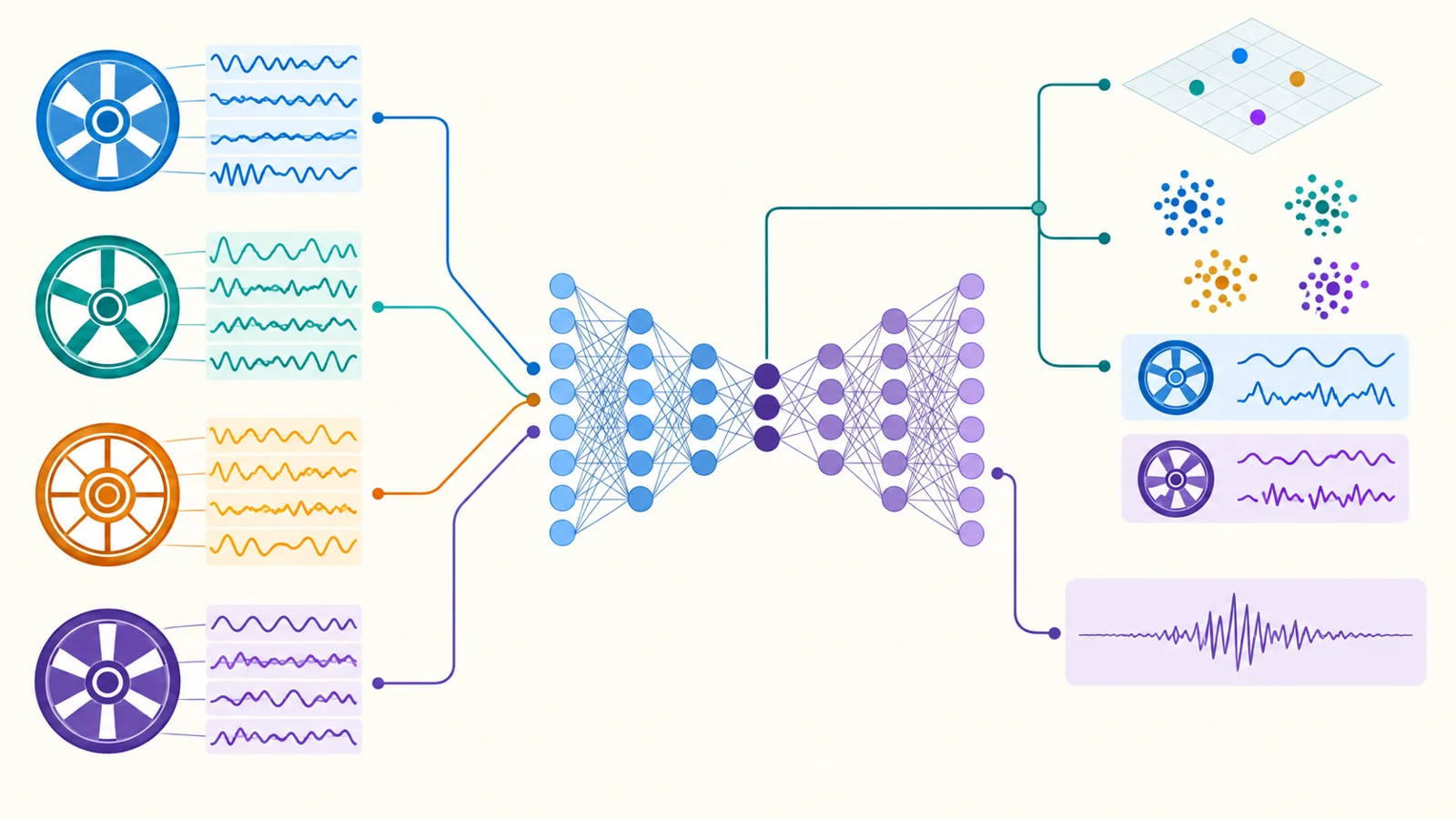
The detector is a convolutional autoencoder trained on real reaction-wheel telemetry. An autoencoder learns to compress an input and reconstruct it. Differences between the input and its reconstruction can provide an indication that a window of measurements is unusual. The network’s intermediate activity contains information about how it represents that window, but those internal values are not inherently readable descriptions.
The peephole method processes that activity through three connected operations. It extracts a compact representation from a selected intermediate layer, reducing many activation values to a smaller set of coordinates. It then characterizes how these representations gather into clusters. Finally, it associates the clusters with tags that people can inspect, producing a compact descriptor for the input.
A useful way to picture this is as a collection of telemetry windows arranged by how the network represents them. Windows with related internal representations may occupy similar regions. The semantic step gives those regions a connection to recognizable categories. A new window’s position can then help characterize the pattern passing through the detector.
The anomaly score and peephole output therefore answer different questions. The score expresses the detector’s assessment of unusual behavior. The descriptor supplies associations with disturbance type or wheel location. According to the authors, this information can be extracted without adding neural classifiers; the added processing operates on representations the detector already produces.
That distinction matters for interpreting the method. A peephole gives operators a compact view of patterns in the network’s internal activity. It does not supply a complete verbal account of every computation the network performed.
What the reaction-wheel tests exposed the detector to
The study uses measurements from four reaction wheels, labeled RW0 through RW3. Each contributes four time series, making 16 telemetry channels in total. The input is divided into windows containing 16 samples per channel. Each window thus captures a short sequence across all four wheels, preserving both the time dimension and the distinction between channels.
The researchers introduce five kinds of synthetic anomaly by corrupting normal data. This makes it possible to specify what disturbance was added and where it was placed. In one test scenario, the disturbance is restricted to channels belonging to a particular wheel. That arrangement directly tests whether the resulting descriptions retain information about the affected wheel, even though the detector receives all 16 channels together.
The disturbances are set to a signal-to-noise ratio of 0 decibels. Here, that means the normal signal and the added disturbance have equal expected energy. It does not mean there is no noise, and it does not establish sensitivity to arbitrarily faint faults. The test describes behavior under a defined disturbance strength.
These choices give the experiment a concrete reference point. Because the corruption is controlled, the researchers can examine whether the descriptor is associated with the introduced disturbance and its location. The experiment’s reach depends on those exposure conditions, including the selected anomaly types and the way they are inserted into normal telemetry.
Controlled disturbances and a real event play different roles
The authors report that peephole descriptors support identification of anomaly type and origin. In the wheel-specific experiments, “origin” concerns the wheel-associated telemetry carrying the disturbance. This provides a way to examine localization alongside the detector’s broader assessment that something unusual is happening.
The paper also presents a real anomaly in the test set identified by domain experts. Its illustration places the telemetry, the autoencoder’s score and the sequence of peephole descriptors alongside one another. This lets the reader examine how the internal descriptions evolve during an event that was already recognized as anomalous by specialists.
The two forms of evidence contribute different things. Synthetic tests provide a known disturbance and a known insertion location. The real-event illustration connects the method to an observed telemetry episode beyond those deliberate corruptions. One illustrated event, however, cannot establish how consistently the approach would characterize naturally occurring faults across a mission.
The supported result is qualitative: internal representations can carry information useful for associating detections with disturbance categories and wheel location. It does not establish that adding peepholes improves the underlying detector’s accuracy.
The distance from a descriptor to an operational diagnosis
A semantic association is only as useful as the connection between its tag and the behavior it is meant to describe. A telemetry pattern resembling a particular corruption does not by itself establish a physical cause. Likewise, locating unusual measurements in one wheel’s channels does not prove which part of that wheel, its sensing or its control is responsible. Physical diagnosis requires evidence beyond resemblance within the network’s representation.
Operational coverage is another unresolved issue. Real telemetry supplies the study’s foundation, but the controlled anomalies cover selected disturbances. The evidence does not establish generalization across spacecraft, operating conditions or the full range of naturally occurring reaction-wheel faults. A compact descriptor may be easy to inspect while still reflecting limitations in the data or detector that produced it.
The authors describe the extra computational demand as marginal and argue that this supports the possibility of onboard use. That is a feasibility argument. The evidence available here does not establish measured performance on flight hardware or flight-qualified operation. Resource suitability would have to include the detector and its added processing under the conditions of the intended spacecraft.
The work also occupies a bounded place within fault detection, isolation and recovery, often abbreviated FDIR. Its main focus is detection, with interpretive support that moves toward identification and isolation. It does not demonstrate an autonomous recovery action or a complete control loop from an alarm to a successful response. As an April 2026 preprint, with peer review not documented in the supplied record, it remains an early methodological result.
What this could change
If the descriptors remain meaningful across operational faults and fit onboard computing constraints, a satellite could attach compact indications of disturbance type and wheel location to its detections. An onboard fault-management system could use those indications to narrow the measurements it examines or the response options it considers. Ground operators could use the same descriptions to focus an investigation on a particular wheel and compare the evolving pattern with the underlying telemetry.
The causal step is specific: a detection accompanied by useful information about pattern and location could give the next stage of fault handling a more precise starting point. With validated links to appropriate responses, that could support more selective handling of spacecraft problems. This preprint explores the descriptive information that such a capability would need.
Key Sources
- Primary source: On-board Telemetry Monitoring in Autonomous Satellites: Challenges and Opportunities
arXiv · Preprint · 2026-04-09
Keep exploring