
Research Signal – Source date 2025-04-21
Induced pluripotent stem cells are adult cells reset into a flexible state from which researchers can make many other cell types. That flexibility gives them two related roles in aging research: they can help researchers study disease in cells carrying a patient’s genetic background, and they may eventually provide cells to replace damaged tissue. Those are different achievements. A cell model can make disease features easier to examine; a replacement therapy would need to function safely in a person.
A review published April 21, 2025, brings together research on both uses. It describes patient-derived models of age-related disease and discusses the prospects and obstacles for regenerative treatment. Its examples illuminate cellular features and research possibilities, rather than reporting a new treatment result for people with aging-related disease.
Resetting a cell opens a route to other cell types
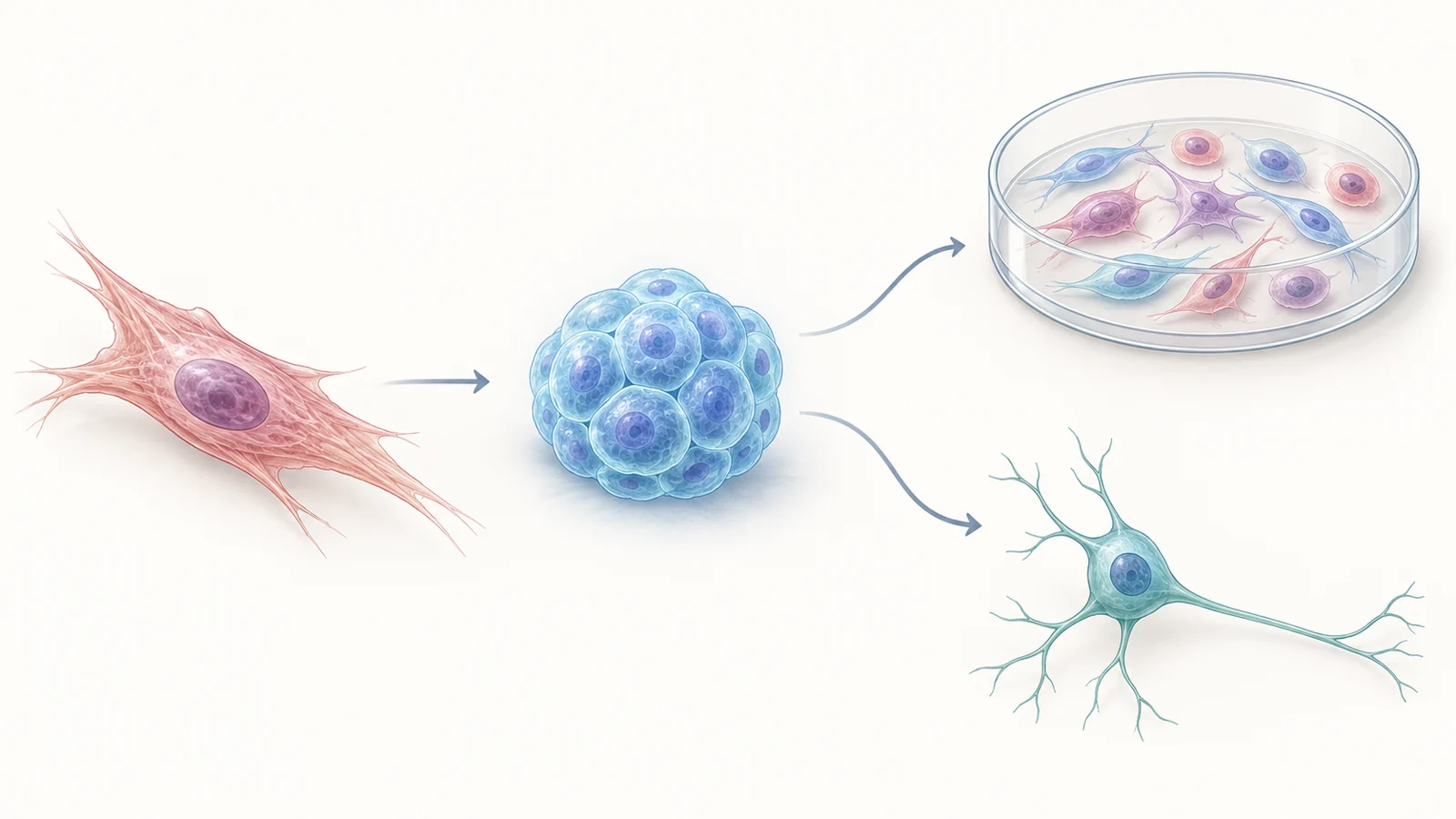
The starting material can be a specialized adult cell, such as a skin or blood cell. Reprogramming factors can reverse aspects of its specialized identity and return it to a pluripotent state, meaning it can renew itself and give rise to cell types from the body’s three main developmental groups. The resulting induced pluripotent stem cells, or iPSCs, can then be directed toward a target cell type.
That sequence creates a useful research opportunity. A patient’s cells can be reprogrammed and differentiated into cells relevant to a disease, allowing researchers to examine disease-associated features in human cells. Patient-derived organoids—three-dimensional cultures that reproduce aspects of tissue organization—can also provide a setting for studying disease and testing potential drugs.
For a therapy, however, “can become” is only the start. The cells must be guided into the intended type and checked to establish that they have the relevant characteristics. Researchers assess pluripotency after reprogramming, while therapeutic work also depends on differentiation that is predictable and produces functional, mature cells. The path from a versatile starting cell to a suitable replacement therefore contains several separate steps.
Patient cells make disease features observable
The review describes Alzheimer’s disease models made by differentiating cells from patients into neurons. In one example involving familial Alzheimer’s disease and mutations in the amyloid precursor protein gene, the derived cells showed elevated amyloid-beta 42, reduced synaptophysin expression, and increased caspase 1 activation. These measurements gave researchers cellular features associated with the disease to investigate in a human-cell setting.
Age-related changes can be difficult to reproduce in cells grown in a laboratory. The review describes a long-term culture system containing iPSC-derived neurons, astrocytes, and microglia that enabled observation of tau hyperphosphorylation and synaptic loss—features that typically emerge in aged neurons. The model’s value lies in making those features observable in a maintained cell system; it is not evidence that the cells treated Alzheimer’s disease in patients.
A contrasting example concerns dyskeratosis congenita, a disease involving telomere dysfunction that can affect multiple organs, including the lungs. Patient-derived iPSCs were differentiated into type II alveolar epithelial cells, a lung cell type. The resulting cells showed disease-related features including shortened telomeres, telomere uncapping, impaired alveolar organoid growth, cellular senescence, and disrupted Wnt signaling.
In that cell-model setting, treatment with the compound CHIR99021 restored Wnt pathway activity, enhanced telomerase function, and rescued observed cellular defects. This is a response measured in derived cells and organoids. It does not show that the intervention repaired lungs or improved health in people with the disease.
Keeping an aging history in the model
Reprogramming changes a cell profoundly, which creates a design challenge for researchers studying aging. The process can reset features linked to a cell’s specialized identity, and signs of premature aging reported in Werner syndrome fibroblasts were suppressed in iPSCs made from those cells. A model that loses an age-related feature during reprogramming may not retain the biology researchers need to study.
Other observations complicate the picture. The review describes mitochondrial dysfunction and higher reactive oxygen species in iPSCs derived from older donors, as well as increased mitochondrial DNA mutations in individual iPSC lines compared with pooled skin and blood samples from elderly people. It also notes that iPSCs maintained in prolonged culture can develop biological differences involving mitochondria and the nuclear envelope.
These findings point in different directions: some aging-associated features may be diminished after reprogramming, while other age-linked changes can remain or emerge in particular cell lines and culture conditions. Researchers need to check whether a model retains the specific age-related feature under study. Otherwise, a result may describe the reprogrammed or cultured cells without accurately representing the older person’s disease.
Making a replacement cell is a further step
For regenerative treatment, iPSCs would be differentiated into a defined cell type intended to replace cells that are aged or damaged. That proposal draws on the same flexibility that makes iPSCs useful in disease research, but its goal is different. Researchers would need to produce cells that are not only the intended type, but mature and functional enough to contribute to the tissue they enter.
Producing the desired cell in a dish does not establish that it will restore tissue function in a person. A treatment would also depend on whether cells can be delivered effectively, remain stable, and work in the patient’s biological environment. The review presents tissue replacement as a prospective application; its disease models and examples do not demonstrate improved patient outcomes from an aging-related replacement therapy.
Safety and consistency shape the clinical challenge
Several practical barriers are connected. If a preparation contains cells that have not differentiated as intended, or cells with unwanted properties, the risk profile may change. The review identifies tumor formation, immune responses, and genetic instability among the safety concerns that require evaluation. Cell maturity matters too: a cell that resembles the target type without performing its role may not provide the hoped-for function, and the review notes reduced regenerative capacity in aged iPSC-derived cardiomyocytes as a reason for careful quality control.
Consistency becomes harder as production grows. A therapy would require scalable methods to expand, differentiate, and purify cells while maintaining their relevant properties. The review describes manufacturing challenges in large-scale culture, including the need to manage nutrient delivery and waste removal in suspension systems. If production varies from batch to batch, researchers and clinicians cannot assume that each preparation has the same identity, maturity, or safety characteristics.
Quality control links these issues to the intended benefit. Testing must help establish what the cells are, whether they are stable and sufficiently mature, and whether a production process can make them consistently. Those checks do not guarantee a successful therapy, but without them a promising cell type is not yet a dependable treatment material.
What cell replacement could mean for aging tissues
If researchers can make tissue-specific cells safely and consistently, and show that they function after delivery, replacement cells could one day help preserve or restore function in people whose tissues have been damaged by age-related degeneration. That possibility depends on solving the linked problems of cell identity, maturity, safety, manufacturing, and patient benefit. The research described in this review provides ways to study disease and develop candidate cells; whether those cells can improve life for patients remains to be demonstrated.
Key Sources
- Primary source: Induced Pluripotent Stem Cells-Based Regenerative Therapies in Treating Human Aging-Related Functional Decline and Diseases.
DOI or Journal Page · Review or Meta-Analysis · 2025-04-21
Keep exploring