
Research Signal – Source date 2021-02-27
A wind turbine blade can be difficult to recycle for the same reason it can remain useful for decades: it is built to resist demanding loads. So, when an older blade needs attention, recycling is not automatically the best first step. The 2021 review argues that inspection, repair, reuse, or refurbishment can make more sense for blades that remain safe to operate. Eventually, though, every blade reaches a point when it must leave service and its materials need another destination.
The review brings together work on existing blades and designs intended to make future blades easier to recover. These are different challenges. For a blade already in use, the question is whether its condition and structure support more service. For a new design, engineers can consider how its materials might be separated at end of life. As of the review’s publication, promising materials had been tested in laboratories and in some smaller blade examples, but large-turbine use still faced technical hurdles.
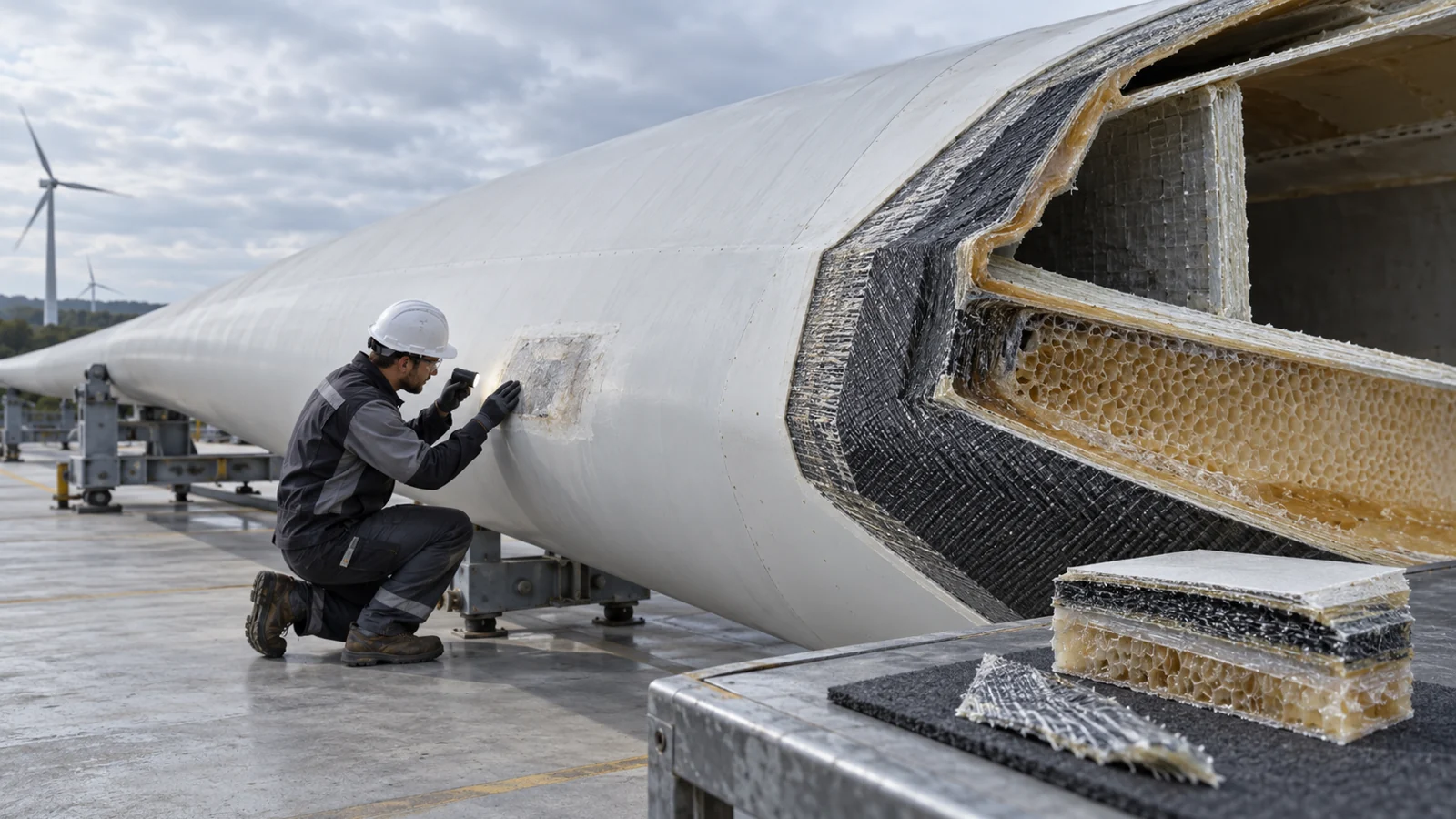
A blade is built to resist damage and separation
Most blade composites combine strong, stiff fibers with a tough polymer resin that binds them together. The fibers help carry loads; the resin holds the structure in shape and transfers forces between them. Many blades also contain coatings, adhesives, and materials such as balsa wood or foam. Different parts do different jobs, but the combination makes it hard to take a used blade apart into clean, reusable materials.
That toughness persists after the blade’s service life. A composite can still be strong after years of fatigue and exposure, even if it has defects. Cutting it into smaller pieces does not automatically separate its fibers from its resin, or sort out the other materials. A blade may therefore be technically recyclable in some sense while still being difficult or costly to turn into materials with a dependable next use.
The review describes the scale of the coming waste challenge using estimates from earlier studies. One estimate puts blade waste worldwide at 43 million tons by 2050, with a quarter in Europe. Such projections depend on their underlying assumptions, but they point to a growing end-of-life problem as installed turbines age. They do not, by themselves, say which recovery option will work best for a particular blade.
Keeping a blade in service starts with its condition
For an installed blade, continued use depends on an engineering assessment, not age alone. The review describes monitoring and inspection to identify damage, followed by evaluation of structural stability and remaining operating potential. Visual checks and non-destructive inspection can help locate problems without cutting the blade apart. The assessment compares operating loads with design loads and documents damage or unusual wear.
The repair method depends on what is damaged. Surface erosion can be addressed with coatings, tapes, or shields. Filling, sealing, or resin injection may suit small surface cracks and some limited damage within the material. More structural damage, including cracked fibers, can call for a plug or patch, or a scarf repair that removes and replaces a shaped section. These are examples of methods discussed in the review, not a guarantee that every damaged blade can be repaired.
Reuse and refurbishment also require a case-by-case judgment. A blade removed for economic reasons may still have technical life left. Safety evaluation and inspection can inform whether continued operation is reasonable; refurbishment may also enlarge a blade, improve structural features, or remove defects. The review cites an estimate that around 20% of blades in the Netherlands were refurbished and resold. That example shows a route in practice, but it is not a measure of how many blades elsewhere are suitable for reuse.
Extending service life can matter because making a replacement blade requires materials and manufacturing. The review cites life-cycle estimates in which emissions per unit of electricity fell as a turbine’s assumed life increased. For one onshore turbine model, the estimated global-warming impact declined from 6.6 grams of carbon dioxide equivalent per kilowatt-hour at 16 years to 5.3 at 20 years and 4.4 at 24 years. Another cited estimate for a different turbine put the figure at 8.7 kilograms of carbon dioxide per megawatt-hour for 10 years, 4.4 for 20, and 2.8 for 30.
These are model-based estimates, not a universal forecast for every turbine or blade. They illustrate why getting more electricity from equipment already made can change its lifecycle accounting. Whether a specific blade can safely provide those extra years remains a separate technical question.
Recycling can preserve material in different ways
When a blade cannot remain in service, recycling routes vary in what they recover. Mechanical recycling breaks a composite down through shredding, crushing, or milling. The resulting pieces can serve as reinforcement in other products. The review describes uses such as concrete, particleboard, paints, and panel cores. This route can keep material in use, though the output may be a mixture of shorter fibers and resin fragments rather than the original high-performance composite.
Chemical recycling aims to break down the polymer matrix so that fibers can be recovered. The review discusses processes using chemical solutions or fluids under particular conditions. In cited experiments, recovered fibers retained much of their properties, and some chemical approaches were presented as promising because they could recover cleaner, stronger fibers at lower temperatures than pyrolysis. These findings describe particular processes and materials; they do not show that every blade can be processed this way at an affordable scale.
Recovery has practical constraints beyond the chemistry. Mechanical outputs can vary in composition and quality, and recovered fibers may be shorter or weaker than desired. Preparation and post-processing use energy, blade designs and materials vary, and processing can be expensive. Even a technically useful recovered material needs a buyer and a product that can accept it. The review notes that recycling processes still lacked a strong business case in the work it surveyed.
The review also distinguishes recycling from incineration that recovers heat. Both may be considered when a blade reaches end of life, but burning material for energy is not the same as recovering fibers or resin for new products. The article’s central issue is not whether one label sounds greener; it is whether a route can handle the actual mix of a blade and produce a useful outcome.
Future resins aim to make separation easier
The resin is a key design choice because it binds the fibers into a composite. Many conventional blade resins are thermosets: once cured, they form a network that does not simply melt when reheated. One approach to easier recovery is to use a thermoplastic resin, which can be softened by heating or, in some cases, dissolved. Another is to design a thermoset so a chemical trigger can break down the network at end of life.
Thermoplastics have potential manufacturing advantages as well as recycling possibilities. The review describes research into resins that could be processed with existing composite-manufacturing equipment, and into joining blade parts by heat rather than relying on additional adhesives. Researchers demonstrated thermoplastic blade sections and blades at 13 and 25 meters. In one reported approach, dissolved thermoplastic material was recovered with mechanical properties like the original material. These examples show that the idea moved beyond a resin in a test tube, while remaining distinct from proof of readiness for the largest commercial blades.
Recyclable thermosets take a different route. Researchers explored resins with chemical links that can be cleaved under specified conditions, allowing fibers to be separated and the matrix to be recovered or broken down. The review describes laboratory demonstrations, including a composite in which fibers could be recovered intact multiple times. Such designs may preserve familiar thermoset performance while making recovery more feasible, but they also depend on suitable chemistry and processing at the scale of real blades.
Making the resin recoverable is only part of the design problem. A blade must also withstand years of changing loads and environmental exposure, and manufacturing methods must produce large, consistent structures. The review’s examples show active material development, not a settled solution for every component or turbine size.
Renewable materials still have engineering trade-offs
Wood, bamboo, and natural fibers offer another way to change a blade’s material mix. Their renewable origin alone does not determine whether they reduce environmental impact or suit a particular turbine. The blade still needs enough stiffness and strength without becoming so heavy that the rest of the turbine requires more material.
The review cites an estimate for a laminated-wood version of a 61.5-meter blade for a 5-megawatt turbine. The estimated wooden blade weighed 48 tons, compared with 17 tons for a plastic blade, and required a laminate more than half a meter thick. The example suggested that a blade of that length could be built from laminated wood, but its added weight and resource demands raised practical concerns. The review also notes challenges in obtaining wood products of consistent quality and the possible need for glass or carbon elements to improve stiffness.
Natural-fiber composites bring similar trade-offs. In one life-cycle assessment cited by the review, a blend of flax and carbon fibers performed better environmentally than a composite made entirely from flax. Another blend was more favorable on cost. The review also describes research in which natural-fiber composites had higher resin demand, which could worsen their environmental performance compared with conventional glass-fiber composites. The result depends on the material combination and what is being measured, not simply whether a fiber comes from a plant.
By February 2021, wood and bio-based composites had been tested for smaller and medium blades, but the review describes lower mechanical performance and other constraints for large blades. Materials that work at one scale may need different designs, manufacturing methods, or reinforcement to meet the demands of a much larger rotor.
Environmental comparisons depend on what is counted
The review’s cited figures do not produce a single ranking for all end-of-life choices. In one comparison, estimated climate-change emissions were 3,120 kilograms of carbon-dioxide equivalent for refurbishment and 1,000 kilograms for landfilling. The same comparison gave a much higher estimate for using blades in pavements and a different value for pyrolysis. Those results may seem surprising if landfill is assumed to be the worst option, but they belong to one analysis with its own scope and assumptions.
A lifecycle comparison can change with transport distances, processing energy, what material a recovered product replaces, and how much useful service a blade provides before disposal. The review notes that many lifecycle studies either assume landfill or incineration or omit blade end-of-life management altogether. A figure from one comparison therefore cannot establish the lowest-impact route everywhere. It does make clear that the boundary and assumptions behind an estimate matter.
How wind energy could leave fewer spent blades behind
If inspection and repair can safely extend the useful life of suitable blades, operators could obtain more electricity from materials already manufactured, potentially lowering emissions per unit of electricity. If future resin systems and recycling processes can recover useful fibers and polymers reliably at large scale, more blade material could return to productive use instead of becoming difficult-to-manage waste. Both outcomes depend on solving practical limits: proving remaining structural life for existing blades, and demonstrating cost-effective production and recovery for new designs. The review describes reasons to pursue both capabilities, while showing that neither is a universal answer on its own.
Key Sources
- Primary source: Sustainable End-of-Life Management of Wind Turbine Blades: Overview of Current and Coming Solutions.
DOI or Journal Page · Review or Meta-Analysis · 2021-02-27
Keep exploring