
Research Signal – Source date 2026-05-01
Acting out vivid dreams can be more than a sleep disturbance. In isolated REM sleep behavior disorder, or iRBD, a person loses the usual muscle stillness of rapid-eye-movement sleep and may move vigorously while dreaming. The condition is considered a prodromal feature of diseases involving alpha-synuclein, a protein implicated in disorders such as Parkinson’s disease. Yet whether changes in daily sleep and activity rhythms are already present at this early stage—and what they might track—has remained unsettled.
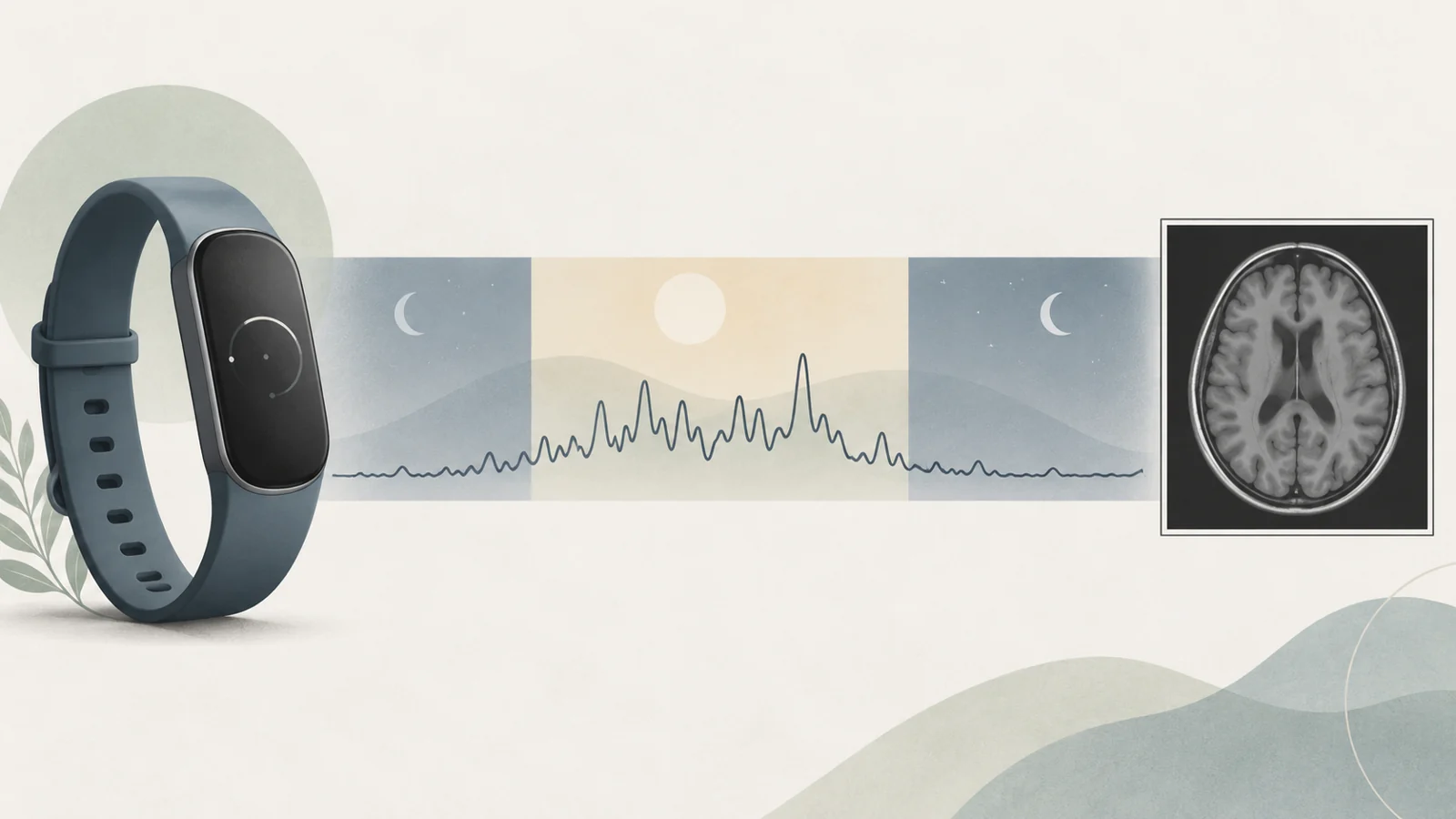
A study published May 1, 2026, followed 42 people with video-polysomnography-confirmed iRBD and 23 healthy controls for seven days using wrist devices. The researchers compared daily patterns with non-motor symptoms and brain-imaging measures related to perivascular spaces and dopamine. The results suggest that an irregular day–night pattern may carry information beyond how much someone moves or sleeps. They do not show that the pattern causes disease or can forecast what will happen to a particular person.
A weaker rhythm, without a shifted body clock
The wrist monitoring showed lower daytime movement among participants with iRBD. Their estimated probability of being asleep was higher in the early morning, and the daily sleep-probability and movement rhythms had lower amplitude and greater fragmentation. In practical terms, the contrast between more active and less active parts of the day was less pronounced and less regular.
The pattern was not simply a clock shifted earlier or later. Researchers found no significant group differences in the measured circadian phase markers, including the midpoints of sleep probability, movement, light exposure and wrist temperature. Light and temperature rhythm measures also did not differ significantly between groups. The finding was about the shape and strength of daily patterns, rather than a clear change in their timing.
A wrist device estimates sleep and activity from signals such as movement; it does not directly measure every stage or feature of sleep. The week-long record offers a view of daily life, but it is not a substitute for specialized sleep testing.
Movement tracked symptoms and manual speed
Within the iRBD group, several movement measures were related to how participants were functioning. Lower average and daytime movement, as well as a less robust movement rhythm, were associated with higher scores for depressive symptoms, apathy, neuropsychiatric symptoms and other non-motor symptoms. These are correlations: the study cannot tell whether symptoms reduced activity, whether disrupted activity was related to symptoms in another way, or whether both reflected other factors.
There was also a link with manual performance. A stronger movement rhythm was associated with faster completion of a manual dexterity task using either hand, and higher average movement was associated with faster performance using the non-dominant hand. Some measures were associated with performance on a test of mental processing speed, but those associations did not remain significant after correction for multiple comparisons. The manual-speed finding and the less robust mental-speed results should not be treated as equivalent evidence.
Two MRI proxies did not tell the same story
The brain scans offered a second perspective, but the measures were indirect. One, the DTI-ALPS index, uses diffusion MRI to estimate water movement along spaces near blood vessels. The other measured the volume of perivascular spaces, small fluid-filled spaces around vessels. Neither directly measures the brain’s overall waste-clearance activity.
Compared with controls, the iRBD group had a lower DTI-ALPS index and larger total perivascular-space volume. The rhythm association, however, centered on DTI-ALPS: among participants with iRBD, higher values were associated with less sleep impairment and greater movement. The larger perivascular-space volumes were a group difference, but the reported relationship between rhythm measures and imaging centered on the DTI-ALPS index. The study found no group difference in choroid plexus volume.
That distinction matters because the two MRI measures capture different features and neither is a direct readout of a whole-brain process. The results point to an association worth testing, not a demonstrated explanation for why sleep and activity patterns differ.
Dopamine uptake related to rhythm regularity
Dopamine imaging was available for 33 of the 42 participants with iRBD; healthy controls did not undergo these scans. Within the patient group, lower dopamine-transporter uptake in the most affected putamen was associated with selected measures of movement-rhythm fragmentation and robustness, as well as measures of sleep-rhythm regularity and day–night contrast.
The relationship was specific to how regular and distinct the rhythms were. Putaminal uptake did not correlate with overall sleep probability or total physical activity. That makes the result different from a simple claim that people who move less have lower dopamine uptake. It connects two measurements of pattern and contrast, while leaving the biological direction and timing unresolved.
The study was observational and relatively small, especially for the dopamine-imaging analysis. Some participants were taking treatments such as clonazepam, melatonin or antidepressants, or using CPAP; their treatment remained stable, but possible effects on the measures could not be fully ruled out. Wrist-based sleep estimates also have limits, and one week cannot establish how a person’s rhythms change over time. Most importantly, the study did not follow participants to determine whether these measures predict conversion to a neurodegenerative disease. It cannot show whether rhythm changes come before, follow, or develop alongside other changes.
What a wrist measure could add to early risk assessment
Repeated wrist monitoring could offer clinicians a low-burden way to follow daily rhythms in people with iRBD. If longer-term studies show that those patterns predict meaningful outcomes beyond existing assessments, the measures could also help prevention studies identify or monitor participants. That practical use depends on validation over time; this single study establishes an association, not an individual forecast or a benefit from changing sleep or activity patterns.
Key Sources
- Primary source: Circadian alterations in isolated Rapid-Eye-Movement sleep behavior disorder: associations with clinical, glymphatic, and dopaminergic imaging markers.
DOI or Journal Page · Peer-Reviewed Paper · 2026-05-01
Keep exploring