
Research Signal – Source date 2023-09-02
A lightweight plastic part can have a demanding job. It may need to hold its shape under load, tolerate heat or withstand contact with chemicals. Adding fibers can give plastic greater strength and stiffness without much weight. But those useful ingredients also become part of the design problem when the component needs repair or reaches the end of its working life.
A polymer matrix composite is a plastic material containing reinforcement. In the fiber-reinforced versions discussed here, the matrix is the surrounding plastic, while the fibers help provide mechanical performance. Replacing conventional ingredients with plant-derived plastics or natural fibers offers possibilities, but the environmental value depends on what happens when those ingredients become a usable part.
The review Eco-Design of Polymer Matrix Composite Parts, published on September 2, 2023, brings together research on that transition. Its authors describe eco-design as considering technical performance, production, use, end of life and costs together. Their contribution is to connect choices that can otherwise be considered separately, from the bond around a fiber to the information available when someone later tries to recover the material.
The connection between fiber and plastic matters
Flax, jute, sisal, cotton and coconut fibers are among the natural reinforcements discussed in the paper. Their appeal includes their mechanical properties and the potential to reduce some environmental burdens associated with conventional reinforcement. Yet choosing a fiber is only the beginning of making it function inside plastic.
The crucial detail is the interface, where the fiber surface meets the surrounding matrix. Plant fibers contain cellulose, which is hydrophilic, or water-attracting. The polymer around them is usually hydrophobic, or water-repelling. This difference influences how well the two materials bond. A reinforcing fiber needs an effective connection to the matrix for the combined material to make use of its properties.
The authors discuss chemical treatment of fibers as a way to improve that connection. This is an intervention at the surface where the ingredients meet, addressing the compatibility of a particular fiber and plastic. It helps explain why two composites with similar ingredient descriptions may still behave differently: the properties of the ingredients alone do not describe their interaction.
Easy flow does not guarantee an accurate part
Changing the matrix introduces another set of engineering decisions. The review discusses starch-based plastics and polylactic acid, or PLA, as possible alternatives to plastics derived from petrochemicals. Its examples show why manufacturing performance needs to be broken into distinct questions.
In one study summarized by the authors, PLA had favorable flow behavior, and biodegradable polymers offered higher production productivity than low-density polyethylene, or LDPE. Corn-starch-based plastic most closely resembled LDPE in the comparison described. These observations concern particular materials and processing conditions; they are not a general speed advantage for every plant-derived plastic.
The same discussion reports larger dimensional and geometric deviations for the starch-based materials and PLA compared with LDPE. A material can flow readily during production while being harder to turn into a consistently shaped component. Flow describes behavior during processing. Dimensional stability concerns whether the resulting part reliably has the intended size and geometry. A housing that is quick to produce still needs to fit the assembly it belongs in.
Service requirements add further constraints. The review identifies brittleness, chemical resistance, heat-related degradation and temperature resistance among barriers to wider adoption of biopolymers. It also describes the higher cost of some biopolymer matrix composites compared with conventional alternatives. These are separate demands: acceptable manufacturing accuracy does not establish acceptable behavior in a hot or chemically demanding setting.
The authors cite an air-filter-housing example in which replacing a glass-fiber-reinforced conventional polymer with glass-fiber-reinforced PLA was associated with lower pollutant emissions. That example concerns a particular substitution, as reported through the review. It illustrates the potential of a specific redesign without establishing the same savings for other components, materials or uses.
Some design decisions begin with the supplier
The environmental burden of a component begins before its ingredients reach the factory. The authors include the distance between material extraction and final production, the amount transported and the mode of transportation in their account of eco-design. They discuss shorter routes and changes such as moving freight from road to rail as possible ways to reduce transport burdens.
Acting on these options requires information. A designer may know the properties needed from a plastic or fiber while having limited visibility into where suppliers obtain it. The review identifies that lack of supplier information as an obstacle to bringing transport considerations into early design decisions. Material selection therefore also depends on what manufacturers can learn about the chain behind an ingredient.
The authors give shorter supply chains a social dimension, too. Locating production closer to extraction could create opportunities for nearby communities to participate in manufacturing. They present this as a possible contribution to local economic activity alongside reduced logistics demands, rather than a measured employment or profitability gain for a particular company.
Composition information can outlast the component
Repair changes the point at which a useful part becomes waste. The review treats repair and servicing as design considerations because extending a component’s working life can delay replacement. Its stated aims also include examining how geometry, dimensions and internal structure affect lifespan and recyclability.
Information about the material has a role beyond the original factory. The authors discuss labeling that identifies the structure or composition of a composite. For a later user or manufacturer, knowing which plastic and reinforcement are present gives a more useful starting point for decisions than a broad environmental claim. Retaining that information could help those responsible for repair or material recovery assess what they are handling.
A composition label does not itself establish a recovery process. Decisions about recycling still depend on the material and the conditions of the intended treatment. The evidence discussed here supports taking recovery into account during design, but does not provide a basis for choosing one recycling process for an unspecified finished part.
The vocabulary also matters. Renewable origin describes where an ingredient comes from. Biodegradability concerns breakdown under relevant conditions; compostability and recyclability raise their own requirements. These terms cannot serve as interchangeable guarantees for a composite made from several ingredients. The matrix, reinforcement and any treatments all belong to the finished material whose eventual destination must be considered.
How much confidence can these examples carry?
The paper synthesizes literature from multiple research resources, drawing together arguments and counterarguments about eco-design. Its methodology also describes visualizing relationships among literature terms to help identify patterns and connections. This supports a broad examination of design considerations across materials, processes and applications.
That breadth shapes how to read the examples. A manufacturing observation about starch-based plastic, an emissions comparison for an air-filter housing and an argument about shorter supply chains answer different questions. They cannot be combined into a single expected environmental saving for reinforced plastics. Numerical results from individual studies retain the scope of those studies, even when brought together in a review.
The distinction between observations and proposals is especially important for the paper’s future directions. Concentrating reinforcement where it is most needed is a research proposal. Turning it into a dependable component would require reliable fabrication, adequate performance throughout service and a workable route for handling the material afterward. The proposal’s appeal is the connection it could create between structural efficiency and recovery.
What this could change
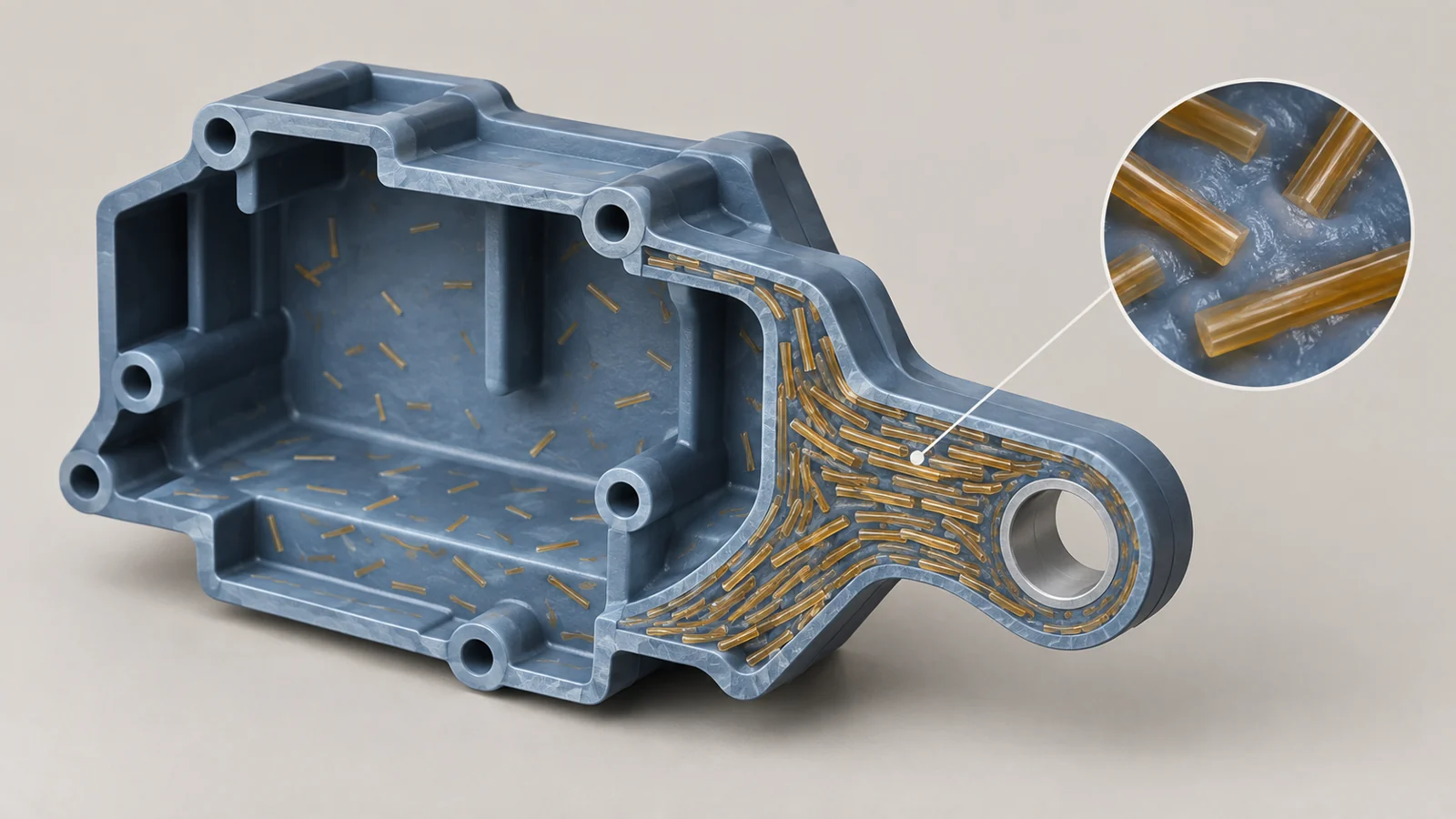
A part does not necessarily face the same mechanical demands everywhere. The authors propose investigating structures with more reinforcement in highly stressed regions and less, or none, in regions that need less strengthening. An attachment region, for example, could receive a greater share of the reinforcement than a lightly loaded area elsewhere in the component.
If manufacturers could produce such structures reliably while preserving the required service performance, they could use less reinforcing material to deliver the same useful function. That would change the design opportunity from choosing a substitute ingredient to controlling how much reinforcement each region actually needs.
The potential extends to material-recovery operations. Regions with little or no reinforcement could make subsequent recycling simpler, as the authors propose, provided the finished structure can be processed through a workable recovery route. Manufacturers could gain a way to reduce material demands, while recovery operators could receive parts whose internal composition is less demanding to handle. The prospective payoff is a durable component that uses reinforcement where it earns its place and leaves a more manageable material at the end of service.
Key Sources
- Primary source: Eco-Design of Polymer Matrix Composite Parts: A Review.
DOI or Journal Page · Review or Meta-Analysis · 2023-09-02
Keep exploring