
Research Signal – Source date 2024-10-23
For a small sensor, replacing the battery can become a bigger practical problem than taking the measurement. That helps explain interest in radio-frequency energy harvesting, which captures energy from radio signals and converts it into electrical power. The attraction is especially strong for devices that are numerous, embedded, worn on the body, or difficult to reach.
A review published on October 23, 2024, brings together antenna and circuit designs aimed at making that possible. Its useful contribution is an explanation of how the parts interact. A compact antenna may capture several frequency bands, yet the attached circuit still has to turn that input into useful power as conditions change. The paper synthesizes progress across those parts; it does not itself establish dependable operation of a new complete device.
From a distant transmitter to usable electricity
The review focuses on far-field harvesting, in which electromagnetic waves carry energy from a transmitter to a receiving antenna. This differs from near-field charging, where energy transfer depends on close coupling between nearby structures. Results from the two arrangements cannot simply be treated as interchangeable measures of wireless power performance.
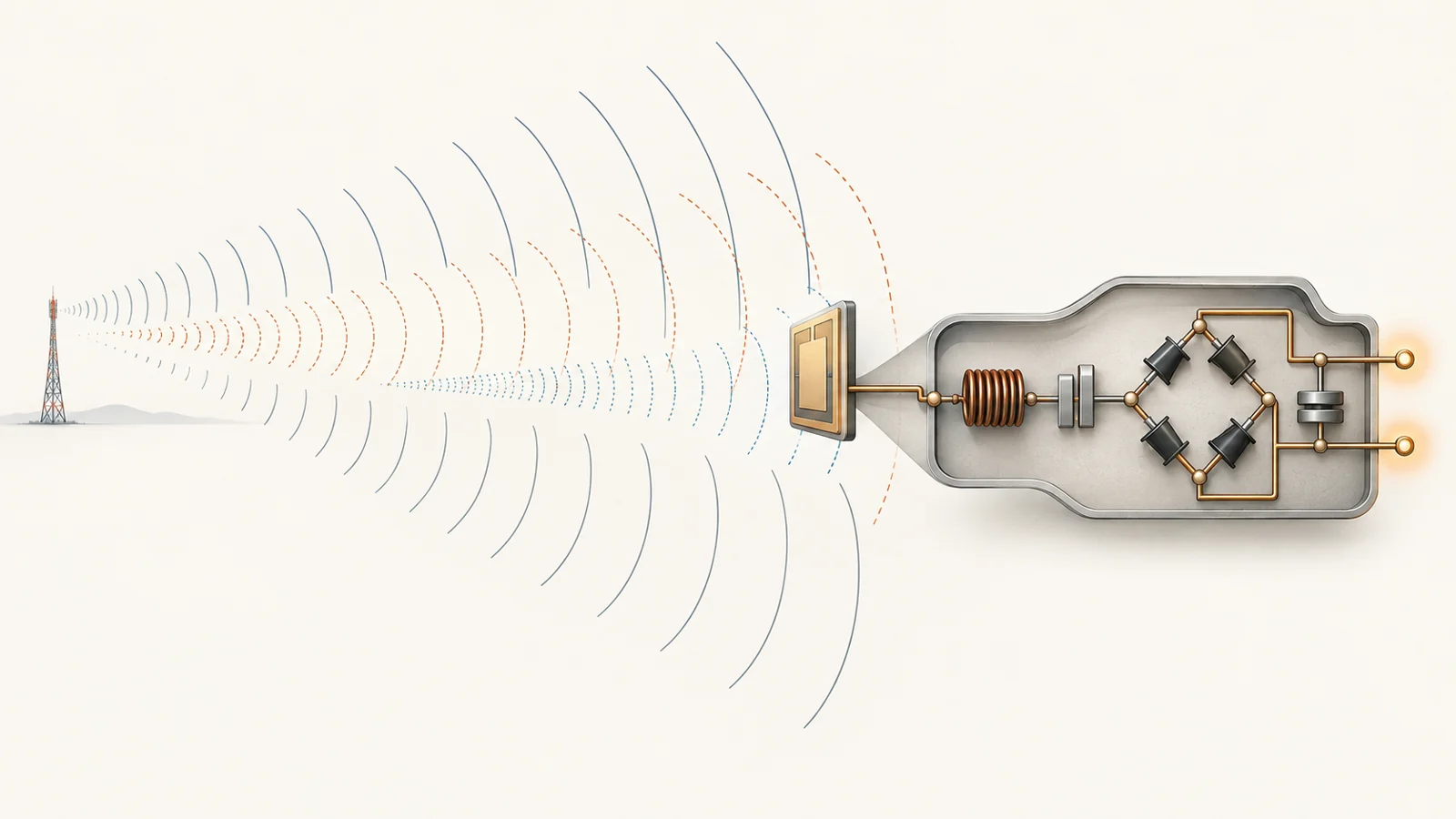
A far-field harvester has three central stages. The antenna receives radio-frequency energy. An impedance-matching network helps transfer that energy into the next circuit with less reflection. The rectifier then converts the rapidly alternating electrical signal into direct current, or DC. An antenna combined with a rectifier is often called a rectenna. Each stage affects how much usable power emerges at the end.
The transmitter may already be serving another purpose, such as broadcasting television or carrying wireless communications. Alternatively, a dedicated transmitter can supply radio energy deliberately. That distinction changes the engineering problem. Ambient harvesting depends on signals whose strength, frequency, and availability may vary. A dedicated source gives the designer a more defined supply arrangement, while requiring its own transmitting infrastructure.
Distance matters throughout. The review discusses a standard transmission model relating received power to transmitter power, antenna gains, wavelength, and separation. It also notes that environmental attenuation and signal variability complicate that estimate. A radio source being within reception range is therefore only part of the information needed to judge its usefulness as a power source.
Why the best antenna depends on where the energy comes from
Antenna gain describes performance in a particular direction. A highly directional antenna can suit a known transmitter because it concentrates reception toward that source. When useful signals arrive from uncertain directions, broader directional coverage may be more suitable. The review distinguishes these situations rather than treating maximum gain as the universal design goal.
Frequency coverage introduces another choice. A multiband antenna operates in several selected frequency bands; a broadband antenna covers a wider continuous range. Either approach can expand access to available radio signals. The appropriate design depends on where useful energy is available and on the circuitry that follows the antenna. A small receiver intended for one dedicated transmitter faces a different task from a sensor trying to collect energy from several ambient sources.
Polarization adds a less visible constraint. It describes the orientation behavior of a wave’s electric field, which affects how well the receiving antenna couples to that wave. The review discusses circular polarization and dual linear polarization as ways to manage reception and polarization mismatch. These choices matter alongside the direction from which a signal arrives, particularly when a device’s orientation can change.
All of this must fit into a physical object. Wearables and portable sensors favor small antennas, but the review’s conclusions identify miniaturization as a potential cost to performance and efficiency. Maintaining circular polarization in a smaller structure adds difficulty. Fabrication cost and environmental effects, including signals arriving along multiple paths, further influence which design makes sense outside a controlled setup.
What engineered antenna structures can contribute
Metamaterial-inspired designs are one route through these competing demands. They use engineered structures to alter electromagnetic behavior. The review describes resonant elements, including split-ring structures, and patterned surfaces that change how fields and currents behave around an antenna. Their geometry gives designers additional ways to adjust the antenna’s electrical response within a limited physical space.
Those tools serve several purposes. Some designs pursue smaller dimensions; others shape reception patterns, broaden frequency coverage, improve gain, or help control polarization. In arrangements with several antenna elements, related structures can reduce mutual coupling—the interaction through which neighboring elements affect one another. Reducing that interaction can help preserve the intended antenna behavior.
One concrete example discussed in the review uses a thick substrate and covers 2.11–3.87 gigahertz, with a reported fractional bandwidth of 58.8%, while maintaining omnidirectional radiation. That number describes the antenna’s operating frequency span. It is not a percentage of radio energy converted into electricity. The distinction matters because bandwidth, gain, physical size, and conversion efficiency describe different properties, even when they appear together in a discussion of harvesting performance.
The practical contribution of these structures is therefore a wider set of design options. Their effects depend on the particular geometry and arrangement. The review also retains miniaturization, fabrication, and efficiency among the outstanding challenges, so an attractive antenna design still has to be assessed in the device and radio environment it is intended to serve.
The difficult handoff into the rectifier
Capturing energy is only the beginning of conversion. At the connection between an antenna and a rectifier, an electrical mismatch can reflect some of the available power instead of transferring it onward. The matching network addresses that handoff. Its job becomes harder when the electrical behavior of the receiving circuit changes with operating conditions.
Diodes and transistors used in rectifiers are nonlinear components: their response does not scale in a simple, fixed proportion to the incoming signal. The review identifies changing impedance and frequency dependence as obstacles to matching an antenna to an RF-to-DC rectifier. Input power also matters. A circuit optimized for one combination of frequency and signal strength may behave differently when either changes.
This connects two otherwise separate-looking problems. Antenna designers may broaden the range of frequencies that can be received, while circuit designers must make conversion work across that range and across varying input levels. The review discusses multiband and broadband rectifiers as responses to this problem, alongside the underlying constraint of low RF power density. Efficient conversion of a weak input can still yield only a small electrical output.
The authors propose matching networks that can adjust to frequency and power changes as a future direction, and suggest that machine learning could assist real-time optimization. That is a proposed design route. The immediate engineering question remains whether the antenna, matching network, and rectifier can work well together across the conditions a device will encounter.
How to read the impressive performance figures
The paper brings together results from different designs, so the meaning of a number depends on what was measured and where. Antenna gain concerns directional reception. Bandwidth concerns frequency coverage. RF-to-DC conversion efficiency concerns the fraction of power converted at a specified measurement boundary. None of those figures alone states how much power a complete device receives over time.
Combining the best figures from separate examples would obscure those distinctions. A compact antenna result, a wideband result, and a high conversion figure may come from different structures and operating conditions. They do not establish that one integrated harvester achieves all three. Likewise, a rectifier’s conversion figure cannot automatically be read as the efficiency of the entire path from a distant transmitter to a powered sensor.
The review supports an account of component advances and the integration problems connecting them. Establishing dependable device operation requires evidence that useful output persists under the relevant distances, frequencies, orientations, and input powers. Its discussion of sensors, wearables, and biomedical devices identifies applications worth pursuing; it does not by itself establish commercial readiness, clinical benefit, or guaranteed battery elimination in those settings.
What this could change
If integrated harvesters can maintain useful output under realistic conditions, they could reduce battery replacement work for distributed, low-power devices. Environmental, agricultural, and building sensors could become easier to place where regular servicing is inconvenient. The causal link is practical: a dependable contribution from radio energy could reduce how often a device needs a fresh battery and how often someone must reach it.
For wearables and selected medical devices, sufficiently compact and effective harvesting could also expand power-supply design options. Those applications have different operating demands, so the benefit would depend on matching the available energy to the device’s needs. From the perspective of this 2024 review, the consequential possibility is a class of small devices whose power supply places fewer restrictions on where they can be used and how often they need maintenance.
Key Sources
- Primary source: Advancements and Challenges in Antenna Design and Rectifying Circuits for Radio Frequency Energy Harvesting.
DOI or Journal Page · Review or Meta-Analysis · 2024-10-23
Keep exploring