
Research Signal – Source date 2022-06-30
A tumor can resist immune treatment partly because of the neighborhood around it. In a so-called cold tumor, immune activity is weak or suppressed, leaving the body’s defenses less able to recognize and attack cancer cells. A 2022 systematic review examined whether radiation could briefly change that environment—and why the change might fade before the immune system gains lasting control.
The review, published on 30 June 2022, brings together preclinical experiments and a small number of studies measuring immune changes in human tumor tissue. Its central idea is that radiation may help start an immune response, while the tumor’s own suppressive environment can push back. The evidence makes this a plausible strategy to investigate, not an established benefit for people with cancer.
A cold tumor can interrupt the immune response
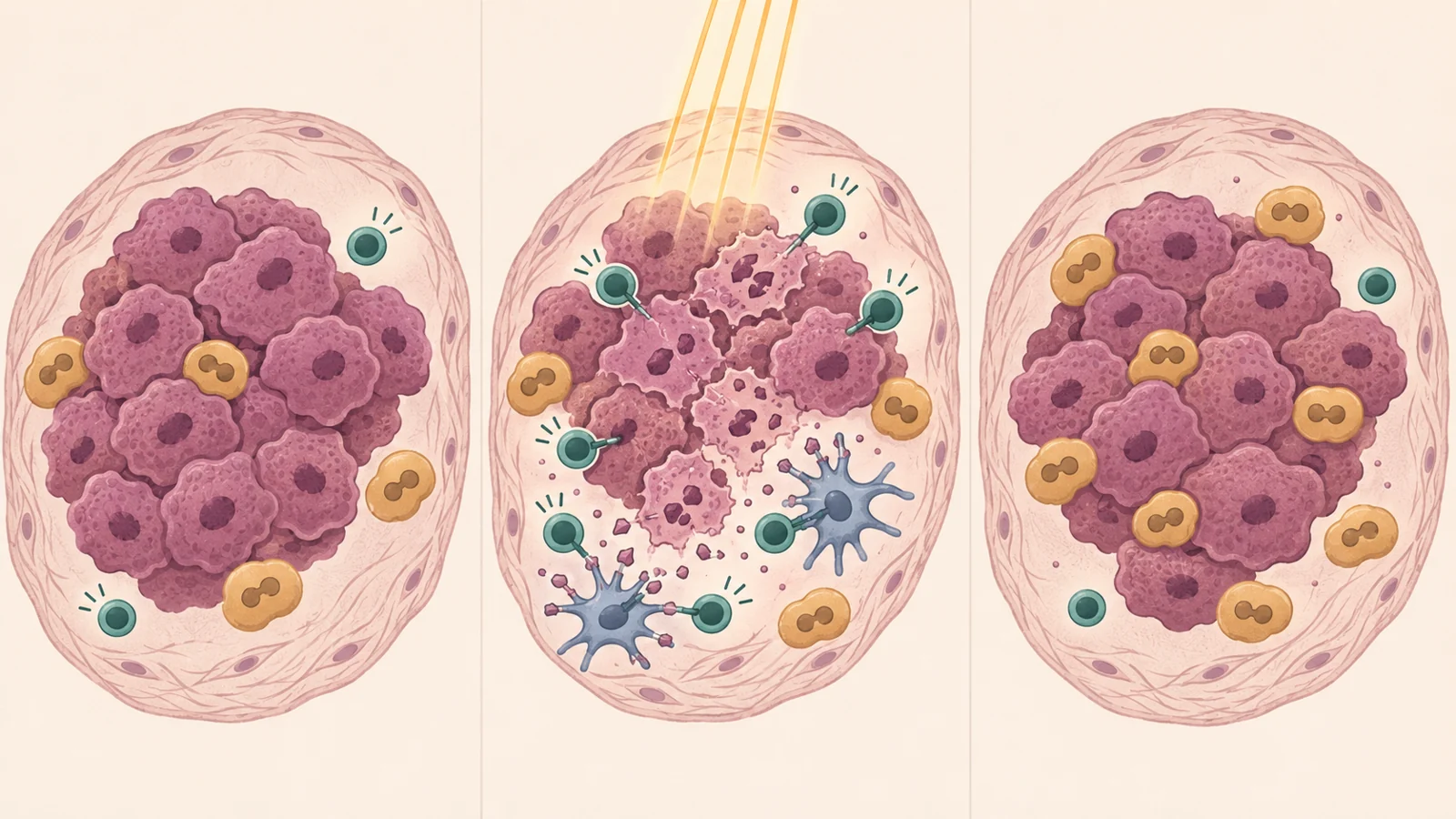
The immune response described in the review unfolds in stages. When radiation damages tumor cells, those cells can release alarm signals and tumor antigens: material that helps the immune system identify what to attack. Antigen-presenting cells collect and display these antigens, helping activate T cells that can recognize and kill cancer cells.
A cold tumor environment can hinder that sequence. It tends to have fewer active immune cells reaching the tumor and more cells that suppress or exhaust immune activity. The review describes regulatory T cells, suppressor cells from the myeloid family, and M2 macrophages among the features associated with this state. By comparison, a more inflamed, “hot” environment tends to have more active T cells and better antigen presentation.
Radiation may trigger the first inflammatory steps, but the response has a built-in brake. In the account presented by the review, tumor cells can encourage suppressive cells to arrive and help the anti-inflammatory response begin sooner. That may close the opening before immune cells can sustain an attack.
Radiation schedules can change the immune response
The radiation studies reviewed did not use one uniform regimen. In mouse experiments, a schedule of 8 gray per session, given three times every other day, was associated with activation of STING, a pathway that responds to DNA inside a cell but outside its nucleus. Gray is a unit of absorbed radiation dose. That activation was linked to increased type I interferon, an inflammatory signal, as well as greater T-cell activity and antigen presentation.
The review also describes a countervailing mechanism: at higher doses per session, tumor cells may produce more of the enzyme Trex1, which degrades the misplaced DNA that can activate STING. The authors discuss doses above roughly 12–18 gray per fraction as a range in which this effect may interfere with the pathway. Across the studies, doses above 10 gray per fraction appeared less promising for this immune effect than 8–10 gray every other day, while doses below 8 gray might not trigger enough inflammation.
These comparisons help explain why dose and timing matter biologically. They do not identify a schedule clinicians can select from this review. The findings came from differing studies and models, and the authors leave the best dose, number of fractions, immunotherapy, and timing unresolved.
Mouse combinations tested whether the opening could last
In one mouse mammary-cancer model, radiation at 8 gray for three sessions produced an initial immune change, but radiation alone did not provide lasting tumor control. When researchers paired that schedule with an immunotherapy called immune checkpoint blockade, the review reports better control of both irradiated tumors and tumors at distant, untreated sites in that model. The combined treatment was associated with more CD8 T cells and interferon, and fewer suppressive cells.
Another mouse study examined a cold neuroblastoma model. A single 12-gray session prompted an inflammatory response, followed by a rise in suppressive T cells. The review reports that combinations adding immune therapies produced stronger results in that model; one multi-part combination was associated with complete responses in 80% of mice after 60 days and with immune memory against a later rechallenge. That result belongs to the specific mouse model and regimen tested. It does not show that the same combination works for patients.
Findings at untreated tumor sites are especially relevant to the proposed strategy: they suggest that local radiation might help activate immune activity beyond the treated area. But an effect at a distant site in a mouse experiment is not evidence that people will reliably experience the same benefit. The reviewed experiments give researchers a reason to test combinations; they do not settle which combination, if any, will produce dependable distant tumor control in patients.
Human tissue showed immune changes, not a treatment answer
The review also included studies that examined tumor tissue from patients. In one study, samples from 24 people with localized prostate cancer were assessed before and after a radiation treatment called high-dose-rate brachytherapy. The researchers reported immune-marker changes consistent with a shift toward a more inflamed tumor environment in about 80% of the examined tumors. The samples also showed later recruitment of regulatory T cells, cells that can suppress immune activity.
A separate analysis of rectal cancer samples found that radiation, with or without chemotherapy, was associated with changes in immune-related gene expression. More immunogenic profiles before or after treatment were associated with better tumor regression in that study. These patient observations show that immune features in tumor tissue can change around radiation treatment. They do not establish that adding immunotherapy improves outcomes or that marker changes reliably predict a response at tumors radiation did not reach.
The distinction matters because measuring a biological change answers a different question from measuring whether treatment helps people live longer, feel better, or control cancer. The review describes promising tissue observations, but its human evidence is limited compared with its preclinical evidence.
What the review could and could not settle
The authors followed PRISMA guidance for their search, using PubMed, Embase, and Cochrane. Their final database search was in August 2021. After screening and additional relevant papers, they included 27 research papers. The review organizes evidence across different models, radiation regimens, immune measurements, and treatment combinations; it is not a single clinical trial testing one approach.
At its publication date, the evidence supported a mechanistic possibility: radiation can provoke inflammatory immune changes in some cold tumor settings, and mouse studies suggest that immunotherapy may help sustain those changes. The patient tissue studies add evidence that immune markers can shift after radiation, alongside signs of renewed suppression. The review could not determine the best schedule, immunotherapy choice, timing, or which tumors and patients might benefit.
How this could shape the future
For someone with cancer in several places, a useful future capability would be to treat one tumor with radiation and reliably coordinate it with immunotherapy so the immune response also reaches disease beyond the radiation field. Radiation and immunotherapy already exist; the advance would be dependable benefit from using radiation to make an immune-resistant tumor more recognizable to the body’s defenses. The reviewed local immune changes and mouse findings at untreated sites offer a reason to pursue that possibility, while the unresolved schedule and combination choices show how much development and testing remain.
A nearer milestone would be prospective human studies that use a defined radiation–immunotherapy schedule and show sustained immune changes alongside better outcomes at nonirradiated tumor sites. That would connect the tissue-level changes seen in the reviewed patient studies to the broader clinical benefit suggested by the mouse experiments.
Key Sources
- Primary source: Can Radiotherapy Empower the Host Immune System to Counterattack Neoplastic Cells? A Systematic Review on Tumor Microenvironment Radiomodulation.
DOI or Journal Page · Review or Meta-Analysis · 2022-06-30
Keep exploring