
Research Signal – Source date 2023-02-28
A quantum computer cannot protect its information simply by noticing that something has gone wrong. It needs to interpret measurements, work out the likely consequences of errors and decide how to respond. Much of that work falls to a classical computer operating alongside the quantum hardware.
This is the practical tension behind quantum error correction, which protects quantum information by encoding it across multiple physical qubits. Repeated measurements supply clues about errors. A classical processing system called a decoder interprets those clues and provides a tentative correction. Its decisions must fit into the operation of the whole machine.
In the May 2023 revision of this perspective, the authors examine how to make this process work in real time. They bring together reported decoder implementations, algorithms and hardware proposals. Their contribution is an account of the engineering problems between a promising correction method and a system that can support reliable quantum computation.
Measurements provide clues, not a complete error record
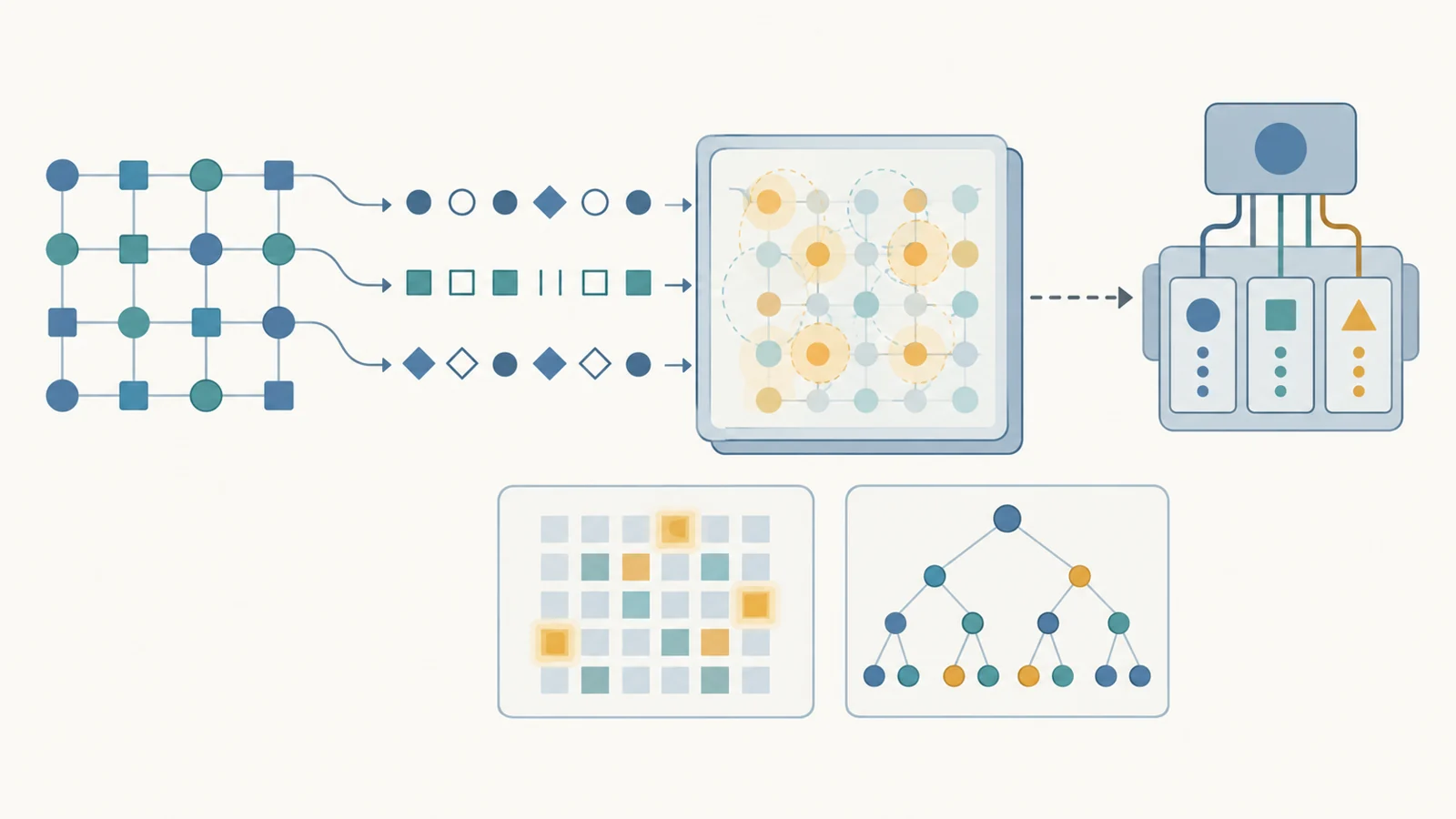
The information being protected is called logical information. It is encoded across physical qubits so that errors affecting individual components need not destroy the encoded state. Additional measurements repeatedly check for signs of trouble, producing a collection of results known as a syndrome.
A syndrome is not a direct inventory of everything that happened to every qubit. Different errors can be consistent with the available clues. The decoder must infer their likely effect on the logical information and select a corresponding correction. That is why the authors describe its answer as tentative: interpreting the measurements is itself a task with room for mistakes.
Measurements can also be faulty. A decoder may therefore need evidence from successive rounds to distinguish changes in the quantum data from errors in the checks themselves. The problem extends through time, rather than ending with one snapshot of the device.
An accurate answer is useful only if the control system can use it when required. The classical processor, measurement electronics and quantum operations must form a coordinated sequence. Running a correction algorithm successfully on stored measurements tests an important component, but operating it within that sequence tests a broader capability.
There is no universal one-microsecond deadline
The perspective associates a commonly used benchmark of roughly one microsecond—one millionth of a second—with superconducting transmon qubits. Their rapid error-correction cycles put especially tight demands on classical processing. Other qubit technologies operate on different timescales, so this benchmark is not a deadline imposed on every quantum computer.
Two timing questions matter. Can the processing system handle the continuing flow of measurement results? And can a particular answer reach the control system before an operation needs it? A machine can process many answers over time yet still take too long to deliver one crucial decision. Communication and scheduling therefore belong in the timing budget alongside computation.
Architecture can change that budget. The authors discuss parallel processing and schemes that use an additional auxiliary qubit for certain operations, allowing the decoding result to be needed later. These approaches trade processing organization or quantum resources for more time. They do not make the cost disappear; they change where the machine pays it.
The best decoder architecture for each qubit technology remains an open question in the perspective. A useful design must be chosen together with the hardware it serves and the operations that hardware will perform.
A fast lookup can become an enormous memory problem
One appealing shortcut is to calculate correction decisions in advance. When a syndrome arrives, the machine finds the corresponding answer in a lookup table. Retrieving a stored answer can be extremely fast, and the perspective describes this as a relatively straightforward approach for small demonstrations.
The difficulty is the number of answers that must be stored. As the possible measurement patterns multiply, the table’s memory requirements grow exponentially. A method that responds almost immediately in a small experiment can become impractical when expanded. Its apparent simplicity during operation conceals a growing storage burden.
Algorithms that compute an answer from incoming clues offer a different route. For surface codes, a widely studied way to arrange error protection, the perspective discusses minimum-weight perfect matching. This method connects detected changes through candidate error patterns, seeking a low-weight explanation consistent with the measurements. Another approach, union-find, has a runtime that grows approximately in proportion to the size of the problem.
These methods replace exhaustive storage with structured computation. Their appeal depends on how effectively the algorithm uses the code’s structure and how well its operations fit the available processing hardware. The resource question becomes how much calculation and memory an implementation needs to achieve useful correction accuracy as the protected system grows.
What a decoding-time chart can actually tell us
The perspective compares reported decoding times using code distance 11 where possible. Code distance characterizes a code’s protection against errors; using a common distance helps put differently sized demonstrations on a more comparable footing. The authors chose 11 as a challenging target they considered potentially attainable within a few years of writing.
Even with that common target, the entries answer somewhat different questions. Some calculations include measurement errors and must process measurements across multiple rounds. Others leave measurement errors out. For entries that include them, the comparison generally divides the time for decoding a block spanning several rounds by the number of rounds. That produces a time per round, which should not automatically be read as the waiting time for an individual correction decision.
Some distance-11 values are extrapolated from results at other distances. Lookup-table access times receive different treatment because access time is roughly constant. Certain processor results measure the calculation alone. These distinctions matter when a reader wants to know how a decoder would behave inside an operating quantum computer.
Physical error rates also affect the comparison. For matching and union-find approaches, more detected changes can mean more work. A reported time therefore depends partly on the conditions under which the algorithm was tested, even when code distance is held constant.
The chart is useful for seeing the range of approaches and their computational demands. It cannot by itself establish a winner across qubit technologies, noise conditions and hardware budgets. Nor does an extrapolated or computation-only result demonstrate performance during fault-tolerant logical operations.
The decoder must understand the device it serves
Errors in a real machine need not follow a simple, stable pattern. They can be correlated, so that multiple errors occur together more often than an independent-error model would suggest. Qubits can also leak outside the states used to encode information. Components may behave differently from one another, and their noise can change over time.
These effects alter which explanations of a syndrome are plausible. A decoder tuned to the wrong assumptions can favor the wrong correction even if it completes its calculation quickly. The authors therefore argue for decoding hardware that can adapt to the characteristics of a particular device and be retuned as those characteristics change.
Learning-based decoders make the information problem especially clear. In a simulation, researchers can generate errors and retain a record of what they introduced. That supplies both the measurement clues and the expected answers for supervised training. On quantum hardware, the syndrome is available, but the underlying errors on the data qubits are not directly known. The training examples do not come with the same ready-made answer key.
The perspective identifies reinforcement learning as an interesting route for working with hardware data. It also describes unresolved choices about neural-network design and the balance between correction performance and hardware cost. Predictable inference time—the time a trained network takes to produce an answer—is attractive, but a practical implementation must also handle realistic noise. Progress in general neural-network accelerators offers tools to explore; it is not itself a measurement of a working quantum error-correction decoder.
What this could change
If accurate decoding can operate within the timing and resource limits of larger machines, researchers could attempt longer quantum computations while continuing to protect the logical information throughout their operations. That would extend error correction from preserving information over limited demonstrations toward supporting the sustained sequences of operations that useful quantum algorithms require.
The supporting classical infrastructure could become more manageable, too. The perspective describes a proposal to divide union-find decoding among different hardware units, duplicate the slower units and share faster ones across multiple decoders. If demonstrated successfully, this could reduce the need to reproduce every processing component for every protected quantum unit.
That offers a concrete path toward controlling larger machines without letting the classical equipment grow through simple duplication alone. The payoff depends on effective error correction, adaptation to actual device noise and integrated performance at scale. Together, those capabilities could make longer protected computations practical within a workable hardware budget.
Key Sources
- Primary source: Real-Time Decoding for Fault-Tolerant Quantum Computing: Progress, Challenges and Outlook
arXiv · Preprint · 2023-02-28
Keep exploring