
Research Signal – Source date 2021-04-17
Cisplatin-resistant ovarian cancer tissue showed higher levels of both PVT1, a long noncoding RNA, and PD-L1, an immune checkpoint protein. The two measurements rose together. In a separate laboratory experiment, lowering PVT1 changed how resistant ovarian cancer cells grew and survived. The findings point to a possible connection between the RNA and PD-L1, while leaving open whether targeting both could help people with recurrent disease.
The study, published April 17, 2021, examined tissue from cisplatin-resistant epithelial ovarian cancer and conducted functional experiments in A2780cis cells. Its results offer a biological lead, not evidence that a treatment combination works in patients.
PVT1 and PD-L1 rose together in resistant tissue
On average, the study found higher PVT1 and PD-L1 expression in cisplatin-resistant ovarian cancer tissue. Their expression was positively associated: samples with more PVT1 tended to have more PD-L1. This is a tissue-level relationship. It does not by itself show that PVT1 raises PD-L1 or causes cancer to resist cisplatin.
The researchers also reported that higher expression of either marker was associated with more malignant clinical behavior and shorter progression-free and overall survival. Progression-free survival refers to the time before cancer worsens; overall survival refers to the time patients remain alive. These associations describe how marker levels related to clinical features in the studied tissue. They do not show that either marker caused those outcomes.
Lowering PVT1 changed resistant cells
The team then reduced PVT1 in A2780cis cells, a cisplatin-resistant ovarian cancer cell model. In those cell assays, the cells proliferated and invaded less, while apoptosis—programmed cell death—increased. These are changes observed in cells under laboratory conditions, not responses to treatment in people.
The cell experiment gives the tissue association a more direct test: changing PVT1 was followed by changes in several cell behaviors. It still does not establish that PVT1 is the original cause of cisplatin resistance, or that the same effects would occur in a tumor in the body.
A proposed route through JAK2 and STAT3
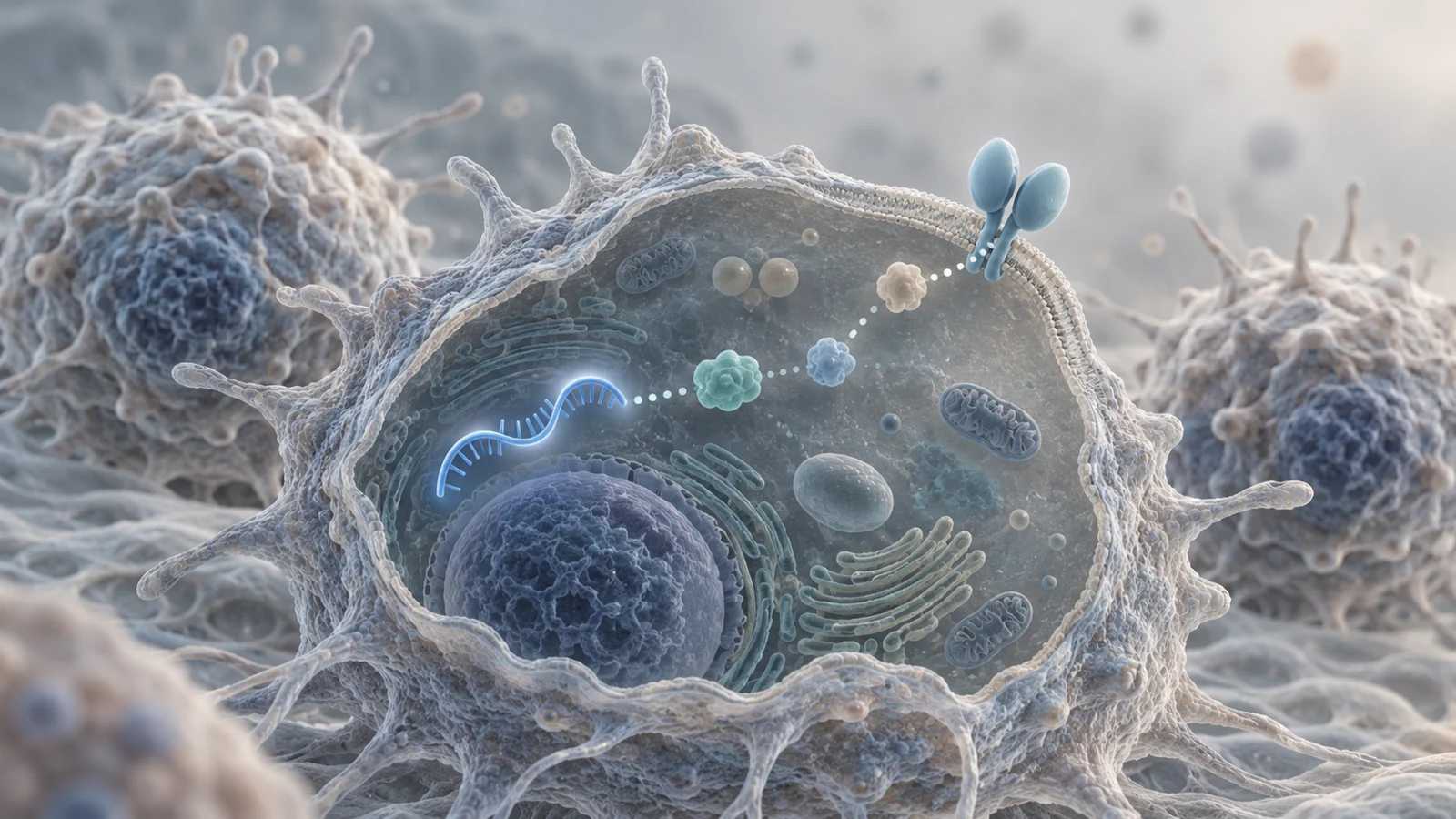
The authors suggest that reducing PVT1 may lower PD-L1 by repressing JAK2/STAT3, a cell-signaling pathway. In this proposed explanation, the pathway could connect the change in PVT1 to the observed decrease in PD-L1 and to the cell-assay findings.
The abstract describes this link tentatively: the effects “may be related” to reduced pathway activity and PD-L1 expression. That wording matters because the results support a possible mechanism, not a fully established chain of cause and effect. The tissue findings show that PVT1 and PD-L1 were associated; the cell experiment shows what changed after PVT1 was knocked down. The proposed pathway helps connect those observations, but the evidence summarized here does not settle every step.
The combination claim needs direct evidence
Atezolizumab, named in the paper title, blocks PD-L1. The authors propose studying it alongside PVT1-targeted therapy for cisplatin-resistant recurrence. The abstract describes the PVT1 knockdown experiment, but does not provide a result from a combined PVT1-targeting and atezolizumab treatment. Its use of “synergistic” in the title therefore cannot, on the supplied evidence, be treated as a demonstrated combination benefit.
For the proposed approach to become more than a research idea, experiments would need to show what the combination does, whether PVT1 can be safely and effectively targeted, and whether any benefit carries over to patients. The cell findings make the question worth pursuing; they do not answer it.
What PVT1 targeting could add to ovarian cancer treatment
For people whose ovarian cancer returns after becoming resistant to cisplatin, a treatment that targets PVT1 alongside PD-L1 blockade could eventually offer another way to address the disease. That possibility depends on demonstrating combination effects, safe delivery of PVT1-targeted therapy, and patient benefit. The 2021 study supplies an early rationale for that line of research, rather than evidence that such a treatment is ready or effective.
Key Sources
- Primary source: Atezolizumab and blockade of LncRNA PVT1 attenuate cisplatin resistant ovarian cancer cells progression synergistically via JAK2/STAT3/PD-L1 pathway.
DOI or Journal Page · Peer-Reviewed Paper · 2021-04-17
Keep exploring