
Research Signal – Source date 2021-11-14
A cancer treatment can help immune cells recognize a tumor and still leave the tumor with ways to resist them. That tension is central to a systematic literature review published on November 14, 2021, which examined experimental treatments affecting PD-L1 signaling in prostate cancer cell lines and mouse models.
The review did not test one universal regimen. It assembled findings from different preclinical experiments, including studies of tumor cells alone, tumor cells grown with immune cells, and tumors developing in mice. Across those settings, the same broad question kept returning: when blocking one immune defense has limited effects, can another treatment make the tumor easier to attack without weakening the immune response itself?
Why blocking one immune defense may not be enough
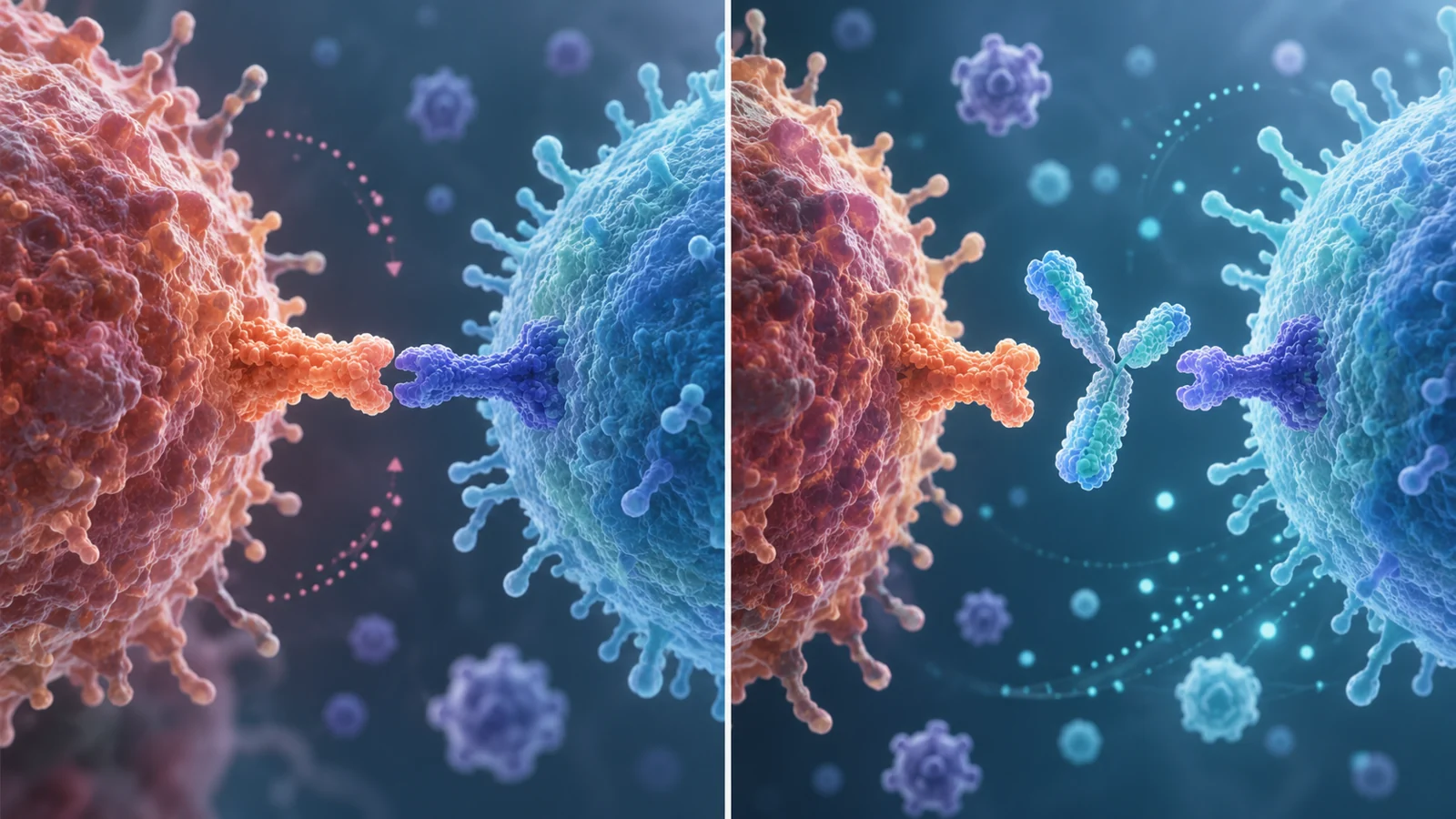
PD-L1 is a protein that can engage PD-1 on T cells. That interaction helps regulate immune activity, but cancer cells can use it to restrain the T-cell attack directed at them. Blocking the interaction between PD-1 and PD-L1 is therefore different from reducing how much PD-L1 a tumor cell displays. One approach interrupts the contact; the other changes the amount of one participant in that contact.
The distinction matters because a change in PD-L1 expression is not the same as successful treatment. In some of the experimental models reviewed, blocking only the PD-1/PD-L1 pathway had limited effects on tumor growth. The tumor might still receive support from other signaling pathways, suppressive immune cells, or treatment-induced changes in its surroundings.
That is the biological rationale for combining treatments. A second intervention could alter the tumor cell, stimulate immune activity, or reduce another source of suppression. The useful combination would not simply contain more drugs. It would have to affect different parts of the contest while preserving the immune cells’ ability to recognize and kill tumor cells.
The experiments linked a molecular change to immune-cell killing
The review brought together experiments using human and mouse prostate cancer cell lines, including primary and metastatic models. Researchers treated the cells with different agents and, in some studies, placed them in co-culture with natural killer cells, CD8-positive T cells, or CAR-T cells. This allowed the experiments to connect a molecular measurement with an immune-cell function.
Across the reviewed findings, inhibitors affecting NF-kB, MEK, JAK, or STAT signaling variably reduced PD-L1 expression. In co-culture experiments, lower PD-L1 expression was associated with greater immune-cell cytotoxicity. When PD-L1 was increased, the reported pattern went in the opposite direction. These results make the mechanism easier to understand: the amount of PD-L1 on a tumor cell can change how effectively an immune cell attacks it in a controlled experimental setting.
But the measurements remain separate. A fall in PD-L1 is an expression result. Greater killing by an immune cell is a functional result. Reduced tumor growth and longer survival in a mouse are different outcomes again. A combination that changes one of these measures cannot automatically be treated as having achieved all of them.
Radiation could make a tumor more visible and more defensive
Radiation shows why treatment effects have to be read in context. The reviewed research describes radiation as capable of damaging tumor-cell DNA, increasing the release of tumor-associated antigens, and altering inflammatory signals. Those changes can make a tumor more noticeable to the immune system and can influence the surrounding immune environment.
They can also trigger defenses against immune attack. In mouse models, radiotherapy was among the treatments associated with PD-L1 upregulation and immune evasion. The review describes one route in which damage to the tumor environment increased amphiregulin production, which in turn increased PD-L1 on cancer cells. Fractionated radiation was also reported to induce PD-L1 through production of interferon-gamma by CD8-positive T cells.
A different experiment illustrates why these findings do not support a single rule for every radiation schedule or prostate cancer model. After one 10 Gy radiation dose, three prostate cancer cell lines—PC3, DU145, and LNCaP—showed lower surface PD-L1 and higher expression of some immune-stimulating molecules, including OX40 ligand and 4-1BB ligand. The dose did not prevent interferon-gamma from inducing PD-L1, however. Other immune markers also varied by cell line.
Radiation could therefore improve some features of immune recognition while leaving, or even provoking, a route to renewed immune suppression. The experimental conditions—cell line, dose pattern, immune signals, and model—are part of the result.
One combination changed several outcomes at once
One of the clearest combination examples in the review came from a prostate cancer mouse model. The experiment combined IL-15, an immune-signaling protein, with antibodies blocking CTLA-4 and PD-L1. Compared with IL-15 alone, the three-part treatment was associated with more CD8-positive T cells, greater T-cell lytic activity, increased interferon-gamma release, reduced tumor growth, and improved survival in the mice.
The comparison is important. The reported result was not simply that a larger treatment package worked better than no treatment. It was that adding two forms of immune-checkpoint blockade to IL-15 changed several measured immune and tumor outcomes relative to IL-15 alone in that model.
The logic also involved different immune controls. PD-L1 blockade addressed one restraint on T cells, while CTLA-4 blockade affected another. IL-15 supplied an immune-stimulating signal. Together, these interventions were intended to strengthen the attacking cells while reducing inhibitory signals. The finding supports a possible experimental strategy, not a ranking of combinations or a clinically proven regimen.
More inhibition can disturb immune balance
A pathway can support tumor suppression in one cell population while also participating in immune functions needed for durable tumor control. That makes pathway inhibition more complicated than simply turning an immune signal up or down.
The review describes myeloid-derived suppressor cells as one example. Broadly acting approaches aimed at JAK/STAT3 signaling could reduce suppressive-cell numbers, but a reported finding involving JAK1/2 inhibition paired fewer of these cells with increased suppressive activity. In other words, there were fewer cells by one measure, yet the remaining cells were more suppressive by another.
This difference between abundance and behavior is central to combination design. A treatment that removes a population may still leave an immune environment that restrains T-cell proliferation or function. The reverse problem is also possible: an intervention aimed at tumor-associated signaling may interfere with T-cell activation. The reviewed experimental work therefore points toward cell-selective strategies rather than assuming that stronger pathway inhibition is always better.
Models show where translation becomes difficult
The review’s systematic methods help organize a scattered preclinical literature. It reports PRISMA-guided methods and searches across multiple databases, then brings together results from cell-line experiments, immune-cell co-cultures, and mouse studies. That synthesis is useful because it shows how a treatment can behave differently depending on which biological level is being measured.
The models themselves are not interchangeable. Much of the knowledge about PD-L1 and PD-1 blockade in prostate cancer came from immunocompetent mice injected with syngeneic mouse prostate cancer cells. These models preserve an immune system that can interact with the tumor, but mouse and human immune systems are not identical. The development and progression of prostate cancer in mice also do not reproduce the human disease in every respect.
Humanized mice, which have a functional human immune system, may help investigate treatments aimed at human cancer and human immune interactions. The review notes that only a small number of prostate cancer studies had used them. Even so, such models would remain preclinical experiments, not substitutes for clinical validation.
This is the translation boundary: a systematic review can report varied experiments in a disciplined way, but that reporting does not make heterogeneous models equivalent or show that their combinations will improve outcomes for patients. The effects on PD-L1 expression, immune-cell killing, tumor growth, and mouse survival must remain attached to the models and comparisons in which they were observed.
What combinations could change for patients
From the publication’s 2021 perspective, the practical possibility is a treatment strategy that does two jobs at once: preserve the immune attack and counter the tumor defenses that blunt it. For patients whose tumors resist checkpoint blockade alone, such combinations could eventually make immune treatment more useful and improve tumor control if the experimental effects translate to people and the regimens prove tolerable.
That possibility remains conditional. The reviewed cell and mouse experiments do not establish patient survival benefit or an acceptable balance between benefit and harm. They identify a route worth testing: combine immune stimulation or checkpoint blockade with interventions that address the tumor’s signaling and suppressive environment, while protecting the immune cells needed to attack it.
Key Sources
- Primary source: What Do We Have to Know about PD-L1 Expression in Prostate Cancer? A Systematic Literature Review. Part 4: Experimental Treatments in Pre-Clinical Studies (Cell Lines and Mouse Models).
DOI or Journal Page · Review or Meta-Analysis · 2021-11-14
Keep exploring