
Research Signal – Source date 2026-04-17
When prostate cancer spreads and continues growing despite hormone suppression, the next treatment is not determined by the diagnosis alone. One tumor may still depend on altered androgen-receptor signaling; another may have lost a DNA-repair function or changed its cellular identity. Some tumors display a target that can be reached with radioactive medicine, while others may be more vulnerable to immune-directed treatment. These differences help explain why options that show promise for one group can have little effect in another.
A review published on April 17, 2026, brings together preclinical and clinical research on treatments beyond androgen-receptor pathway inhibition. Its reported PubMed search covered English-language papers published from January 2019 through February 2026, with reference lists also screened. It spans randomized trials, smaller early studies and mechanistic research; it does not report a new trial comparing these treatment strategies against one another.
Resistance can take several biological routes
Androgen deprivation remains a foundation of treatment for advanced prostate cancer, but disease progression is common. Drugs such as abiraterone and enzalutamide block the androgen-receptor pathway, yet the review describes radiographic progression often appearing within 12 to 18 months. A tumor can find ways to keep using that pathway, or it can become less dependent on it.
Some cancers acquire changes to the androgen receptor itself. The review describes receptor mutations and splice variants, including AR-V7, detected in circulating tumor DNA. These features can be associated with shorter benefit from androgen-pathway drugs, and the mix of tumor-cell variants can change as disease progresses. A blood sample may therefore capture a moving population rather than a permanent tumor profile.
Other cancers shift toward a different cell identity. Changes involving RB1 and TP53 can accompany lineage plasticity, in which tumor cells lose androgen dependence and take on features associated with neuroendocrine disease. The review describes this as a serious form of resistance, while also noting that estimates of its frequency differ between autopsy and imaging-based studies.
A third route is altered survival signaling. Loss of PTEN can leave the PI3K-AKT pathway active, helping cancer cells continue to grow. These routes can overlap, but they pose different treatment questions: is the cancer still using the blocked pathway, has it changed identity, or has another growth circuit become important?
DNA repair defects can create a specific vulnerability
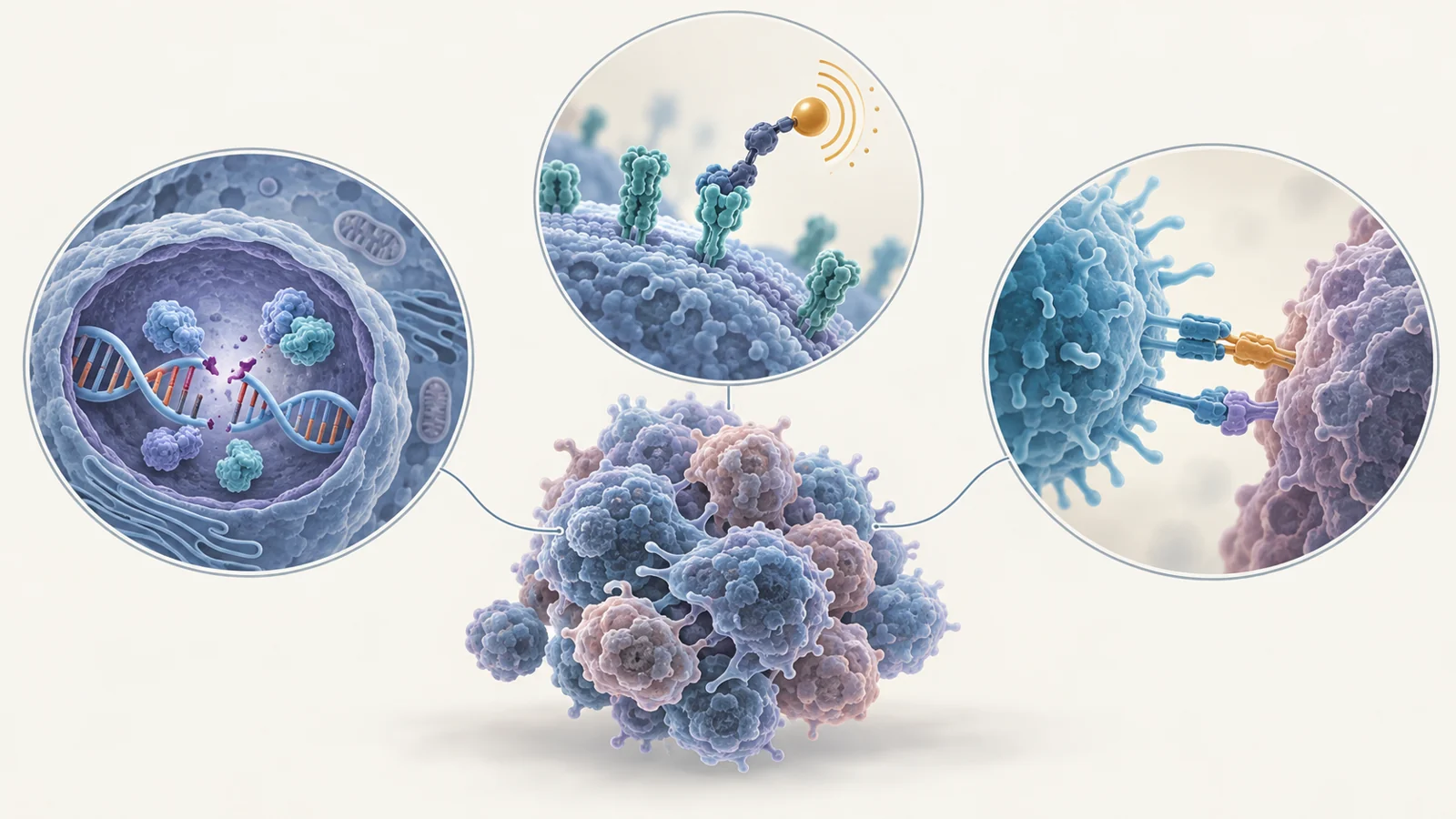
The clearest example of a molecular feature changing how a treatment result should be read comes from PARP inhibitors. The review estimates that at least one in five tumors has a harmful alteration in a gene involved in homologous recombination repair, a process cells use to repair serious DNA damage. When repair is impaired, blocking PARP can make it harder for tumor cells to survive further DNA damage. This vulnerability is often described as synthetic lethality.
The clinical results summarized in the review support treatment benefit for some patients, but the gene involved matters. In the PROfound trial, olaparib reduced the risk of progression in the BRCA1/2 subgroup; the review reports no outcome improvement for tumors with ATM alterations. It also describes findings that point to the importance of whether both copies of a repair gene are disrupted: a reported rucaparib response rate was higher in BRCA2 cases with changes to both copies than in cases with only one affected copy.
That makes “a DNA-repair mutation” too broad a description for predicting benefit. The review discusses combining DNA and RNA-based tests to identify tumors with functional repair deficiencies, including some that lack an identifiable DNA mutation. It presents this as a direction requiring prospective validation, not a settled testing standard.
Even a useful vulnerability can disappear under treatment pressure. The review describes BRCA2 reversion mutations in some progressing tumors. These changes can restore the gene’s reading frame and with it some DNA-repair function, weakening the rationale for PARP inhibition and potentially affecting response to platinum treatment. A result from an earlier biopsy or blood test may not describe the tumor’s later state.
Radiation treatment depends on where the target is
PSMA-targeted radioligand therapy addresses a different problem. It pairs a radioactive isotope with a molecule that seeks prostate-specific membrane antigen (PSMA) on cancer cells. For the treatment to reach a tumor, that tumor must show enough PSMA uptake. A patient can have metastatic prostate cancer and still have lesions that do not display the target strongly enough.
The review reports results from VISION, a randomized study of 831 people with PSMA-positive disease that had progressed after at least one androgen-pathway inhibitor and one or two taxane regimens. Lutetium-177–PSMA-617 plus permitted standard care reduced the risk of death compared with standard care alone; with at least four years of follow-up, median overall survival was 15.3 months versus 11.3 months. These results apply to the trial’s previously treated, PSMA-positive population, not to every person with advanced prostate cancer.
Tumor uptake can also change. The review describes evidence that androgen-deprivation treatment may temporarily increase PSMA imaging uptake, while later progression on androgen-pathway drugs may lower it in some lesions. It discusses combining PSMA scans with other imaging and blood-based measures to help assess disease over time. Such approaches are under study; the review does not show that an integrated imaging and blood-testing strategy improves patient outcomes.
For disease with little PSMA uptake, the review describes other targets such as GRPR, B7-H3 and FAP. Early imaging or treatment findings for these targets remain exploratory. They illustrate the effort to find additional routes to tumors that PSMA-directed treatment may miss, rather than offering established substitutes on the strength of the small studies summarized here.
Immune drugs work in different ways
Checkpoint inhibitors and bispecific T-cell engagers are both immune approaches, but they do not do the same job. Checkpoint drugs seek to release restraints on immune activity. In unselected groups with metastatic castration-resistant prostate cancer, pembrolizumab produced objective responses in about 5–9% of patients in the studies reviewed. The longer-lasting responses were concentrated in tumors with features such as high microsatellite instability or high tumor mutational burden; the review also discusses biallelic CDK12 loss as a possible marker of response.
A bispecific engager instead connects a T cell to a target on a prostate cancer cell, helping bring the two into contact. Early studies of PSMA- or STEAP1-directed engagers reported signs of activity, including PSA declines and tumor responses, among heavily pretreated patients. These phase I findings are not evidence of a comparative survival benefit. They also bring a distinct safety concern: cytokine-release syndrome, an inflammatory reaction that can be severe. The review describes step-up dosing as one approach used to reduce this risk, while noting that the toxicity remains important.
The difference in mechanism matters for interpreting the results. A low response rate for checkpoint therapy across an unselected population does not answer whether an engager can help a patient whose tumor displays its target. Nor do early engager responses show that this approach is better than checkpoint treatment. The studies involve different patient groups and treatment designs.
Trials offer different levels of evidence
The review’s discussion of AKT inhibitors shows how a randomized trial can test a biomarker-defined treatment effect. In IPATential150, adding ipatasertib to abiraterone improved radiographic progression-free survival in tumors with PTEN loss, while the PTEN-normal group showed no significant advantage. The reported benefit therefore centers on a defined subgroup, rather than showing a uniform effect across all participants.
A very different kind of evidence comes from first-in-human studies of antibody-drug conjugates, which carry a cell-killing drug to a target on the cancer cell. In a phase I study summarized by the review, the B7-H3-directed conjugate vobramitamab duocarmazine produced an objective response rate of 34% and a PSA decline of at least 50% in 67% of participants at the recommended phase II dose. Median progression-free survival was 7.2 months, and peripheral neuropathy was reported. These findings can help identify activity and safety issues for further study, but a small early-phase study cannot answer the same questions as a randomized phase III trial.
The review’s account of CAPItello-281 illustrates why even trial summaries need careful reading. Its passages differ on whether the reported survival benefit from capivasertib extends beyond tumors with PTEN loss. The supplied findings do not resolve that subgroup question, so they cannot support a firm claim about who benefits outside the PTEN-loss group.
Access also shapes what happens after a biomarker is found. A real-world chart review cited by the paper found that only 55% of patients with germline BRCA2 alterations received targeted treatment, with reimbursement barriers and concerns about use in heavily pretreated cases among the reasons reported. A promising result in a trial does not automatically become an option every eligible person receives.
Treatment choices may need to change as tumors change
A tumor’s biology is not a fixed label. Reversion mutations may restore DNA repair; PSMA levels can shift across lesions or over time; and blood-based measures may reveal changing tumor features. The review discusses liquid biopsies, PSMA imaging and artificial-intelligence tools as potential ways to track these changes and improve response assessment. It does not test an integrated system for using them to switch treatments, or show that such a system improves outcomes.
For readers, the central point is that “hormone-resistant” does not describe one uniform disease. A repair defect, loss of a growth-pathway brake, weak target uptake or an immune-sensitive profile may each point toward a different research-backed option, with different evidence and risks. The value of testing depends on what it measures, when it is done and whether the result has been shown to predict treatment benefit in that specific setting.
What better matching could change for patients
More reliable ways to match treatment to a tumor’s current features could help clinicians avoid giving a targeted therapy when its target is absent, or missing a treatment opportunity when a repair defect makes a cancer vulnerable. The practical benefit depends on validating the tests, showing that treatment changes guided by them improve outcomes, and making effective options accessible to the people whose tumors fit the evidence.
Key Sources
- Primary source: Novel therapeutic strategies for metastatic castration‑resistant prostate cancer: Beyond androgen receptor pathway inhibition (Review).
DOI or Journal Page · Review or Meta-Analysis · 2026-04-17
Keep exploring