
Research Signal – Source date 2024-10-16
The PROSOMNIA Sleep Therapy proposal examines an unusual question in insomnia care: could a single, closely monitored anesthesia session improve sleep afterward? The intervention is not presented as an established treatment. It is a registered clinical investigation intended to assess whether anesthesia-induced sleep changes specific sleep measures in adults with chronic insomnia, sleep deprivation or related REM-sleep concerns.
Anesthesia itself is not the same thing as demonstrating restorative sleep. Being unconscious during a procedure would not, by itself, show that a person later sleeps more effectively, feels better during the day or experiences fewer insomnia symptoms. The relevant question is whether the session produces meaningful changes that persist beyond the procedure, while remaining acceptably safe for the people selected to receive it.
What the proposed session involves
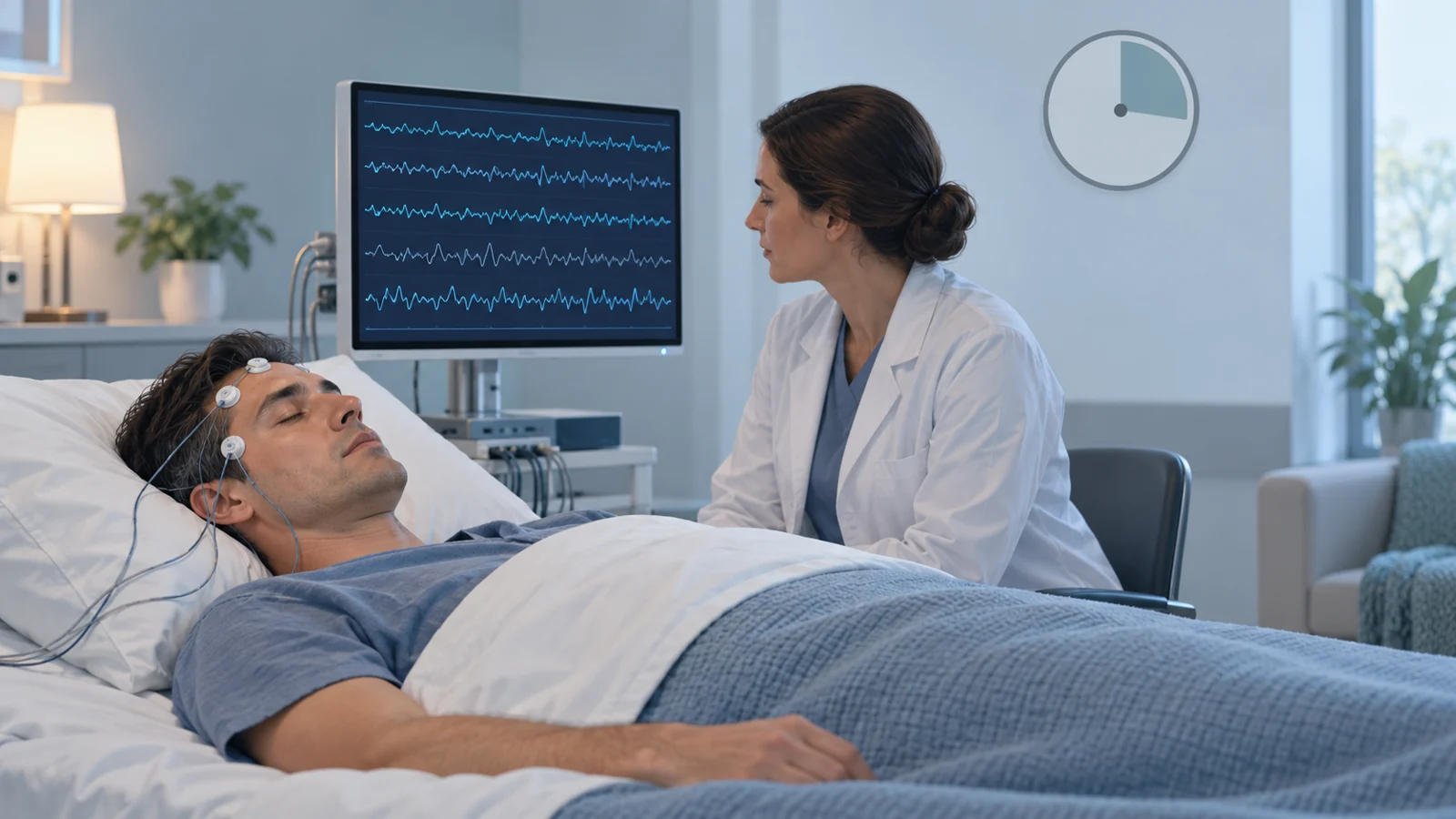
The registry describes one PROSOMNIA Sleep Therapy session lasting between 60 and 120 minutes, using the anesthetic Diprivan, also known as propofol. An electroencephalogram, or EEG, records electrical activity from the brain during the session. Investigators intend to use this monitoring to assess sleep stages, including REM sleep, but the supplied evidence does not establish that propofol produces the intended REM effects.
The procedure and its intended effects are separate parts of the proposal. EEG monitoring can show patterns of brain activity during the session, but monitoring does not establish that the resulting state has the same benefits as ordinary sleep. The registry presents the approach as an attempt to influence sleep architecture, especially the balance and quality of sleep stages. Whether that translates into better sleep after the session is an outcome the investigation is meant to examine.
Better sleep has several different meanings
The proposed objectives separate sleep into measurable questions rather than treating improvement as one broad feeling. One asks whether the quality of REM sleep improves. REM means rapid eye movement sleep, a sleep stage the registry identifies as a particular focus of the therapy.
Another objective concerns the amount of sleep obtained in REM and/or non-REM stages. More time in a stage is not automatically the same as better-quality sleep, so duration and quality represent different dimensions. The proposal also measures sleep onset latency, meaning how long it takes a person to fall asleep. A shorter time to fall asleep could matter to someone with insomnia, but it would not by itself show that the entire night was more restorative.
These distinctions are important because the session is designed around what happens during a controlled period of anesthesia, while the patient-relevant question concerns sleep and functioning beyond that period. A change in one recorded measure would not automatically establish improvement across all of them.
Who the proposal is intended to study
The registry describes adults aged 18 to 65 with diagnosed or undiagnosed chronic insomnia or sleep deprivation as potential participants. It also lists exclusions for people with severe obesity, significant cardiovascular, neurological or psychiatric conditions, and for those with an ASA status above II.
The proposed study is non-randomized, single-arm and open-label: all participants receive the intervention, there is no comparison group, and participants and investigators know what treatment is given. This design limits the ability to attribute any improvement to the session itself and cannot directly establish whether it works better than established care. The eligibility criteria also limit whom eventual findings could apply to; they do not establish safety, even for the selected population.
The registry’s description includes intended therapeutic explanations involving sleep homeostasis and REM sleep. Those explanations should be read as part of the rationale for testing PSTx, not as demonstrated effects in patients. The supplied record does not establish improved daytime function, cognitive recovery, relief of insomnia symptoms or any broader health benefit.
What a single session could mean for insomnia care
A single-session approach could become useful if it produced a clinically meaningful improvement in subsequent sleep and made falling asleep easier, without exposing appropriately selected patients to unacceptable risk. That would offer a different kind of treatment experience from an intervention that must be repeated night after night, but the value would depend on effects that extend beyond the monitored session.
For now, the PROSOMNIA entry represents a proposal to test that possibility, not a report that the possibility has been realized. The evidence needed for a practical insomnia treatment would include an acceptable safety profile and benefits that patients can actually feel and sustain. Until those questions are answered, anesthesia-induced sleep remains an investigation into whether a brief, controlled procedure can lead to better sleep later.
Key Sources
- Primary source: Evaluating the Efficacy and Safety of PROSOMNIA Sleep Therapy™ in Patients With Sleep Deprivation and Chronic Insomnia
Government or Regulator · Clinical Trial · 2024-10-16
Keep exploring