
Research Signal – Source date 2024-01-10
In a laboratory test, a channelled block made to catch carbon dioxide held more of the gas at −20 °C than at 25 °C when exposed to a mixture containing 400 parts per million CO₂. But the amount the material could hold was only part of the story: in a flowing test bed, gas flow affected how much was captured before CO₂ began escaping, and moisture changed both capacity and capture speed.
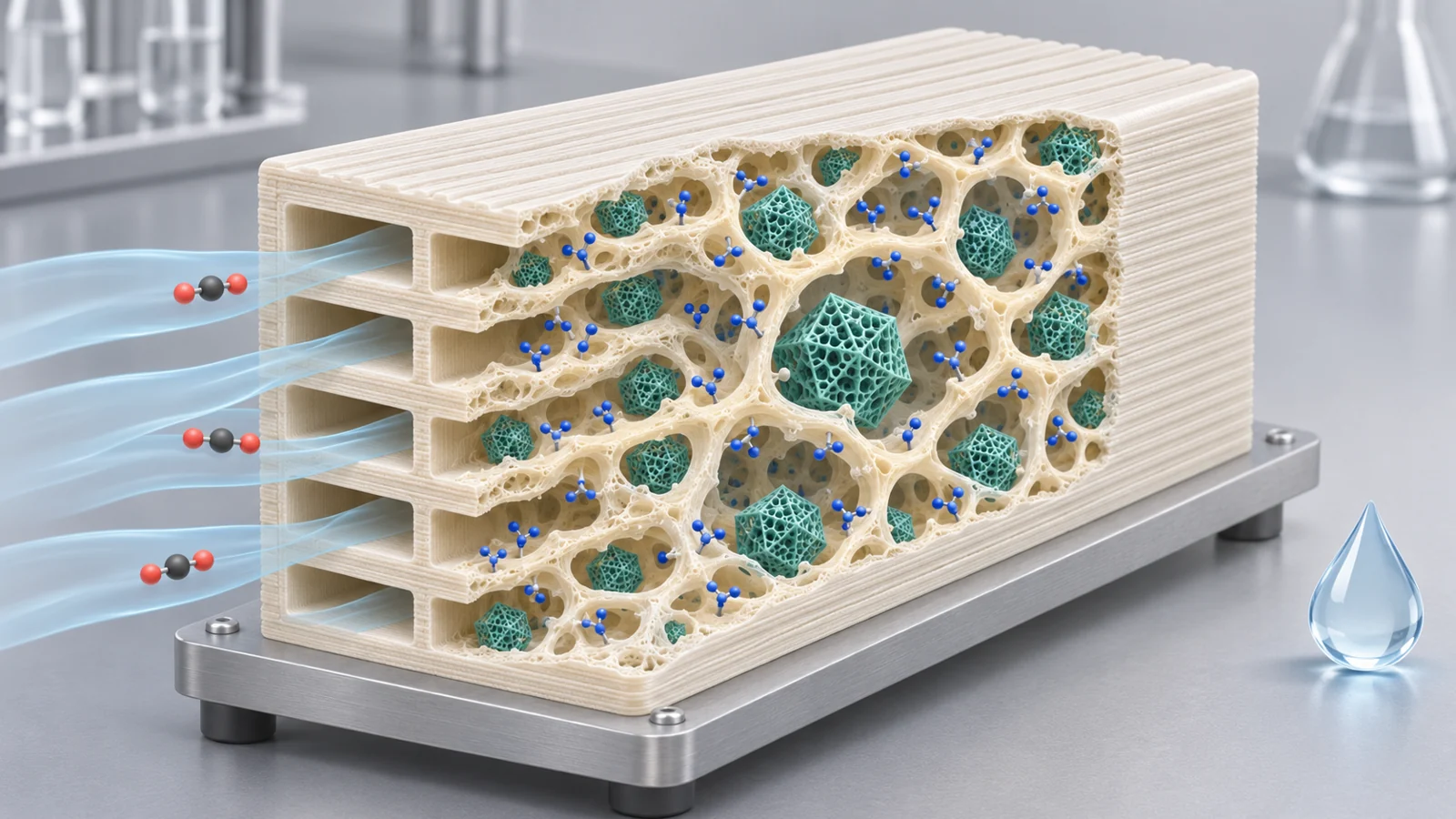
The 2024 study tested a printed sorbent made from cellulose acetate and a porous material called MIL-101(Cr), with an added amine-rich polymer to bind CO₂. It is a laboratory prototype, not an outdoor capture trial. Its results show how shaping a powder into a channelled contactor can preserve promising cold-temperature uptake—and why the channels, flow, and moisture history matter to a working system.
Turning sorbent powder into a channelled block
Direct air capture starts with a practical challenge: CO₂ is dilute in air, so a contactor must bring a great deal of gas into contact with a sorbent. Fine powders can offer many places for CO₂ to attach, but a bed made from loose particles can impede airflow. A shaped contactor needs open routes for gas while keeping enough active material within reach.
The team used solution-based additive manufacturing, a form of 3D printing, to make cellulose acetate (CA) monoliths containing tiny crystals of MIL-101(Cr), a metal–organic framework (MOF). MOFs are porous crystalline materials; here, MIL-101(Cr) supplied a network of small pores that could host the CO₂-binding ingredient. The printed block’s channels let gas pass through, while larger pores within the cellulose acetate structure helped connect the material’s interior to those channels.
After printing, the researchers loaded the monolith with branched polyethylenimine (PEI), a polymer rich in amine groups. Those groups provide sites that interact with CO₂. The measured monolith contained about 62% MIL-101(Cr) by weight, and microscopy showed the crystals distributed through the polymer framework rather than gathered in obvious clumps. The researchers also demonstrated printed cellulose acetate monoliths containing zeolite 13X, but the cold and humidity results discussed here focus on the PEI-loaded MIL-101(Cr) material.
Adding more PEI improved CO₂ uptake only up to a point. Capacity rose with amine loading, then levelled off above about 20 millimoles of nitrogen per gram of MOF. The paper suggests that excess PEI may block pores, limiting access to some binding sites. The result is a materials-design trade-off: more CO₂-binding groups do not necessarily mean more usable capacity if the pathways to them become restricted.
Capacity survived printing, while time still mattered
In a material measurement at 400 ppm CO₂, the tested monolith took up about 1.1 millimoles of CO₂ per gram at −20 °C, compared with 0.57 millimoles per gram at 25 °C. These figures describe how much the sample held under the measurement conditions. They do not say how quickly a stream of air could be processed through a packed bed.
The researchers compared cold uptake kinetics—the rate at which the sorbent approached its measured capacity—with powder and pellet forms of the same PEI-loaded material. The monolith reached about 95% of its eventual uptake in roughly two hours, similar to the powder. A small pellet reached a similar fraction in about 160 minutes, while a larger pellet reached only about two-thirds in that time. The comparison points to diffusion distance: CO₂ must travel through the composite to reach binding sites, and a longer route can slow the approach to capacity. In these tests, printing did not substantially slow uptake compared with powder, but pellet size did matter.
A separate breakthrough experiment put the monoliths in a packed test housing and passed a 400 ppm CO₂ mixture through the channels. At the highest tested flow, 200 standard cubic centimeters per minute, CO₂ appeared at the outlet almost immediately. The researchers suggested that some gas might pass through the straight channels without enough contact with the sorbent. When they lowered the flow to 100 and then 50 standard cubic centimeters per minute, more CO₂ was captured before the outlet concentration reached the study’s breakthrough threshold: about 0.53 and 0.60 millimoles per gram, respectively.
The bed’s eventual, or pseudoequilibrium, uptake stayed close to 1.05 millimoles per gram as flow changed. The earlier outlet breakthrough at faster flow therefore reflected a contact-time problem, not simply a lower final capacity of the material. This distinction matters for a device: a sorbent may have available capacity, yet gas can leave before the bed has had time to use it. The tested flow rates do not establish how the contactor would perform at the air speeds sought for practical direct air capture.
Humidity changed the bed’s history and its pace
Moisture did not produce one simple wet-versus-dry result. The team tested two different sequences at −20 °C. In one, they first exposed the monolith to humid gas until it was moisture-loaded, then introduced humid 400 ppm CO₂. In the other, they began with a dry monolith and fed it humid CO₂ directly.
With the bed presaturated by moisture, CO₂ uptake became slower: the outlet curve broadened, indicating a more gradual passage of CO₂ through the bed. Yet the measured capacity increased from 1.05 millimoles per gram under dry conditions to 1.43 millimoles per gram in the presaturated humid test. Water around the amine sites or within the material’s pores may have added resistance to CO₂ movement, the authors suggest. The higher final uptake therefore came with slower capture behavior.
The dry-start humid-feed test followed a different path. In that test, CO₂ stayed in the bed longer on average, and its eventual uptake rose by 22% compared with the dry test. The bed co-adsorbed about 7 millimoles of water per gram, around one-third of the water measured after presaturation. The researchers proposed that the duration of the adsorption step could be tuned to gain CO₂ capacity without taking on the full water load. That is a process possibility suggested by the experiment, not a demonstrated energy saving.
Fourteen cycles show repeatability, not lifetime
The team also alternated two-hour CO₂ capture periods at −20 °C with two-hour release periods at 60 °C. Across 14 laboratory temperature-swing cycles, the monolith averaged about 0.95 millimoles of working capacity per gram—the amount captured and then released under that test schedule. This shows that the sample could be regenerated repeatedly over those cycles at the tested temperature. It does not establish long-term durability or the energy required to regenerate a complete capture system.
The block also faces structural and flow challenges. Compression tests showed that the ridges between neighboring channels deformed more than the wider base, and delamination occurred mainly around those ridges. The base did not break under the maximum load applied in the test, but the pattern indicates where a printed structure could need reinforcement. The paper also identifies the material loading and relatively simple channel designs as limitations. Its preliminary tests of a more complex, gyroid-shaped channel did not resolve how alternative geometries would behave at practical air velocities.
What this could change
A channelled sorbent that retains useful capacity in deep cold could eventually help engineers design compact contactors for capturing CO₂ from dilute air across a wider range of conditions. The path to that capability runs through a real engineering balance: channels must move enough air, pores must keep binding sites accessible, and the material must hold up through repeated capture and release. If future designs solve those constraints and confirm performance at relevant air speeds and over longer operation, printed monoliths could make cold-weather capture equipment easier to shape around a site’s needs. This study offers a laboratory step toward that possibility, not proof that an outdoor system is ready.
Key Sources
- Primary source: Cold Temperature Direct Air CO 2 Capture with Amine-Loaded Metal-Organic Framework Monoliths.
DOI or Journal Page · Peer-Reviewed Paper · 2024-01-10
Keep exploring