
Research Signal – Source date 2024-06-05
Squeezing a material can do more than deform it. In a research report dated June 5, 2024, researchers describe a polymer gel in which mechanical force starts a chemical sequence that builds new connections inside the material. They report 100% self-healing efficiency after compression at 50 megapascals (MPa) for five minutes, followed by 72 hours at room temperature. The three-day wait is part of that result, and the percentage refers to a particular healing measure—not necessarily every property of the gel.
How the chemical sequence unfolds
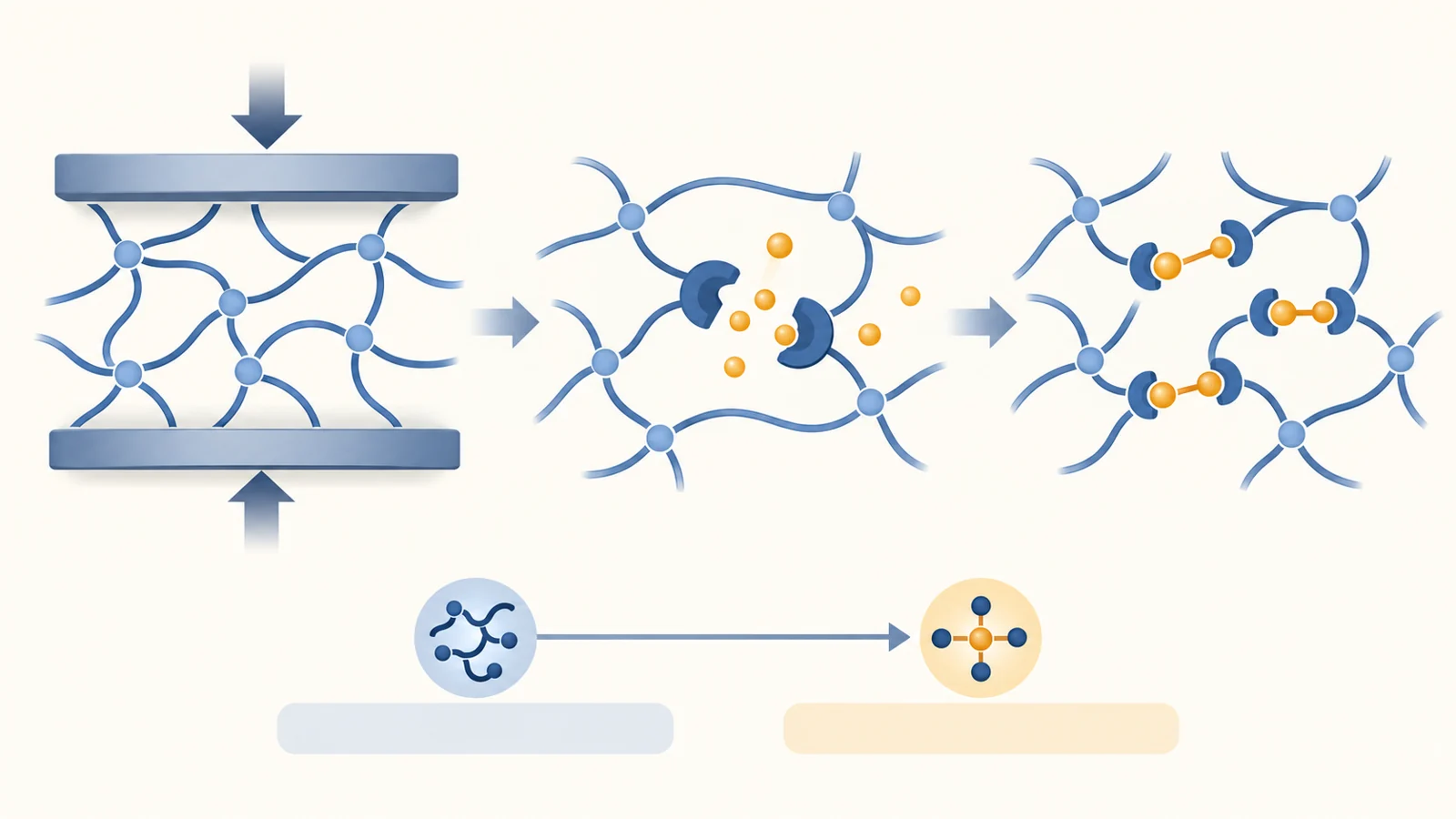
The gel contains ferrocene, a chemical component that responds to mechanical force. The authors describe it as a mechanophore: a part of the material through which force can trigger a chemical change. In their proposed sequence, ferrocene decomposes under force and generates iron ions called Fe³⁺.
Those ions then bind to catechol groups attached to the sides of the polymer chains. These binding sites allow new connections, or crosslinks, to form within the material, creating a new network. This is the meaning of “cascade-responsive” in the report. One event enables the next, from a force-sensitive component changing chemically to released ions linking parts of the polymer together.
The design therefore puts both the trigger and the ingredients for additional connections inside the gel. The account describes a specific chemical route to self-crosslinking; it does not establish that the force-responsive ingredients can replenish themselves indefinitely.
A treatment sequence and three distinct behaviors
The quantified healing result belongs to a two-stage procedure. The gel first underwent five minutes of compression at 50 MPa, a pressure of 50 million pascals. It then stood at room temperature for 72 hours. Room-temperature recovery describes the second stage, while the substantial compression remains an essential part of the reported treatment. The result does not establish an immediate response to an everyday squeeze.
The abstract also reports self-strengthening under repeated mechanical loading. That concerns how the material changes as loads are applied repeatedly. Healing concerns recovery relative to a reference condition. A material becoming stronger during loading and a material recovering a measured property are different observations, even if the same network-forming chemistry helps explain both.
A third reported behavior is resistance to the spread of microcracks caused by high pressure in seawater. This brings the experiment closer to a possible service environment, but it answers another question: how small cracks propagate under those conditions. It should not be read as a separate demonstration of 100% healing in seawater.
What the healing percentage can tell us
A healing efficiency needs a defined property and a comparison value. Recovery of one measured property to its reference level would not automatically show that the material’s shape, flexibility, strength and every other characteristic had all returned to their earlier states. The abstract available here does not identify which property defines the reported percentage or how its reference value was chosen. That limits how precisely the number can be interpreted.
This account rests on the report’s abstract. Without verified experimental details, it is not possible to assess the controls, variation among samples or repeatability of the result. The available account also does not establish the number of loading cycles, the size of the strengthening effect or the duration of seawater exposure. These are limits of the evidence available for this article, rather than findings that those details are absent from the full work.
Those distinctions matter when moving from a laboratory result to a durable material. A recovery measurement after one treatment cannot establish performance across different kinds of damage or repeated rounds of use. Nor does the abstract establish how long the chemistry remains able to create useful new connections.
What this could change
One possible application is a protective polymer material for equipment exposed to pressurized seawater. If the reported resistance to microcrack growth persists through repeated loading and prolonged exposure, it could help such a material retain its protective function for longer. That is an application inference from the experiment, not a demonstrated marine coating.
For that possibility to become useful, the pressure needed to activate the response and the time needed for recovery would have to fit the equipment’s operating conditions. A three-day recovery period may shape where the approach can be used. The potential payoff is protection that lasts longer under demanding conditions, provided the laboratory behaviors translate into sustained performance.
Key Sources
- Primary source: Self-healing Polymer Gel with Cascade-Responsive Properties
DOI or Journal Page · Peer-Reviewed Paper · 2024-06-05
Keep exploring