
Research Signal – Source date 2024-10-29
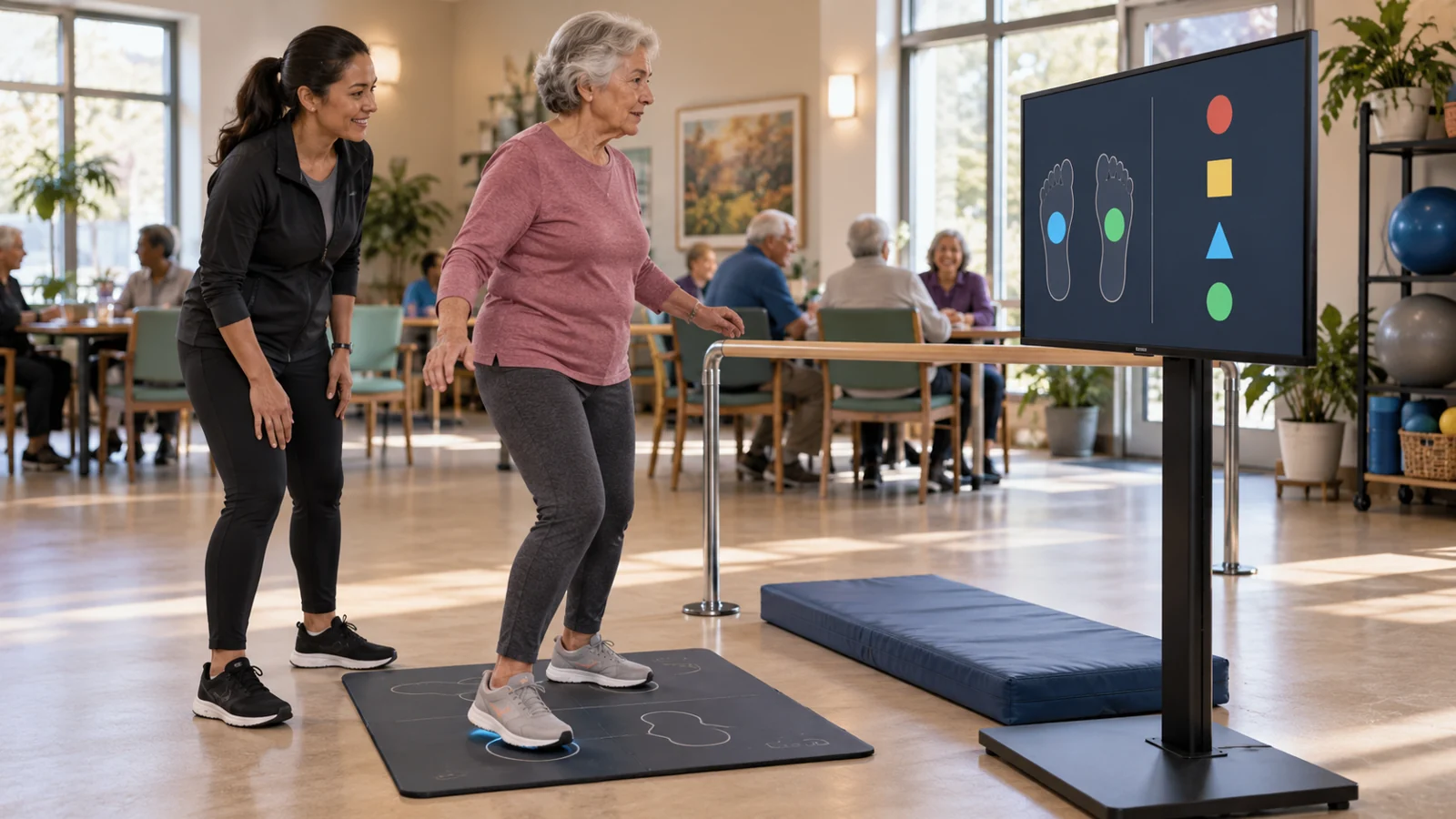
Can a floor mat help older adults rehearse a balance movement while also asking them to remember a sequence? A ClinicalTrials.gov registration describes a program under evaluation at a community senior center, combining a pressure-sensing mat, a monitor, linked software, and coach-led group sessions.
The historical account is anchored to the registry publication date of October 29, 2024. The supplied registry context separately records an actual study start date of January 15, 2024. The intervention details below follow the supplied registry description; they are not a verified reconstruction of every word that appeared in the record on that date.
One mat, two kinds of guided activity
The described equipment is a thin, flexible pressure-sensor mat placed in front of a standing monitor. The mat is intended to register where participants place their feet, while the screen shows positions or sequences to follow. A fitness coach leads the group through the activities, with safety bars and surrounding cushion mats described as additional supports.
Some sessions use the setup for balance practice. Examples in the registry description include side stepping, standing on the heels or toes, and quarter squats. Other activities use foot placement as part of a cognitive task, such as remembering a series of positions, answering quiz questions, or working through tasks involving numbers, spatial perception, or logical thinking.
The distinction matters. A screen-guided exercise can focus on balance, while a memory game can ask participants to move to remembered locations on the mat. The supplied description does not mean that every activity trains balance and cognition simultaneously. It describes a combined program containing both kinds of activity, delivered as a coached group experience.
From a pilot signal to a controlled comparison
The research plan has two stages with different jobs. The pilot involves one intervention group completing assessments before and after the training. Those assessments are intended to examine areas such as balance, physical fitness, cognition, and quality of life. The pilot also includes user-centered interviews to gather participants’ views of the program and help shape later research.
A before-and-after change in that group could show how participants’ measurements differ over the training period, but it would not by itself show that the program caused the change. People can change over time for many reasons, and participants may also become more familiar with the tasks or assessments.
The main study is described as a randomized controlled trial. Participants are assigned to either the mat-based intervention or a no-intervention control group, and the evaluator conducting assessments is not told which group each participant belongs to. Measurements are planned before training, after eight weeks, and after sixteen weeks, covering physical and cognitive functions alongside other described health and quality-of-life domains.
A control group gives the researchers a reference for changes that occur without receiving the program. Comparing the groups over time can therefore help assess whether differences are associated with the intervention rather than simply with the passage of time. The comparison still concerns the complete package: coaching, group participation, balance exercises, cognitive games, software, and the mat. It is not designed, as described here, to isolate the pressure sensor’s contribution from everything else.
Why the prevention label needs careful reading
The registry describes the program’s purpose as improving cognitive and physical functions in community-dwelling older adults, within a broader dementia and fall prevention aim. Those are reasons for conducting the study, not evidence that the intended benefits have already occurred.
The supplied evidence does not establish that participants improved their balance or cognition, experienced fewer falls, or had a lower risk of dementia. It also does not establish commercial availability, routine adoption by community centers, or suitability for unsupervised use at home. At this historical point, the record supplies a human-study design for testing a plausible service model; it does not supply an intervention effect.
What combined training could offer community centers
If meaningful benefits are demonstrated and the sessions prove workable to deliver, a community center could offer older adults one coached group activity that brings balance practice together with memory and quiz games. The potential value would be practical: a repeatable setting where physical movement and cognitive tasks are scheduled within the same supervised program.
Whether that opportunity is worth the equipment, staff time, space, safety arrangements, and repeated sessions depends on what the comparison study shows. The registration describes how the possibility is being tested. It does not yet establish that the program prevents dementia, reduces falls, or is ready for routine community use.
Key Sources
- Primary source: Development of Pressure Sensor Based Dementia and Fall Prevention Program for Older Adults
Government or Regulator · Clinical Trial · 2024-10-29
Keep exploring