
Research Signal – Source date 2025-09-19
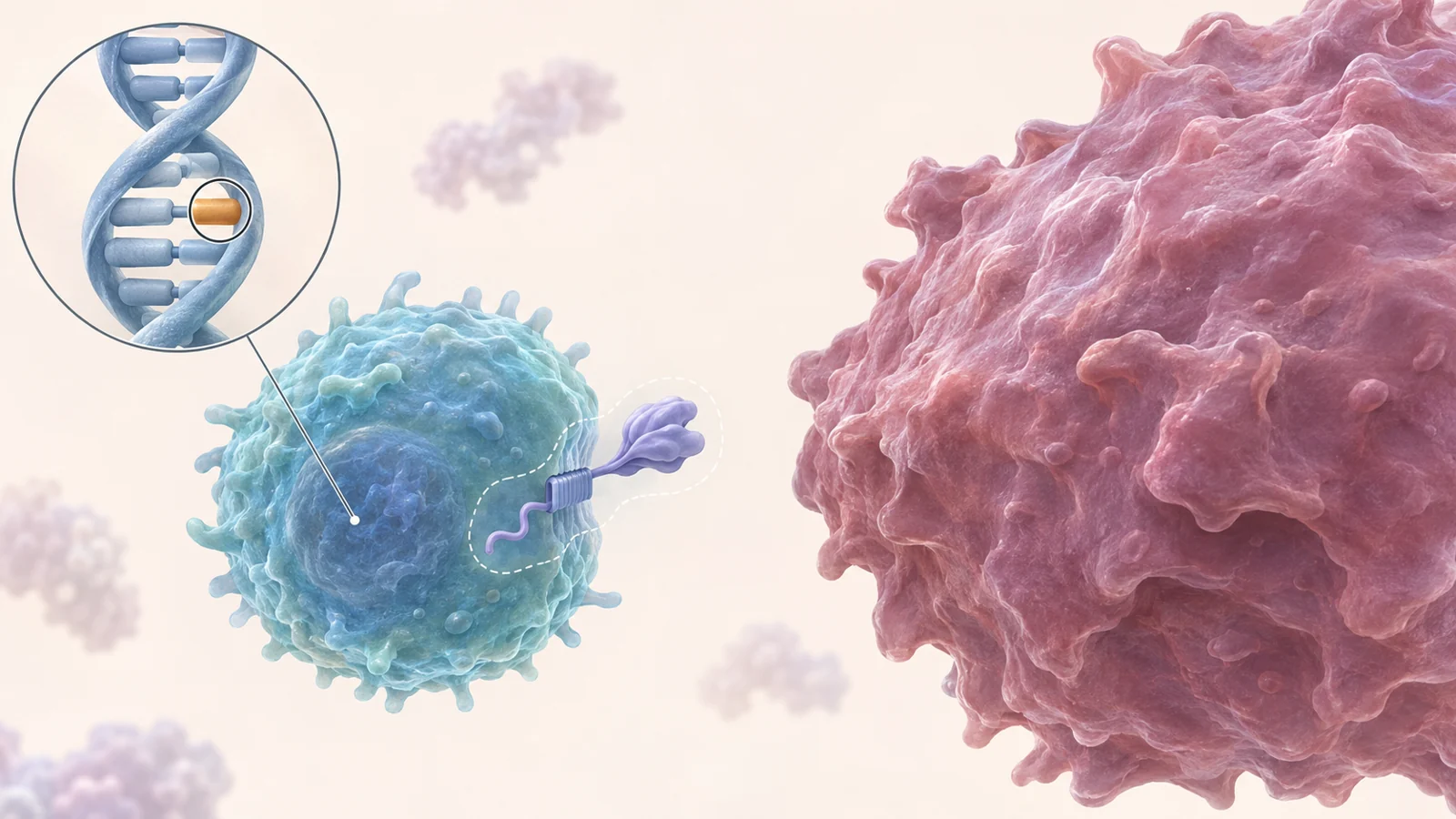
Engineered T-cell treatments can help people with certain blood cancers, yet they have struggled to show the same effectiveness against solid tumors. A review published on September 19, 2025, describes how base and prime editing might help researchers redesign these immune cells. The central idea is to make defined changes to DNA so a T cell can be better suited to recognize cancer, function as intended, or be produced more efficiently.
The prospect is significant because the obstacles are connected. Cancer cells can resist treatment, many tumors offer a limited set of suitable targets, and producing individualized cell therapies can be complex and time-consuming. More precise editing could give researchers additional ways to address those problems. The review describes ongoing clinical trials, but the existence of trials does not show that these edits have improved outcomes for people with solid tumors.
Where engineered T-cell therapies have worked so far
Some T-cell therapies give immune cells engineered recognition receptors. These receptors are designed to help T cells identify and kill cancer cells. Two broad approaches use chimeric antigen receptors, or CARs, and T-cell receptors, or TCRs. The review says adoptive T-cell therapies using these approaches are effective for certain blood cancers.
That progress has not made the approach broadly effective against cancer. Resistance can arise, targetable antigens—the features on cancer cells that a treatment can recognize—are limited, and solid tumors remain a major challenge. Making the therapies is also a complex process. A treatment may therefore need both a useful target and cells that can be prepared to act against it; improved editing alone would not guarantee either.
Changing DNA with more precision
Conventional CRISPR-Cas9 is useful for altering genes, adding a therapeutic gene, or disabling a gene. But editing can also produce unwanted changes, including translocations, in which chromosome segments become joined in the wrong arrangement, and chromosomal truncations, where part of a chromosome is lost. These possibilities matter when researchers are modifying cells intended for treatment.
Base editing and prime editing offer another way to make planned changes. The review describes them as tools for installing defined nucleotide variants—specific changes to DNA letters—in primary T cells. It groups these methods under the term “CRISPR 2.0.” The practical distinction is that the goal is to program a particular DNA-letter change with high precision, rather than relying only on conventional editing approaches that can yield unwanted chromosomal outcomes.
Precision is an aim, not a guarantee that every edit will be correct or that unwanted edits disappear. The review presents base and prime editing as versatile engineering tools, while the clinical value of any resulting cell depends on what was changed and how the modified cells perform.
Three aims for redesigned immune cells
The review points to three related uses. Researchers may edit T cells to augment their immune function, broaden the range of antigens they can target, or make production more streamlined. Each addresses a different pressure on current therapies: how well an engineered cell works, how many cancers it might recognize, and how difficult it is to manufacture the treatment.
These are research aims rather than reported patient benefits. A wider target range could matter where few useful antigens are available, while changes intended to improve cell function could help address resistance. More streamlined production could ease a manufacturing challenge. But the supplied evidence does not specify a production improvement or demonstrate that any of these aims has yet translated into better outcomes for solid-tumor patients.
Trials mark a step toward clinical testing
At the review’s publication date, multiple clinical trials of cellular therapies modified with base or prime editing were ongoing. That places the technology beyond an idea discussed only in the laboratory: edited cell therapies were being investigated clinically. The review, however, does not provide a trial-specific result that would allow readers to compare a particular product’s safety or effectiveness with conventional editing or existing treatments.
For solid tumors, the key question remains whether a suitable edited T-cell product can recognize cancer and produce meaningful responses in patients. Trial activity is evidence of investigation, not evidence that the approach works. Nor does the review establish that newer editing methods outperform conventional CRISPR-Cas9 in people.
What this could make possible
A person with a solid tumor might eventually have an engineered T-cell option where current approaches have shown limited effectiveness. That possibility depends on a chain of advances: defined edits would need to improve immune-cell function or widen the set of recognizable targets, the chosen targets would need to matter in the cancer being treated, and clinical studies would need to validate the resulting therapy. Easier production could also help make a treatment process more manageable, but the review does not establish that this has been achieved.
One observable milestone would be a published report from a solid-tumor trial that identifies a specific base- or prime-edited T-cell product and describes its safety and tumor responses. Such a report would show what happened in that trial; it would still need to be interpreted in context before claiming a broader benefit. The review’s contribution is to explain why precise editing is attracting clinical investigation and what challenges those trials must address.
Key Sources
- Primary source: Next-generation T cell immunotherapies engineered with CRISPR base and prime editing: challenges and opportunities.
DOI or Journal Page · Review or Meta-Analysis · 2025-09-19
Keep exploring