
Research Signal – Source date 2025-10-29
At 0 °C and 1 bar, a porous copper framework called Cu-BTC held 7.99 millimoles of carbon dioxide per gram after a measured dose of potassium was added. The undoped material held 3.78 millimoles per gram under the same conditions. But adding still more potassium nearly erased the improvement: the most heavily doped sample held 3.92 millimoles per gram.
Those measurements, reported in an October 2025 preprint, point to a narrow useful range rather than a simple rule that more potassium means more capture. The authors also report that the best-performing sample retained over 98% of its measured capacity after ten adsorption–desorption cycles. The results offer a promising materials-level finding, while leaving open how the material would perform in a working capture process.
The best result came at an intermediate dose
The researchers compared undoped Cu-BTC with samples made at different potassium-to-copper molar ratios. At the 1:30 ratio, uptake was 4.16 mmol/g. It rose to 7.21 mmol/g at 1:20 and reached 7.99 mmol/g at 1:10. The 1:10 sample therefore held about 111% more CO₂ per gram than the undoped material in the reported test.
The next increase in potassium reversed most of that gain. At 1:7.5, the sample held 3.92 mmol/g, close to the undoped material’s 3.78 mmol/g. In these ratios, 1:7.5 represents more potassium relative to copper than 1:10. The material’s response peaked at the intermediate dose; the measurements do not support treating potassium addition as an open-ended way to increase uptake.
The pore measurements changed alongside the adsorption results. The reported surface area rose from about 460 square metres per gram in undoped Cu-BTC to about 1,123 in the 1:10 sample. Its measured micropore volume—the volume attributed to the material’s smallest pores—increased from about 0.165 to 0.419 cubic centimetres per gram. At 1:7.5, the surface area fell to about 519 square metres per gram, and uptake fell with it.
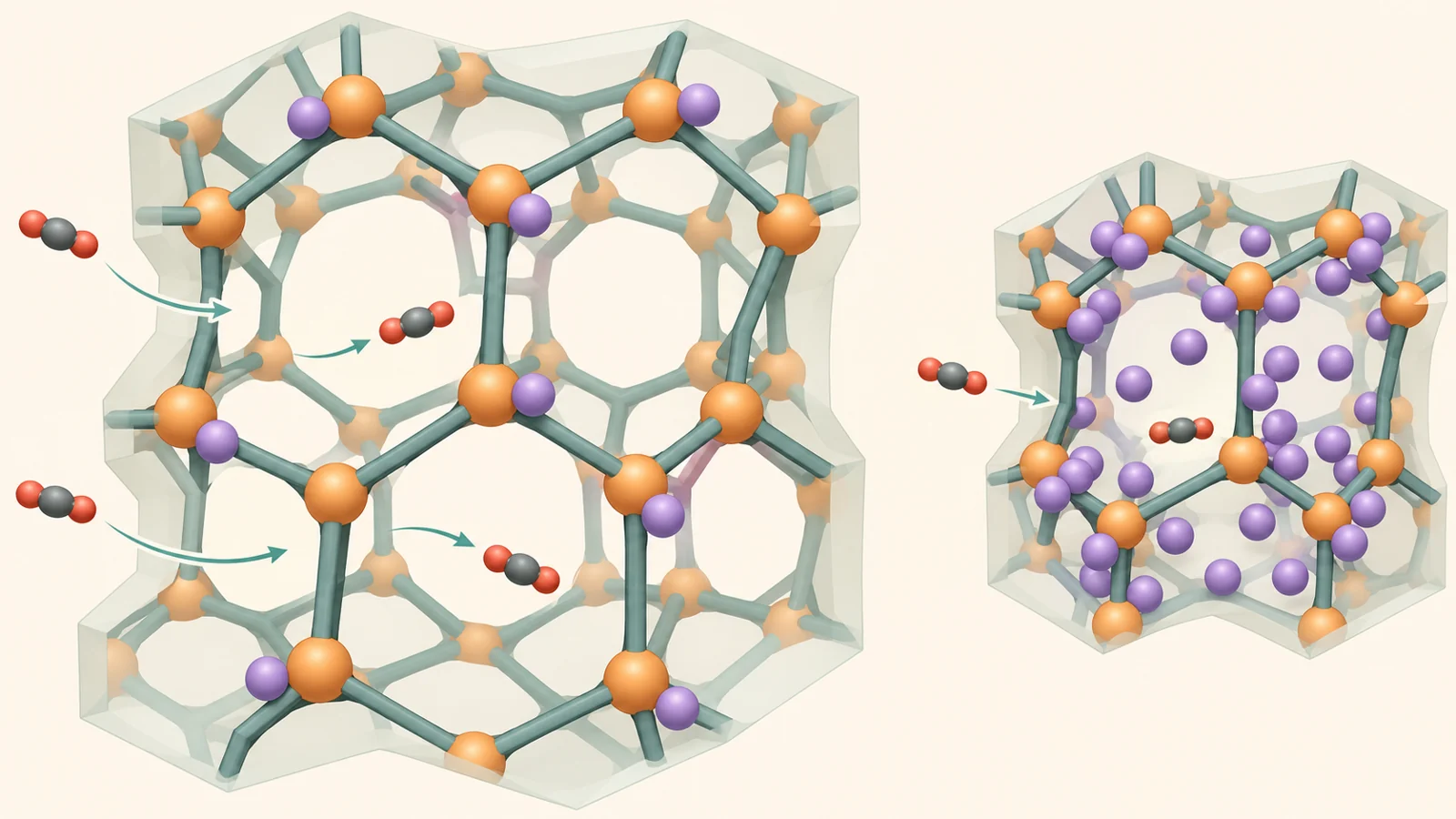
The authors interpret this reversal as a consequence of excess potassium aggregating and obstructing pores. If fewer of the pores remain accessible, CO₂ has less room to enter and be held. This explanation fits the measured decline in surface area and uptake, but it is the authors’ account of the results rather than a direct view of potassium blocking individual pores.
Two kinds of clues support the proposed “rivet” effect
Cu-BTC is a porous metal-organic framework: a solid whose linked components create spaces where gas molecules can enter and interact with the material. The authors propose that potassium ions help preserve this structure and alter how it attracts CO₂. They describe the ions as atomic-scale “rivets,” a useful picture of the proposed role, not a directly imaged structure.
The structural case comes from several measurements. The authors report changes in pore size and volume as potassium content changes, as well as more uniform crystal surfaces and fewer visible defects in the doped material. They interpret these observations as evidence that potassium anchors parts of the framework and restrains structural changes that could otherwise occur during repeated use. The supplied characterization supports changes in structure and morphology, but does not establish every atomic detail of the proposed anchoring.
The electronic measurements provide a separate clue. X-ray photoelectron spectroscopy, a technique that measures signals associated with elements near a material’s surface, showed a change in copper’s measured oxidation-state balance. The authors report that the ratio of Cu⁺ to Cu²⁺ rose from 0.14 in undoped Cu-BTC to 0.36 in the 1:10 sample. They interpret this as evidence that potassium changes the local electronic environment around copper. In their account, that shift may strengthen electrostatic attraction between the framework and CO₂, whose charge is distributed unevenly across the molecule.
Together, the pore and surface measurements make the proposed mechanism plausible: potassium may help shape accessible micropores and alter local interactions with CO₂, while an excessive amount may obstruct those same pores. The evidence connects the material’s measured properties with its uptake. It does not directly capture the full atomic-scale process implied by the “rivet” metaphor.
Reuse is part of the capture challenge
An adsorbent is useful only if it can both take up a gas and release it again. A capture bed would need to collect CO₂ during one part of a process, then give up the captured gas so the material can be used again and the CO₂ can be handled separately. Capacity on a single measurement is therefore only part of the performance question.
For the 1:10 potassium-doped sample, the authors report more than 98% capacity retention after ten adsorption–desorption cycles. That is encouraging evidence that the material maintained its measured uptake over a short repeated-use test. It does not establish long service life: ten cycles cannot show how capacity would change over the much longer operation expected of a capture bed.
The uptake figures also describe a specific laboratory comparison at 0 °C and 1 bar. They show how much CO₂ the samples held under those measurement conditions. They do not establish sustained working capacity in a mixed exhaust stream, where other gases and operating conditions would matter. Nor do they establish the energy use, cost, or overall performance of a complete capture process. A promising adsorbent measurement is one part of that larger engineering task.
What this could change
If the dose-dependent result holds up under more demanding tests, a potassium-modified Cu-BTC could eventually contribute to reusable beds that pull CO₂ from facility exhaust and release it for collection. Capture beds are an existing approach; the potential contribution here is a porous material that, at a particular potassium dose, combined higher measured uptake with encouraging short-cycle retention. Its pore behavior also suggests why finding the right dose matters: too much potassium may close off some of the space the gas needs to reach.
Getting from powder measurements to a dependable bed would require independent process development. One meaningful milestone would be sustained CO₂ working capacity through substantially longer adsorption–desorption cycling in a relevant mixed gas stream. That would begin to show whether the laboratory advantage survives conditions closer to the job a capture material would need to do.
Key Sources
- Primary source: K⁺-Doped Cu-BTC Achieves Doubled CO₂ Adsorption Capacity and Unprecedented Cycle Stability via Atomic-Scale "Rivet" Architecture
DOI or Journal Page · Preprint · 2025-10-29
Keep exploring