
Research Signal – Source date 2024-04-17
Biogas made by fermenting municipal waste contains methane, a useful fuel, alongside carbon dioxide that purification aims to remove. In a 2024 study, researchers tested a newly synthesized porous material called VM-COF on this waste-derived gas. They reported better purification than commercially available activated carbon.
The comparison brings the study closer to a practical cleanup challenge than a measurement of the material alone. But the reported advantage is qualitative in the evidence available here. The results offer a promising material candidate, not a measure of how a full facility would perform.
A porous structure with sites that favor carbon dioxide
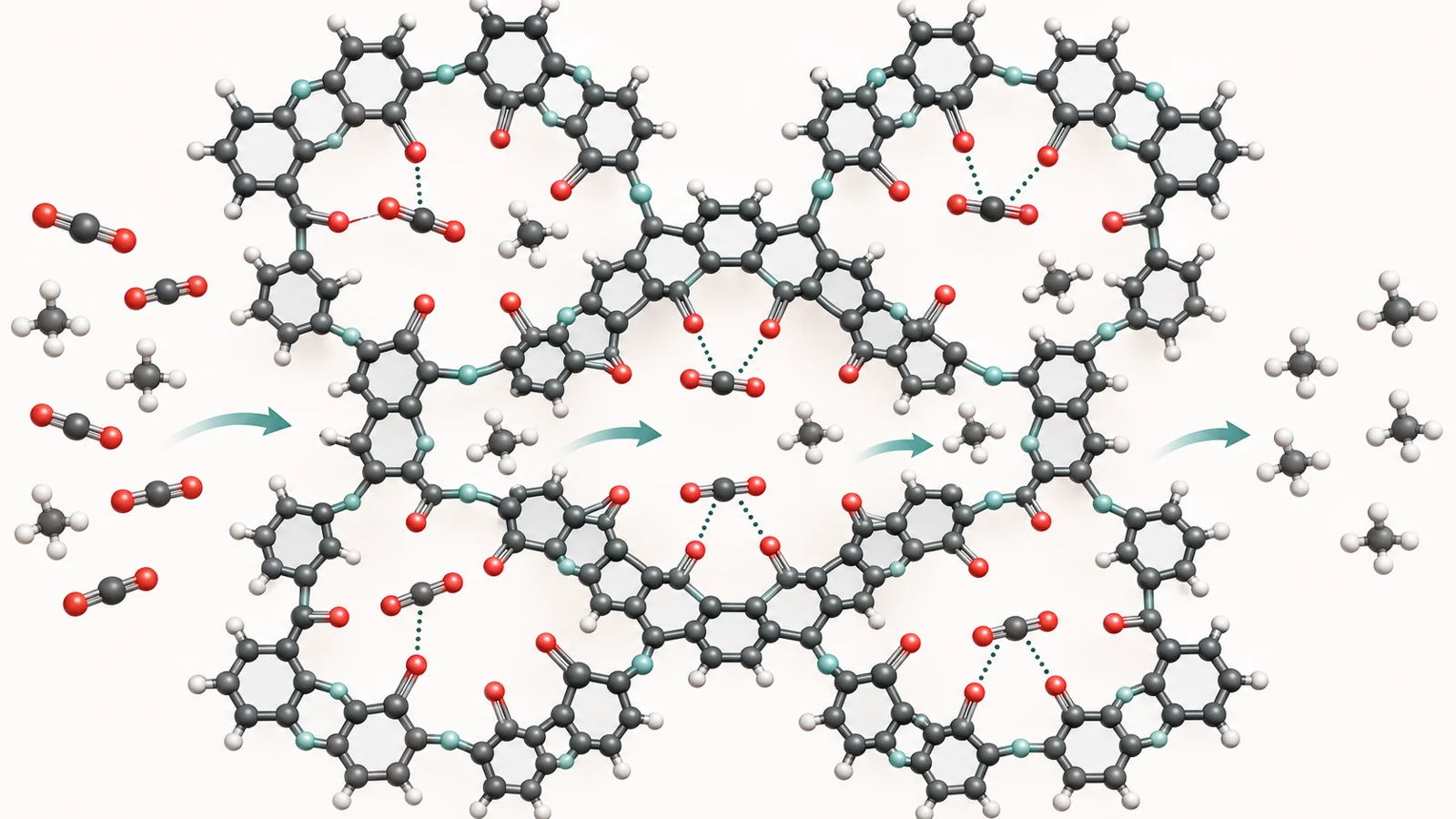
VM-COF is a covalent organic framework, a material built from linked organic molecules into an ordered, porous structure. Its carbonyl-rich sites contain carbon–oxygen double bonds. In the researchers’ model, those sites had stronger carbon dioxide binding than the other carbon-rich sites they examined.
The calculated binding energy at those favored sites was −39.44 kJ/mol. This theoretical result offers a proposed explanation for why the material attracts carbon dioxide. It describes binding at particular sites in a model; on its own, it does not tell us how quickly a bed of material would clean a stream of gas or how much usable methane would pass through under facility conditions.
The researchers also measured a surface area of 1,258 square meters per gram and a carbon dioxide adsorption capacity of 3.58 millimoles per gram at 298 K, or about 25°C. Surface area describes the extensive internal area available across a small mass of porous material. Adsorption capacity measures how much carbon dioxide the material took up under the reported test conditions. Neither figure is the same as selectivity between gases.
Two gas pairs, two different selectivity values
Selectivity describes how strongly a material favors one gas over another in a mixture. Using a calculation method called ideal adsorbed solution theory (IAST), the authors estimated VM-COF’s selectivity for carbon dioxide over methane at 10.9, and over hydrogen at 881.7. These values refer to different gas pairs, so they are not interchangeable measures of one general performance level.
The paper’s abstract says breakthrough analysis experimentally supported the selectivity findings. In a breakthrough test, a gas mixture passes through an adsorbent, and the appearance of each gas at the outlet helps show how the material separates them. This provides experimental support alongside the IAST calculations, though the supplied evidence does not include numerical operating results for the municipal-waste biogas comparison.
The test moved from material measurements to waste biogas
A strong adsorption capacity or gas-pair selectivity does not by itself show how a material handles a real mixture. To take a step toward that question, the researchers used VM-COF to purify biogas produced through the biofermentation of municipal waste. They report that it purified the gas better than commercial activated carbon.
That head-to-head result is relevant because it tests the material against an existing adsorbent on the gas mixture the study set out to address. The available evidence does not quantify the size of the advantage, so it cannot show how much additional carbon dioxide was removed or how much methane was retained compared with activated carbon. It supports the direction of the comparison, not a numerical performance claim.
Stability and operation answer different questions
The authors describe VM-COF as having high thermal and chemical stability. Those material properties matter, but they are not the same as demonstrating reliable operation through repeated treatment and regeneration cycles. A practical evaluation would need to establish how performance holds up as the material is reused and as the biogas composition changes.
Other key questions are how much gas the material can process, how it performs under sustained operation, and what its quantitative advantage over activated carbon would be under comparable conditions. The evidence summarized here does not establish facility-scale throughput, operating economics, deployment, or environmental benefits. Those are questions for process and scale-up evidence, beyond the reported material characterization and qualitative biogas comparison.
How this could shape the future
If the reported binding behavior and selectivity translate into dependable performance in repeated real-biogas tests, a municipal-waste facility could gain another independently validated adsorbent option for removing carbon dioxide before using its methane-rich biogas. Cleanup of biogas is already a practical need; the potential advance here is an additional material choice, with the waste-biogas comparison providing an early bridge from laboratory measurements toward that use.
A nearer milestone would be repeated breakthrough and regeneration testing on real biogas with different feed compositions, alongside a quantitative comparison with activated carbon. That would help show whether VM-COF can maintain useful separation through operation. Reliable performance at useful throughput, and other process advances, would still be needed before this candidate could support a facility-level decision.
Key Sources
- Primary source: Purification of Waste-Generated Biogas Mixtures Using Covalent Organic Framework's High CO 2 Selectivity.
DOI or Journal Page · Peer-Reviewed Paper · 2024-04-17
Keep exploring