
Research Signal – Source date 2023-06-14
Carbon dioxide makes up only a small fraction of ordinary air, so capturing it directly means finding a material that can bind sparse molecules and later release them for collection. In a 2023 study, researchers tested a hybrid sorbent—a material designed to hold CO₂—under conditions relevant to direct air capture. They reported uptake of up to 0.58 millimoles of CO₂ per gram at 298 K, alongside rapid capture and release and cycling stability.
The result addresses two linked questions: can the material take up CO₂ when it is highly diluted, and can it be used again after releasing what it has collected? The experiments offer evidence about this material’s behavior. They do not, by themselves, show how a complete air-capture facility would perform.
A porous host holds the reactive liquid
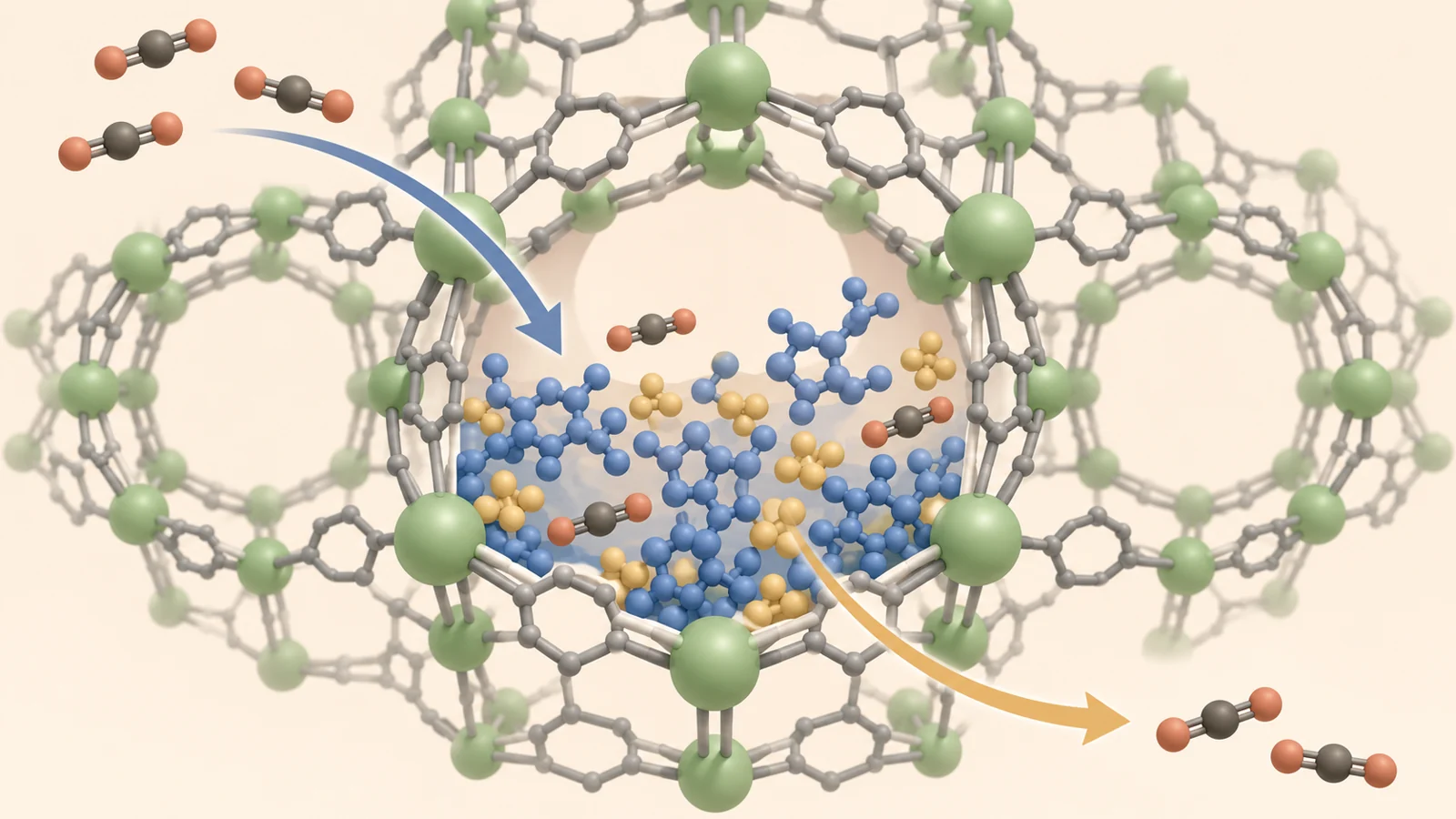
The composite combines a nickel metal-organic framework, or Ni-MOF, with a superbase-derived ionic liquid. A metal-organic framework is a porous solid whose structure contains cavities. Here, those cavities hold the ionic liquid, which supplies reactive sites that interact with CO₂.
The researchers report that the hybrid retained its crystallinity and chemical structure. That matters because the design depends on combining the two components while preserving their reported structural features. The proposed advantage is that the framework can confine the liquid’s reactive sites within its cavities, changing how strongly those sites interact with CO₂.
Two tests probe dilute carbon dioxide
The paper reports two distinct capture assessments. In a low-pressure volumetric measurement at 0.4 millibar, the composite reached an uptake of up to 0.58 millimoles per gram at 298 K. Separately, a fixed-bed test passed gas containing 400 parts per million CO₂ through a bed of material. That concentration makes the test relevant to the challenge of capturing CO₂ from air, where it is dilute.
The uptake figure describes how much CO₂ the material held under the reported measurement conditions. It is not a measure of how much a facility could remove from the atmosphere, nor does the abstract give a direct comparison with a commercial sorbent. The flowing-gas test adds a different kind of evidence: the material was examined as gas moved through a bed, rather than only in a low-pressure volumetric assessment.
Confinement offers a possible explanation
The authors used theoretical calculations and small-angle X-ray scattering to examine the material’s structure and interactions. Together, these support their interpretation that confinement inside the MOF cavities strengthens the interaction between the ionic liquid’s reactive sites and CO₂.
This is a proposed explanation for the hybrid’s performance, rather than the uptake measurement itself. The measured capacity shows how much CO₂ was taken up in the reported test; the calculations and scattering help explain why pairing the porous host with the liquid might improve its interaction with CO₂. The distinction matters because a plausible material-level mechanism does not establish how much energy or equipment a full capture process would require.
Reuse depends on giving the CO₂ back
A capture material must do more than collect carbon dioxide once. It also needs to release the captured CO₂ so it can be gathered separately and the material can be used again. The authors describe the hybrid as having fast CO₂ release, energy-efficient release behavior, rapid capture kinetics and exceptional cycling stability.
Those are promising material-level findings, but the abstract does not provide a numerical regeneration-energy result or enough cycling detail to quantify long-term durability. Without those measurements, the reported release and stability claims cannot tell us how the material would perform through extended operation or how much energy a working process would consume.
The study therefore supports a focused conclusion: the hybrid was tested at low CO₂ pressure and in a 400 ppm flowing-gas examination, and the authors report favorable capture, release and cycling behavior. Judging its contribution to a complete direct air capture process would also require measured regeneration energy, retained capacity across extended cycles, and performance in realistic air streams. Storage, integration with capture equipment and durability outdoors would each need to be assessed separately.
Where this research could lead
If the hybrid retains its capture and release behavior under practical operating conditions, it could become a reusable sorbent inside direct air capture equipment, collecting dilute CO₂ for a separate storage step. The study offers a material design for that possibility, but it does not demonstrate a working facility or a climate benefit.
A nearer milestone is extended testing in realistic air streams that reports both how much capture capacity remains over repeated cycles and how much energy regeneration takes. Those results would help show whether the material’s reported behavior can carry beyond laboratory tests. Storage, system integration and outdoor durability remain separate requirements for any broader use.
Key Sources
- Primary source: Harnessing the Hybridization of a Metal-Organic Framework and Superbase-Derived Ionic Liquid for High-Performance Direct Air Capture of CO 2 .
DOI or Journal Page · Peer-Reviewed Paper · 2023-06-14
Keep exploring