
Research Signal – Source date 2023-05-27
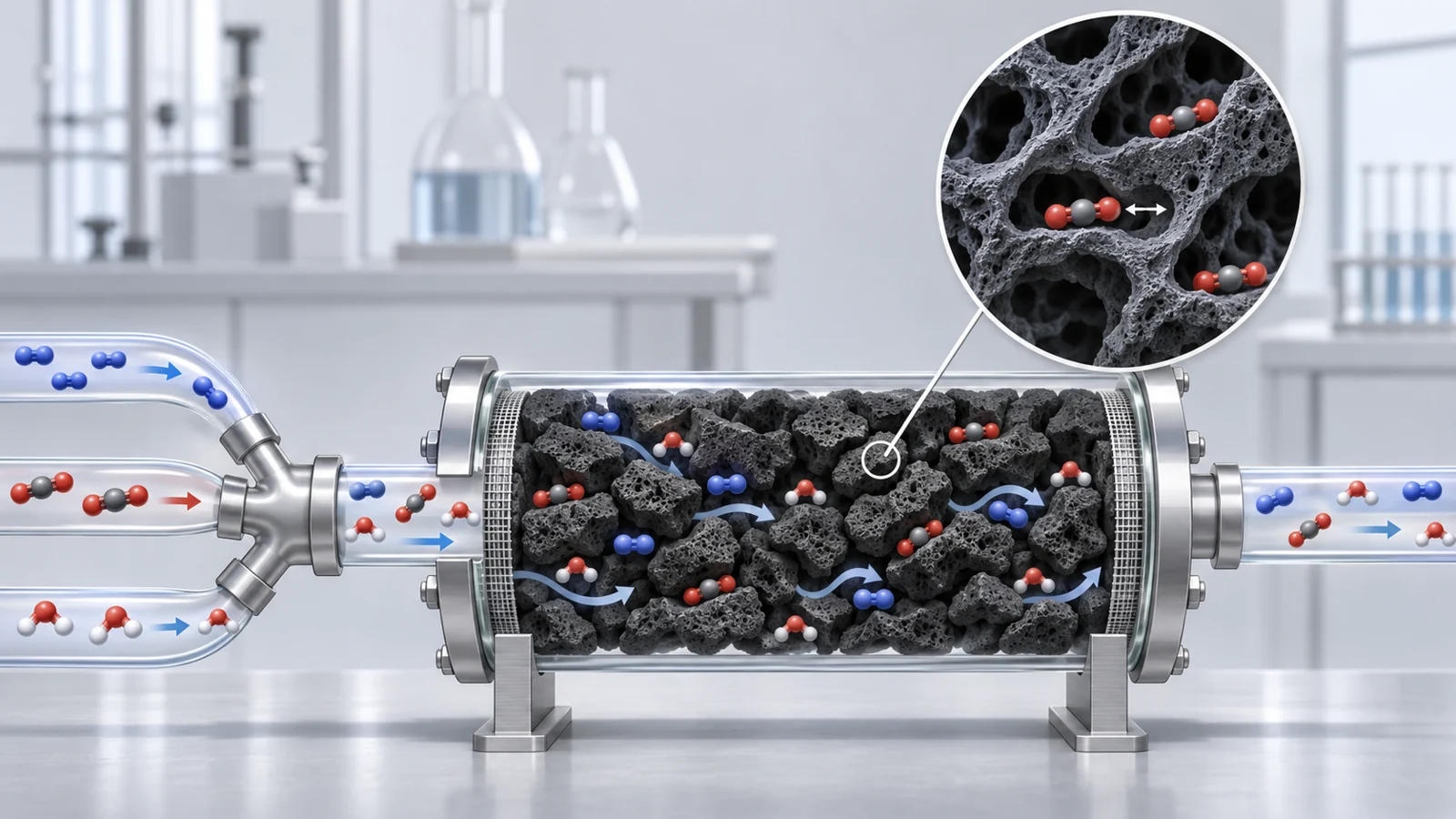
A porous carbon material captured 10.6 cubic centimeters of carbon dioxide per gram in a dry laboratory flow test and 10.0 cm³ per gram when water vapor was present. The close results suggest that moisture did not erase the material’s ability to hold carbon dioxide under those test conditions. That matters because combustion exhaust contains water vapor, which can compete for space in a porous material and complicate separation.
The experiment offers a measured answer in a controlled gas bed, not a demonstration in an operating power plant or industrial exhaust system. To understand what the result does show, it helps to distinguish the study’s flowing-gas tests from its larger headline uptake figure, which came from a different kind of measurement.
A polymer recipe became a nitrogen-rich carbon
The researchers first made porous organic polymers by crosslinking melamine and pyrrole, two nitrogen-containing building blocks. They varied the proportion of melamine to pyrrole, changing the nitrogen content and pore structure of the starting polymers. The polymers were then heated under a flow of nitrogen to 700 °C or 900 °C. This high-temperature conversion, called pyrolysis, transformed them into nitrogen-doped porous carbons: carbon materials with nitrogen incorporated into their structure.
Heating also changed the materials’ pore patterns. The resulting carbons had more micropores, meaning very small pores, than their polymer precursors. Those tiny spaces and the nitrogen-rich structure were design features intended to favor carbon dioxide capture. Across the materials, measured surface areas reached as high as 900 square meters per gram. The best-performing sample in the dynamic separation tests was called NPC101-900.
This design involved more than maximizing one property. Changing the monomer ratio affected both nitrogen content and the balance of small and larger pores; the carbonization temperature also influenced surface area. The study therefore compared related materials produced through different recipes and heating conditions, then tested selected samples for gas uptake and separation.
The largest uptake figure came from a static test
In single-gas adsorption measurements, the researchers exposed the materials to carbon dioxide or nitrogen and measured how much each took up. The highest reported carbon dioxide uptake was 60 cm³ per gram at 273 K (0 °C) and 1 bar, roughly atmospheric pressure. That is a useful measure of how much gas the material can hold under those specified conditions. It is not the amount captured in the later flowing-gas test.
The static measurements also showed much lower uptake for nitrogen than for carbon dioxide in the tested materials. The team used those single-gas results in an Ideal Adsorption Solution Theory model, which estimates how a material might behave with a mixture of gases. This modeled selectivity is a useful step toward assessing separation, but it remains a calculation based on adsorption data. A flowing mixture can reveal behavior that a single-gas measurement or model alone cannot, especially when water vapor is included.
The reported 60 cm³-per-gram maximum was measured at 273 K. The dynamic capacities were measured at 298 K (25 °C) in a different setup and under different conditions. These figures answer different questions, so comparing them directly would not measure the effect of humidity.
A flowing bed showed carbon dioxide breakthrough
For a dynamic test, the researchers placed activated NPC101-900 in a bed and passed a gas mixture through it. The dry feed contained 80% nitrogen and 20% carbon dioxide, a laboratory mixture intended to mimic the proportions of those gases in flue gas. The outlet was monitored to see when carbon dioxide began to emerge. This moment is called breakthrough: the material has retained incoming carbon dioxide for a period, and some starts appearing downstream.
In the dry test, the material’s dynamic carbon dioxide capacity was 10.6 cm³ per gram. The researchers then tested a humid mixture of nitrogen, carbon dioxide and water vapor. Under that wet condition, the measured capacity was 10.0 cm³ per gram, slightly below the dry result. The material still selectively retained carbon dioxide for a period in the humid flow.
This is a more demanding test than measuring uptake from a single gas because the components pass through the bed together. Water vapor can compete with carbon dioxide for adsorption in porous materials. The similar capacities in these particular dry and wet tests are therefore encouraging evidence that the selected carbon retained much of its measured performance in humid laboratory flow. They do not establish how it would behave in a plant, where exhaust composition and operating conditions can vary.
Reuse was tested over more than five cycles
The researchers also measured repeated breakthrough behavior over more than five cycles. In this sequence, the sample was first exposed to a wet nitrogen stream at 91% relative humidity until water saturation was observed. A dry stream containing 20% carbon dioxide was then introduced, and the outlet was monitored for breakthrough. Between cycles, the material was regenerated by passing moist nitrogen through it at 298 K.
NPC101-900 continued to show carbon dioxide capture across the measured cycles. This provides a bounded test of reuse: the material could be exposed, regenerated and tested again without the reported measurements showing a loss of performance over that sequence. The cycle protocol is distinct from the earlier humid mixed-gas breakthrough test. In particular, the cycling sequence used wet nitrogen exposure followed by dry carbon dioxide injection; it should not be read as an extended test under a continuously wet, changing exhaust stream.
More than five cycles provide an initial look at repeatability, not a service-life estimate. A capture bed intended for ongoing use would need to work for much longer periods, through changing gas mixtures and repeated regeneration. The study’s controlled measurements do not establish those operating demands or the energy and cost of meeting them.
From a laboratory bed to exhaust capture
The motivation is practical: existing liquid-solvent capture methods have drawbacks, including energy use, corrosion and solvent degradation, and porous solids are being studied as another approach. But this paper does not provide a verified, process-level comparison between its carbon and liquid-solvent systems. Its results concern a material and controlled gas-separation experiments, rather than a complete capture process with validated energy, cost or safety performance.
Moving from a small controlled bed to an exhaust-capture process would require engineering around realistic gas composition, longer operating periods and the requirements for regeneration. Those questions matter alongside the material’s ability to retain carbon dioxide when water vapor is present. The laboratory result narrows one uncertainty about humid flow; it does not settle how a full system would perform.
What this could change
If nitrogen-doped porous carbon can keep selectively capturing carbon dioxide in humid flow and be regenerated reliably at process scale, an industrial operator could eventually have a dependable solid-bed option alongside liquid-solvent capture. The evidence bridge is the material’s selective uptake in a humid laboratory flow test and its repeated breakthrough behavior over more than five measured cycles. Turning that result into a real choice would still require process engineering and validation beyond this material study.
A nearer sign of progress would be sustained breakthrough and regeneration measurements using a more realistic exhaust mixture over substantially longer operation. That would show whether the promising short tests can hold up under conditions closer to the job a capture bed would need to do.
Key Sources
- Primary source: Design and Synthesis of N-Doped Porous Carbons for the Selective Carbon Dioxide Capture under Humid Flue Gas Conditions.
DOI or Journal Page · Peer-Reviewed Paper · 2023-05-27
Keep exploring