
Research Signal – Source date 2026-04-28
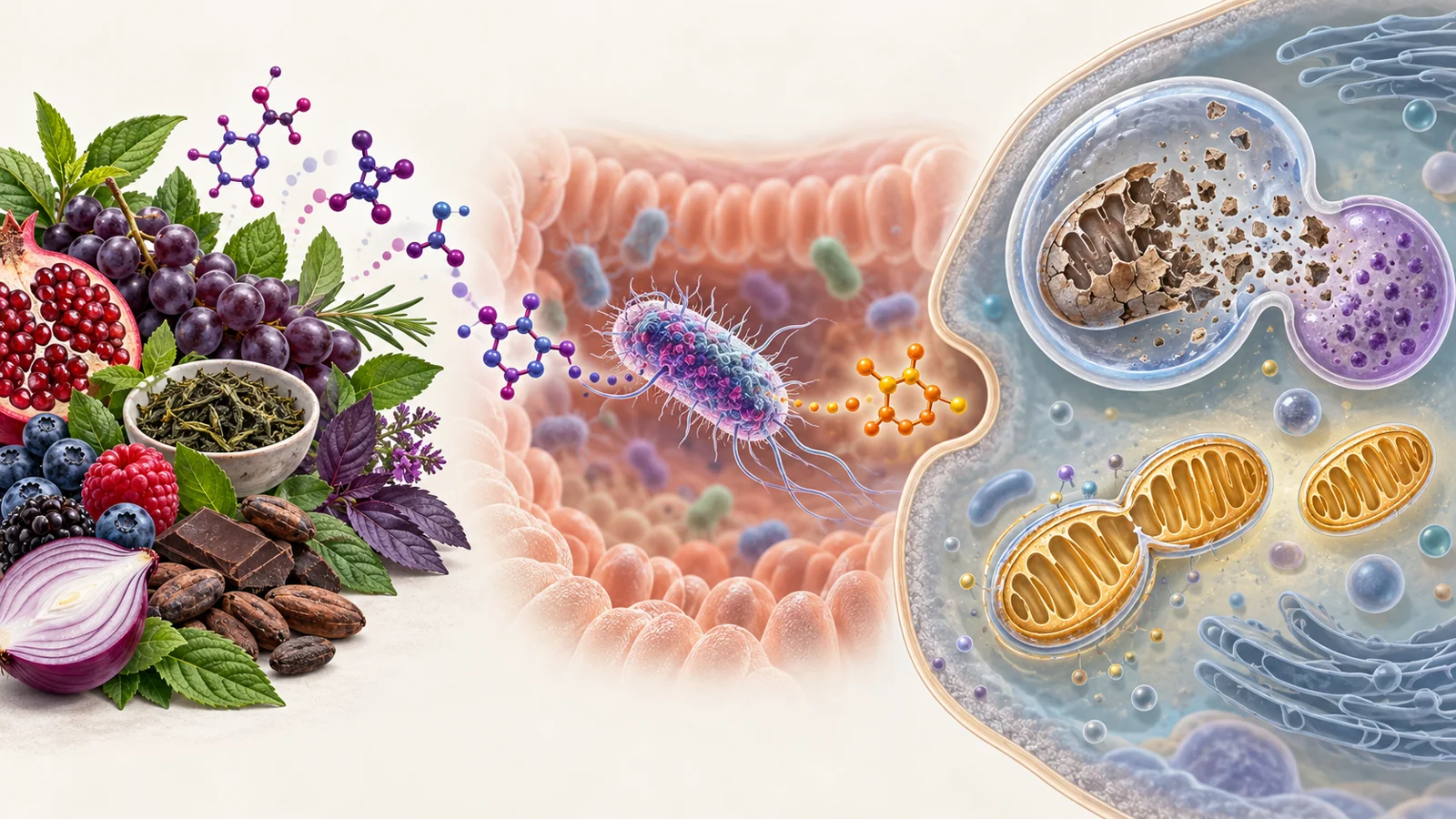
A cell’s mitochondria help produce usable energy, but keeping them functional takes more than making new ones. Damaged mitochondria need to be separated and cleared, while the working network adapts to changing demands. A review published on April 28, 2026, examines how dietary polyphenols may influence this upkeep and how gut microbes can alter the compounds people are exposed to.
The review brings together research on resveratrol, epigallocatechin gallate (EGCG), curcumin, and quercetin. It is a synthesis of existing findings, not a new intervention trial. Its central idea is that mitochondrial quality control links energy production with redox balance, inflammation, and cellular stress. The mechanistic case is broad; whether these effects preserve human function with age is a separate question.
Mitochondrial upkeep means renewal and removal
Mitochondria make ATP through oxidative phosphorylation and also contribute to other cellular work, including buffering calcium. With age, the review describes changes such as less efficient respiration, altered membrane potential, mitochondrial DNA damage, and disrupted organelle turnover. These problems can reinforce one another: impaired respiration and excess mitochondrial reactive oxygen species can add damage, while defective turnover leaves damaged mitochondria in place.
Quality control is a cycle of maintenance. Biogenesis generates new mitochondria and integrates them into the network. Fusion and fission help the network adapt and segregate organelles under stress. Proteostasis maintains proteins inside mitochondria, and mitophagy directs damaged mitochondria for clearance. If renewal slows while clearance falters, simply increasing mitochondrial number would not solve the underlying problem. The aim suggested by the review is a functional network, with both replacement and removal working well.
Different compounds reach the network by different routes
Resveratrol is the clearest example in the review of a polyphenol linked to energy-sensing pathways. Its reported effects include AMPK- and SIRT1-linked signaling and support for PGC-1α, a regulator of mitochondrial biogenesis. The authors caution that the precise molecular sequence remains debated. The functional picture they describe is qualitative renewal and improved metabolic adaptation, not simply more mitochondria.
EGCG and quercetin are associated with biogenic programs too, but the review describes their routes as less direct. Their redox-related effects may help preserve conditions in which mitochondrial proteins, lipids, and renewal processes can function. Curcumin is among the compounds discussed as influencing aging-related signaling, but the review does not present one uniform mechanism shared by all four. AMPK, sirtuins, mTOR, Nrf2, and NF-κB form an interconnected network involving nutrient sensing, stress responses, maintenance, and inflammation. A compound’s effects depend on context and dose; pathway activity in experimental work does not by itself show a whole-body anti-aging effect.
Gut microbes can change which compounds reach the body
Eating a parent polyphenol and producing a bioactive metabolite from it are different steps. Urolithin A makes that difference tangible: it is a gut microbial metabolite formed from ellagitannins and ellagic acid, rather than a parent dietary polyphenol. In the review, urolithin A is a way to understand how a food-derived compound can be transformed before its effects on mitochondrial quality control are considered.
The capacity to produce urolithin A varies among people because microbial communities differ. That variation can help explain why a shared dietary exposure might not yield the same metabolite profile or response in everyone. The review also summarizes human urolithin A studies that reported changes in mitochondrial gene signatures and other measured phenotypes. Those findings are secondary reporting by the review, and measured biological changes do not on their own establish lasting improvements in everyday function.
Redox balance is not a matter of removing all reactive oxygen
Polyphenols are often described as antioxidants, but that shorthand can obscure how cells use reactive oxygen species (ROS). At physiological levels, ROS also carry signals involved in adaptation and stress responses. The review therefore frames the relevant question as whether redox signaling is regulated in context, not whether every source of oxidative activity should be suppressed.
Mild stress can prompt adaptive responses, a concept known as mitohormesis. Persistent ROS imbalance, by contrast, can contribute to damage when production outpaces repair and detoxification. Polyphenol effects may involve recalibrating pathways such as Nrf2, AMPK, and NF-κB, rather than acting as simple chemical sponges. Timing and mitochondrial turnover matter too: the same pathway’s activity may have different implications depending on the cell’s condition and ability to clear damaged organelles.
From laboratory pathways to human function
The distance between a laboratory mechanism and a dietary benefit is substantial. The review notes that cell experiments often use polyphenol concentrations around 10–100 micromolar or higher, while circulating levels after dietary intake are commonly in the nanomolar to low-micromolar range. Absorption is limited for many compounds, and the forms circulating in people are often metabolites or conjugated forms rather than the original parent compound used in experiments. Dietary intake therefore cannot be assumed to reproduce the same exposure or chemical form as a cell study.
Human research also varies in duration, sample size, and study design. Changes in inflammation, oxidative stress, or mitochondrial markers can help researchers understand biology, but they are not equivalent to preserved strength, mobility, or other lasting measures of function. The review presents polyphenols as plausible modulators of aging-associated pathways, while broader clinical evidence remains limited and heterogeneous. Establishing a healthspan benefit would require human studies that connect relevant exposure and biological changes to meaningful functional outcomes over time.
Could gut-aware nutrition help preserve function with age?
A future nutritional approach might account for both the compounds in a person’s diet and the metabolites their gut microbes can produce. If studies identify people who generate relevant metabolites, show a useful mitochondrial response, and sustain a functional benefit, nutrition could become more precisely matched to individual biology. That possibility depends on achievable exposure and clinical evidence linking biological changes to lasting health or function; it is not an established benefit of polyphenol-rich foods today.
Key Sources
- Primary source: Dietary Polyphenols in Aging: A Systems-Level Perspective on Mitochondrial Quality Control and Microbiome Interactions.
DOI or Journal Page · Review or Meta-Analysis · 2026-04-28
Keep exploring