
Research Signal – Source date 2022-02-22
In one reviewed experiment, T cells responded most strongly when antibodies providing two activating signals were attached to the same flexible synthetic polymer. Putting one signal on each of two separate polymers did not produce the same response.
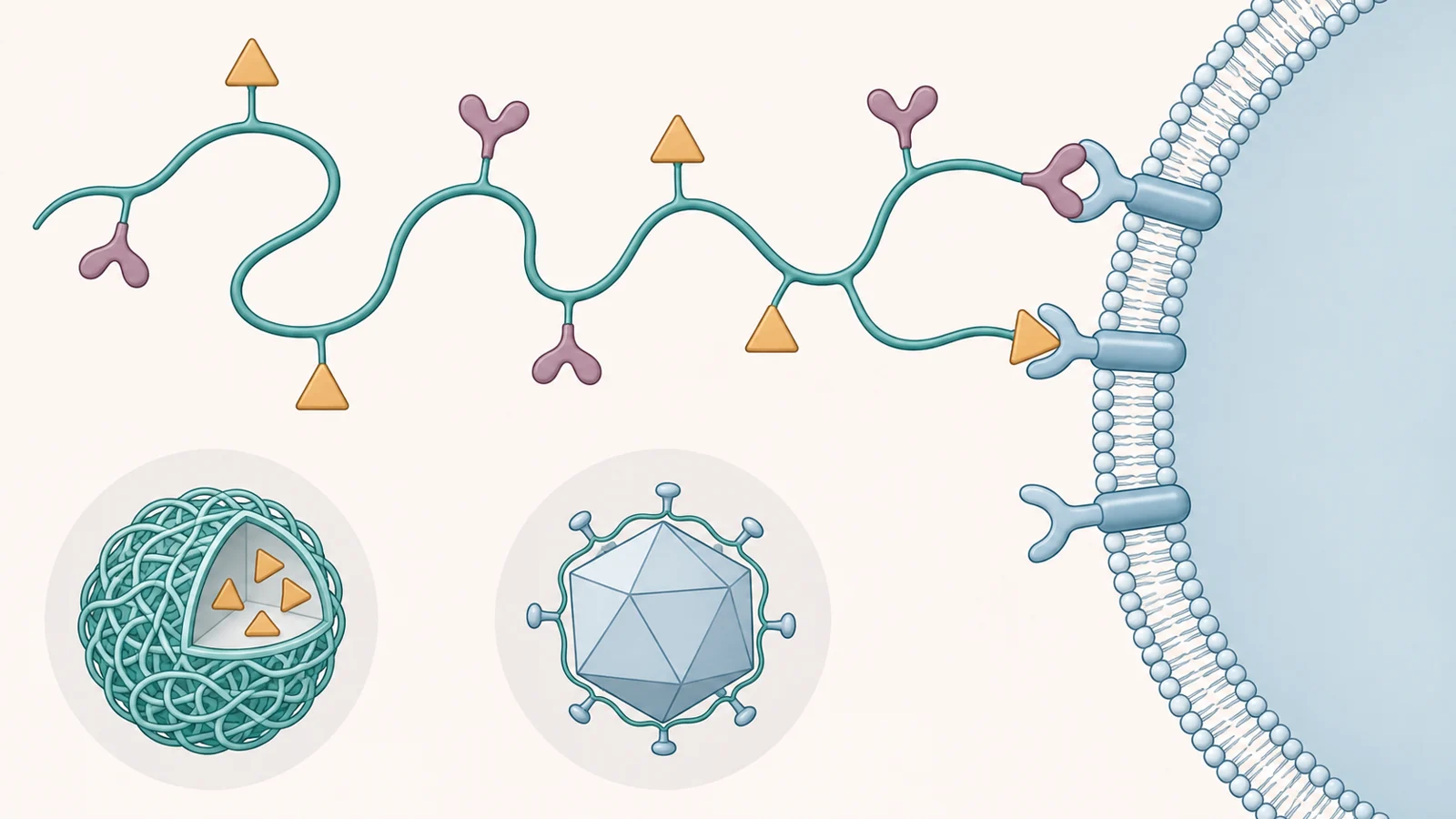
The result points to a quiet but consequential feature of cancer immunotherapy research: materials can affect not only what treatment carries, but how its parts are arranged and where they go. A 2022 review, Polymeric Systems for Cancer Immunotherapy: A Review, brings together experiments in which polymers were paired with checkpoint treatments, engineered T cells, and oncolytic viruses. These are different treatment problems, and the studies do not establish one shared clinical benefit.
One flexible surface carried both T-cell signals
T cells can be activated through molecular interactions that tell them to respond and provide a second, supporting signal. In the experiment described by the review, researchers attached antibodies that engaged these two signals—anti-CD3 and anti-CD28—to a semiflexible polymer about 150–200 nanometers in size. The polymer acted as a synthetic stand-in for some of the interactions normally involved in activating a T cell.
In the mixed T-cell population tested, activation was highest when both antibodies were carried on the same polymer. Using separate polymers, one carrying each antibody, did not improve activation over the polymer carrying anti-CD3 alone. In a comparison using the same amount of antibody, the flexible particles also expanded T cells more effectively than either free antibodies or much larger, spherical particles.
The review’s explanation is about arrangement. T-cell receptors respond to signals presented at the cell surface, and a flexible structure carrying multiple signals together may better reproduce the clustering needed for activation. The experiment suggests that the material’s shape and the co-location of its signals mattered alongside the identity of the antibodies. It does not show that this particular design treats cancer in people.
Checkpoint cargo has to reach relevant cells
Checkpoint inhibitors are immune treatments that block molecular brakes which can restrain T cells. For example, the PD-1 receptor on T cells can bind PD-L1 on other cells, helping limit immune activity. Some tumors can use this interaction to evade T-cell attack. The treatment is the checkpoint blockade; a polymer in these experiments serves a different role, carrying a related cargo toward cells involved in that pathway.
The review describes a preclinical example involving epithelial ovarian cancer cells. Researchers paired PD-L1-targeting small interfering RNA, or siRNA, with a polymer made from polyethylenimine and modified with folic acid. The siRNA is a short genetic instruction designed to reduce production of a selected protein. Folic acid was included to encourage uptake by the cancer cells in this experimental system, while the polymer carried the siRNA.
In the reported cell experiment, this combination delivered the siRNA into the ovarian cancer cells and blocked the PD-1/PD-L1 interaction with T cells, helping those T cells recognize the cancer cells. The example highlights a location problem: an intervention aimed at a suppressive signal has to reach the cells where that signal is relevant. It is a specific experimental approach, not evidence that polymer-delivered checkpoint cargo improves patient outcomes.
CAR-T research shifts the problem to cell preparation
CAR-T therapy uses a patient’s T cells, collected and modified outside the body to carry a receptor that recognizes cancer cells. The cells are activated, genetically modified, multiplied, and then returned to the patient. In this setting, polymer research can focus on preparing the therapeutic cells rather than delivering a checkpoint-related cargo into a tumor.
Researchers have tested positively charged polymers to carry genetic material into T cells. The positive charge helps the polymer bind negatively charged DNA or RNA, forming a package that cells may take up. The review discusses several polymer structures and reports a comparison in Jurkat cells, a human T-cell line. Certain comb-shaped and sunflower-shaped polymers achieved 25–50% transfection in that cell-line comparison, with lower toxicity than some alternatives tested. Transfection means that genetic material entered cells and produced the intended delivery readout.
The same review describes follow-up results in primary T cells for one comb-shaped polymer formulation: average transfection was about 20% with messenger RNA and 10% with plasmid DNA, while cell viability remained above 75% in those experiments. These laboratory measurements help show why polymer structure is being explored for cell preparation. They are not a measure of clinical CAR-T manufacturing performance or patient response.
A virus coating changes where it travels
Oncolytic viruses are designed to infect and destroy cancer cells, with the resulting infection also engaging immune responses. Pairing a polymer with a virus poses a different design challenge from carrying siRNA or modifying T cells: the coating must change how the virus is distributed while leaving its activity intact.
The review describes experiments coating oncolytic adenovirus with polyethylene glycol, or PEG, at two molecular weights: 5 kilodaltons and 20 kilodaltons. In a mouse tumor model, the 20-kilodalton version was associated with lower liver accumulation. Viral gene delivery into liver cells was 19-fold lower than with uncoated virus and 90-fold lower than with the 5-kilodalton coating. The review also reports better survival in mice given the 20-kilodalton-coated virus than in mice given uncoated virus.
Those observations concern a particular virus, coating comparison, and mouse model. They illustrate how changing a material coating can alter distribution and measured outcomes in animals; they do not establish safe or effective systemic delivery in people.
Easier entry can bring a toxicity tradeoff
Many of the polymers discussed for gene or virus delivery carry a positive charge. That charge can help them bind genetic material or form complexes with the negatively charged surface of an adenovirus, supporting uptake into cells. But stronger interaction with cells is not automatically an advantage.
The review notes that polyethylenimine, or PEI, can damage cell membranes because of its cationic charge, and can also disrupt mitochondrial membranes after entering cells. Researchers have explored modifications intended to reduce this toxicity, including attaching other polymers or designing PEI structures that break down under conditions inside cells. The broader lesson is that a useful delivery material has to balance getting cargo into the right cells with avoiding harmful effects on cells and organs.
The evidence in the review comes from different kinds of experiments: cell activation comparisons, gene-delivery tests in a T-cell line and primary cells, cancer-cell experiments, and mouse tumor models. The treatments, materials, and measured outcomes differ. These findings cannot be combined into a single estimate of how much polymers improve cancer treatment, and they do not identify one best polymer for all three treatment classes.
Where this research could lead
Materials that arrange immune signals together, carry genetic instructions into selected cells, or alter where a virus travels could eventually give researchers more control over how immune treatments are prepared and delivered. If those designs prove reliable beyond the specific laboratory and animal experiments reviewed here, they could help make some therapies more precise or easier to manufacture. A meaningful milestone would be showing that a material’s intended advantage persists in relevant human treatment settings while keeping toxicity and whole-body effects acceptable. The 2022 review describes early steps toward that capability, not its arrival in clinical care.
Key Sources
- Primary source: Polymeric Systems for Cancer Immunotherapy: A Review.
DOI or Journal Page · Review or Meta-Analysis · 2022-02-22
Keep exploring