
Research Signal – Source date 2021-08-22
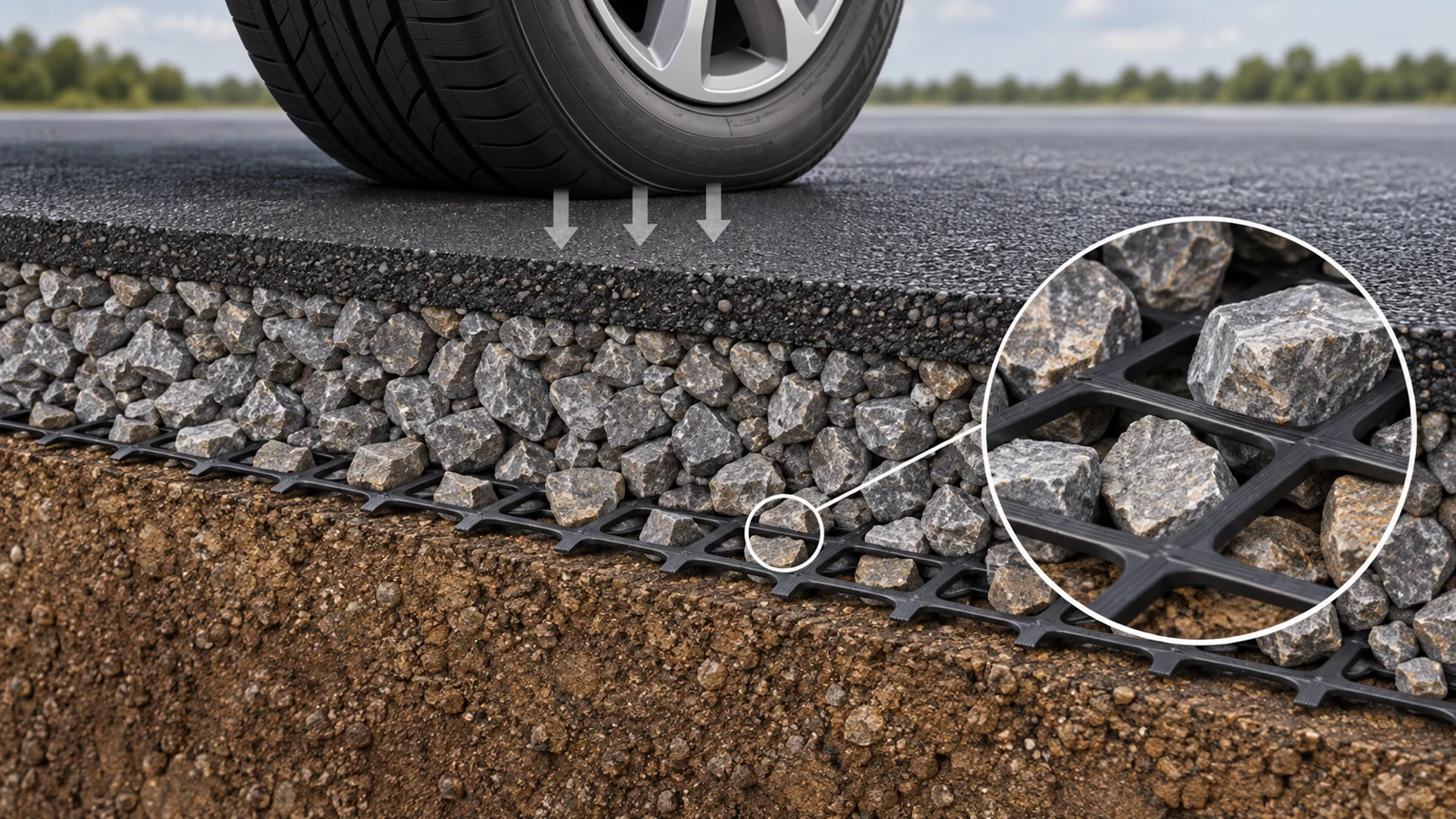
A lightweight polymer grid seems an unlikely foundation for heavy traffic. Much of its area consists of holes, and its narrow ribs look insubstantial beside the stones surrounding them. Yet those openings help explain how it works. Stones engage with the grid, creating a reinforced granular layer that can resist movement under loading.
These open reinforcing structures are called geogrids. An integrative review published on August 22, 2021, brings together research on their materials, geometry, mechanical behavior and applications. Its contribution is to connect features often examined separately, from the polymer within a rib to the response of an entire pavement. The authors collected more than 160 papers during their literature search, selecting material relevant to the review’s sections.
The resulting picture spans laboratory tests, numerical models, pavement experiments and observations from operating infrastructure. It also includes an emerging possibility: a buried grid could carry sensors that reveal where deformation is occurring. Understanding that prospect starts with what happens when stones meet an open mesh.
The openings do part of the work
The granular material beneath pavement is called aggregate. When aggregate enters and engages a geogrid’s openings, or apertures, the particles and grid can act together. Contact with the ribs transfers forces into the reinforcing structure, while the junctions connect those ribs. This interaction helps restrain movement of the surrounding material.
The size of the openings matters because particles must be able to engage them. In one study discussed in the review, researchers tested coated polyester grids with five aperture sizes. Small openings interfered with interlocking and produced highly scattered pullout results. At the other extreme, larger openings reduced frictional interaction. Pullout resistance measures how strongly the surrounding material holds a grid when it is drawn through that material. The study also found that the density of transverse ribs influenced this resistance.
That explains why a grid’s strength in isolation cannot fully describe its reinforcing ability. The openings must suit the granular material, and the ribs must transfer the resulting forces. Junctions deserve particular attention because changes in thickness and local material structure can concentrate stress. Some tensile experiments summarized in the review found failure mainly at joints and edges rather than along the ribs.
Direction adds another dimension. In a soil-slope example discussed in the review, uniaxial grids served as the primary reinforcement. Biaxial grids have ribs aligned in two perpendicular directions. But forces in a parking area or construction site need not align neatly with either set of ribs. A numerical study discussed in the review found the lowest tensile strength and stiffness for the biaxial grid examined when loading was applied at 45 degrees to its manufacturing direction.
Triangular, triaxial arrangements offer a more nearly uniform response across directions, which makes them relevant to pavement foundations. That is a useful geometric distinction, without establishing one arrangement as the best choice for every application.
A brief pull cannot reveal years of stretching
A tensile test can show how a grid responds as it is pulled. A buried reinforcement may also spend years carrying sustained loads. During that time, a polymer can continue to deform even if the load remains steady. This gradual deformation is called creep.
The review describes substantial differences between polymers. In the comparisons it discusses, polyester, commonly abbreviated PET, resisted creep elongation better than polyethylene and polypropylene. Tests comparing high-density polyethylene with PET found substantially greater strain in the polyethylene grid. Strain describes deformation relative to the material’s original dimensions.
Temperature changes this behavior too. In a study of coated PET grids loaded to 65% of their ultimate load, higher temperatures increased both the rate of creep and the accumulated strain. Increasing temperature and load also shortened the time to rupture. A material that performs well in a quick pull therefore still needs a separate assessment of deformation under sustained loading and the temperatures it will experience.
Even the loading arrangement can change the comparison. Tests discussed in the review found greater stiffness under loading in two directions than in one during constant-rate stretching, while sustained-load tests showed the opposite ordering. Immediate stiffness and long-term resistance to deformation answer different engineering questions.
What pavement comparisons actually measured
The mechanical explanation becomes more tangible when researchers measure whole pavement sections. One study summarized in the review compared full-size sections reinforced with a multi-axial geogrid against thicker, unreinforced sections. Dynamic loading simulated highway traffic.
Pressures measured in the base and underlying soil were equivalent between the reinforced and thicker unreinforced sections. Yet the unreinforced sections showed significantly greater subgrade deflection and tensile strain. Deflection records movement of the foundation; tensile strain records stretching. Taken together, these measurements show that similar measured pressures can accompany different amounts of deformation. In this experiment, the reinforced structure moved and stretched less under the applied loading.
An operating highway project provided a different kind of observation. Its modified design used geogrid reinforcement in place of a cement-treated granular base. After two years of service, the reinforced section had an average International Roughness Index 14% lower than the unreinforced section. Measurements used smartphone-based technology, and roughness was also more uniform along the reinforced section.
The roughness index describes unevenness in a road’s longitudinal profile and relates to ride quality. The 14% result is therefore a project-specific observation about the road surface after two years. It does not translate into a 14% increase in pavement life. Whereas the controlled experiment measured structural response to imposed loads, the highway observation captured a surface outcome after exposure to traffic and weather.
Together, these examples connect reinforcement to measurable pavement behavior. They also leave the scale of any thickness reduction to the particular pavement design; neither supplies a universal reduction that can be applied to other roads.
A buried grid could also report strain
Once reinforcement is underground, observing its deformation becomes difficult. The review describes two approaches that could make the grid itself a platform for measurement.
One uses electrically conductive coatings. Carbon black particles added to a polymer coating create conductive pathways whose resistance changes as the material deforms. Experiments discussed in the review measured grid strain up to 20% using sensor-enabled geogrids. This provides a way to turn stretching into an electrical reading.
Interpreting that reading under soil is a further challenge. Tests that included confining pressure found increased variability in the response. Other reported results linked sensitivity to temperature, measurement length and strain rate. Those influences matter because an electrical change needs a dependable relationship to the deformation being measured.
Optical approaches use fibers attached to or incorporated into the reinforcement. Strain changes properties of the light traveling through the fiber, allowing measurements along the buried structure. Studies summarized in the review demonstrated remote strain measurement and localization of regions where damage may have occurred. In another example, fiber Bragg grating sensors captured increasing strain and survived a year of monitoring.
Localization adds something that a single overall measurement cannot provide: an indication of where movement is concentrated. But detecting strain and locating an affected region are distinct from predicting failure. The demonstrations support ways to observe buried reinforcement; dependable failure warnings would require a further connection between those observations and the behavior of the infrastructure.
Durability evidence runs on different clocks
The review’s long-term evidence includes both materials recovered from working structures and laboratory attempts to accelerate aging. These approaches reach into different parts of the durability question.
In one retaining-wall demonstration in the southwestern United States, polyethylene geogrids recovered after 11 years showed minimal mechanical or physical degradation. Another investigation retrieved reinforcement from a soil slope after 11 years and found properties nearly identical to newly produced samples. A separate reinforced earth wall study reported minimal degradation after 36 years. These are observations after elapsed service under the conditions of those structures.
Accelerated aging compresses the investigation by exposing specimens to conditions intended to speed degradation, then estimating behavior under less severe conditions. The review gives a striking example involving polypropylene grids. High-pressure oxygen autoclave tests produced estimated lifetimes of roughly 65 years at ambient conditions, while oven aging in normal air produced estimates exceeding 2,000 years.
Those numbers are predictions from different test methods, not observed service lives. The review explains that the methods were not equivalent, with nonlinear effects of oxygen pressure contributing to the discrepancy. The enormous spread shows how strongly a lifetime estimate can depend on the relationship assumed between accelerated exposure and ordinary aging.
Field retrieval anchors the discussion in what has actually happened over years or decades, but a successful wall or slope does not provide a lifetime guarantee for every buried grid. Likewise, a sensor surviving one year answers a narrower question than whether its measurements will remain dependable throughout a road’s life. Material preservation, pavement roughness and sensor survival are separate outcomes measured over different periods; combining them into one durability claim would obscure what each investigation established.
What this could change
If reinforcement can reliably limit deformation over the required service period, road designers could use it to achieve specified performance with thinner pavement structures in suitable settings. The full-size comparisons give a concrete reason to investigate that possibility: reinforced sections showed lower deformation than thicker unreinforced sections under the tested loading. Translating that result into a road design would require evidence appropriate to the intended foundation and service conditions.
Reliable integrated sensing could add a second capability. Measurements that locate developing ground movement could help infrastructure operators direct inspections toward affected areas, giving them information about reinforcement that is otherwise hidden beneath the surface. From the 2021 perspective, that prospect depends on sensors maintaining a useful relationship between their readings and buried strain over time. Reinforcement and measurement could then serve complementary purposes—helping a foundation carry traffic while making its movement easier to observe.
Key Sources
- Primary source: Polymer Geogrids: A Review of Material, Design and Structure Relationships.
DOI or Journal Page · Review or Meta-Analysis · 2021-08-22
Keep exploring