
Research Signal – Source date 2021-02-03
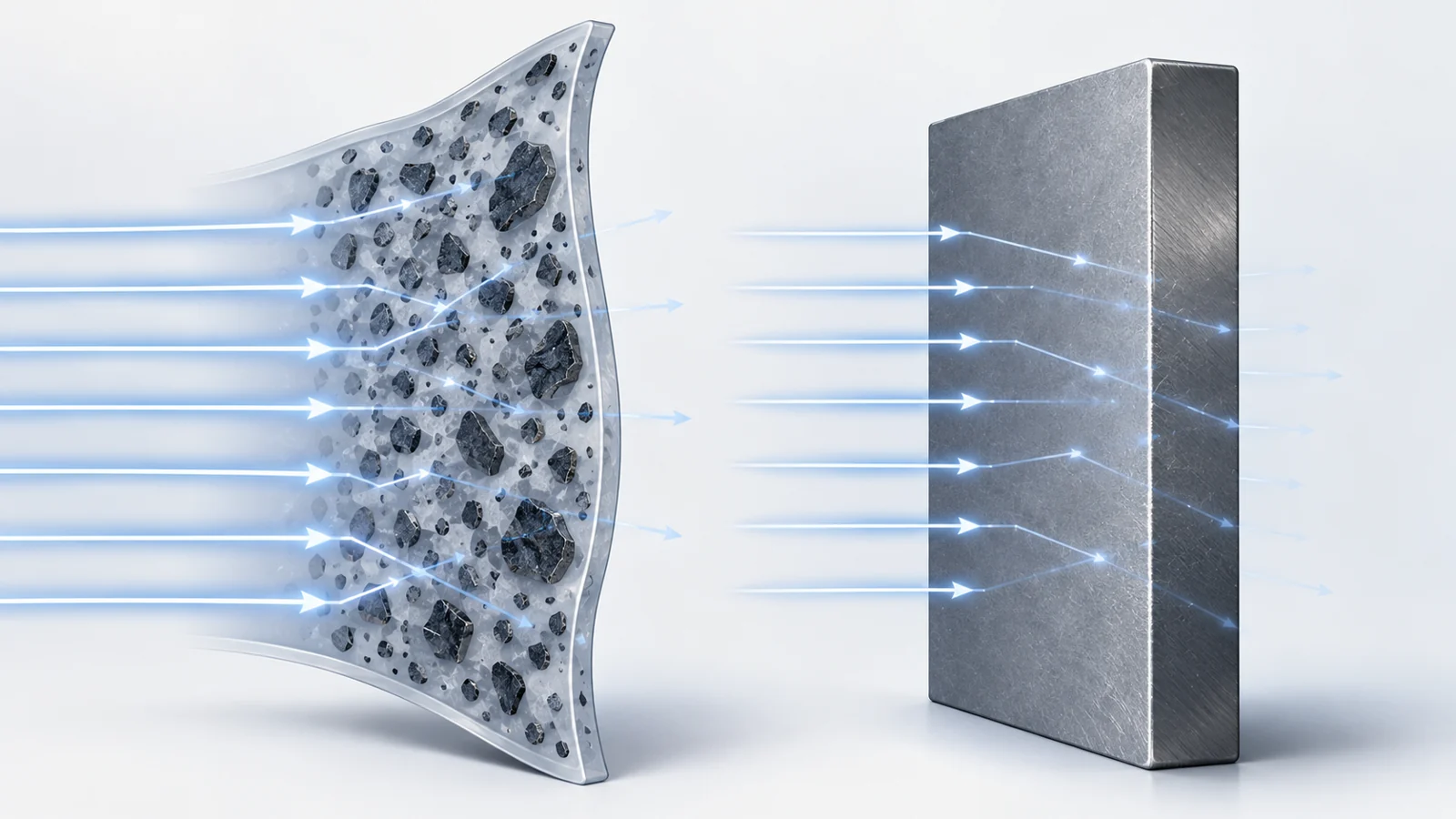
A flexible sheet made from polyethylene and loaded with 45% tungsten by weight had X-ray absorption comparable to a rigid lead sheet in a study cited by a 2021 review. The polyethylene composite also weighed less in that comparison. It is a striking result, but it describes one formulation and one reported comparison—not a general match between plastic shields and lead.
The review, published on February 3, 2021, brings together studies of polymer composites for radiation shielding. Its examples show why the choice of material depends on the radiation being blocked, how much filler is mixed in, and the thickness and energy conditions used to assess performance.
A polymer gives the material its shape
A polymer is a material made of long, bonded molecules. Polyethylene is a familiar example. Polymers can be light, flexible, and shaped during processing, but a polymer on its own may not absorb highly energetic radiation effectively. The review describes adding a filler—a second material mixed into the polymer—to change the composite’s shielding and physical properties.
For gamma rays, the review discusses fillers with a high atomic number. Atomic number is the number of protons in an atom’s nucleus; elements with a high atomic number, such as tungsten, bismuth, and lead, have relatively heavy nuclei. The cited polyethylene sheet used tungsten, while other reviewed examples combine polymers with metal oxides or other dense materials. The aim is to pair the polymer matrix, which provides a workable form, with ingredients selected for the radiation involved.
Neutron shielding calls for a different material choice. The review describes lower atomic number constituents as preferable for neutron attenuation, and discusses polymers and composites designed to absorb fast neutrons. A recipe suited to gamma rays therefore cannot be assumed to work equally well for neutrons. The review does not identify one composite as best for both.
What a shielding comparison measures
A useful way to compare shielding is the half-value layer, or HVL: the thickness of a material needed to reduce a specified radiation beam to half its initial intensity. A lower HVL means less of that particular material is needed to halve that beam under the stated conditions. In selected comparisons summarized by the review, composites with dense fillers had lower HVL values as filler loading increased.
That measurement helps explain why a composite may perform differently as its ingredients change. But a shielding claim needs its conditions alongside it. Radiation energy affects the result, as do filler amount and shield thickness. The tungsten–polyethylene and lead comparison is evidence for those specific materials under the cited test conditions; it does not show that the plastic sheet equals or exceeds lead at every energy, thickness, or setting.
Small particles change the mix
Filler size and distribution matter too. The review cites a low-energy X-ray comparison of tungsten oxide in polyvinyl chloride (PVC): the sample with nanostructured tungsten oxide blocked more X-rays than samples using microsized tungsten oxide. “Nano” refers to particles much smaller than a micrometre-scale filler. The review points to the large surface area of nanoparticles and their interactions with the surrounding polymer as ways nanofillers can alter a composite’s properties.
Making use of very small particles depends on getting them dispersed through the polymer rather than gathered into clumps. The review describes an in-situ synthesis approach in which nanoparticles form within the polymer matrix, a method that can help control particle growth and distribution. This is a fabrication consideration, not evidence that every nanocomposite will shield better: results depend on the filler, its amount, the polymer, and how the material is made.
Recycled plastic poses a separate question
The review also considers whether processed or post-consumer plastics can serve as composite matrices. One cited line of work made composites from recycled high-density polyethylene and lead oxide, using either nanoparticle or bulk filler. Those materials were investigated for possible gamma-ray shielding.
Reusing polyethylene and demonstrating shielding performance are separate questions. A composite’s potential use of recycled material does not by itself establish a net environmental benefit; that requires evidence about the material’s production, use, and end of life. Likewise, the reviewed work does not establish routine protection of people by these recycled shields. Their composition and shielding performance need to be assessed for the intended conditions.
The evidence in this 2021 paper is a synthesis of varied prior studies, including measurements and calculated shielding properties. The individual comparisons belong to the studies the review cites. Together, they illustrate design options and trade-offs, but they do not establish a single best shield across radiation types or demonstrate use in routine medical or industrial settings.
Where lighter radiation shields could fit
Lighter, moldable composite sheets could be useful in medical or industrial settings where the weight or shape of conventional barriers constrains their use. The cited tungsten–polyethylene comparison shows one possible route: combine a formable polymer with a selected shielding filler. Whether that capability becomes useful in a particular setting depends on showing adequate protection for the radiation and thickness involved, as well as workable material properties and safe handling.
Key Sources
- Primary source: Polymeric composite materials for radiation shielding: a review.
DOI or Journal Page · Review or Meta-Analysis · 2021-02-03
Keep exploring