
Research Signal – Source date 2021-03-17
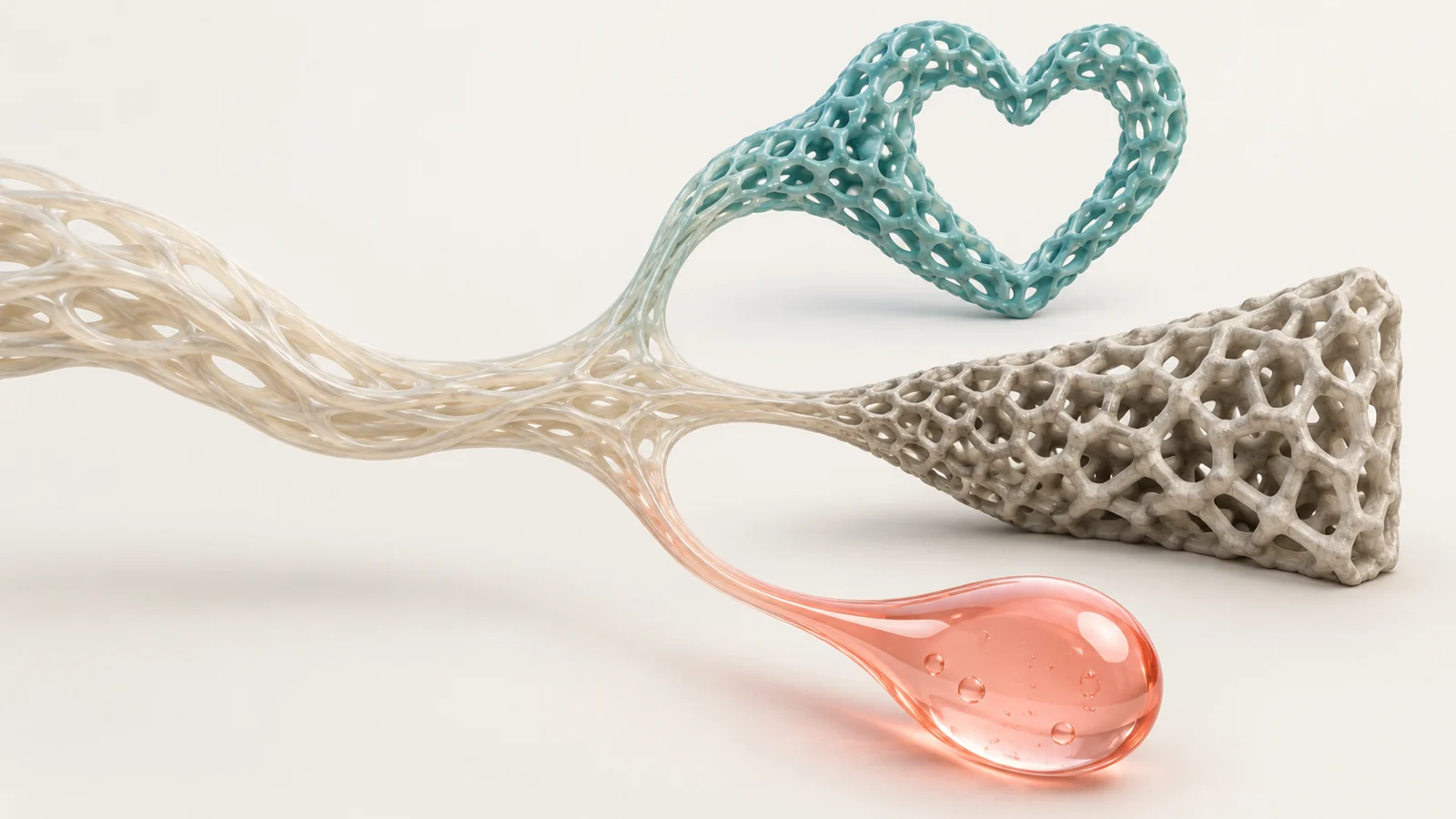
Poly(glycerol sebacate), or PGS, starts with a useful tension: it is a biodegradable material that can stretch and recover, yet the tissues it might support have very different mechanical demands. A soft cardiac patch, a firmer bone scaffold and a drug-carrying gel cannot simply be made interchangeable by choosing the same polymer.
A 2021 review of recent PGS research describes how changes in ingredients, curing and fabrication can produce materials with markedly different properties and shapes. The examples range from porous scaffolds to printable structures and injectable gels. The examples show what researchers have made and measured in the lab, with some animal results; they do not establish clinical benefit.
Small recipe changes can shift stiffness
PGS is made by joining glycerol and sebacic acid into a linked polymer network. Both starting materials occur naturally in the body, but that fact alone does not determine how a finished PGS material will behave or how it will degrade. The degree of chemical linking, or cross-linking, helps set its properties. In plain terms, cross-linking creates connections between polymer chains, like joining strands into a network.
The review reports that changing the curing time alone produced Young’s modulus values—a measure of stiffness—between 0.77 and 1.9 megapascals in the cited PGS work. Changing the proportions of the starting ingredients broadened the reported range to 0.01–5 megapascals. Those figures illustrate why “PGS” does not describe one fixed stiffness: processing choices can matter as much as the material name.
The usual production route helps explain the challenge. First, glycerol and sebacic acid are heated to form a prepolymer. Then that material is cured under vacuum at high temperature, typically for at least 48 hours at 120°C, to build the cross-linked network. This lengthy, hot second step can make pure, unmodified PGS difficult to process into a finished shape.
Chemical modification offers another route. In one example, adding light-reactive groups to the prepolymer created a version that could be cured by photopolymerization in minutes. This is a fabrication advantage: a quicker cure can make it easier to shape a material. It does not, by itself, show that the resulting scaffold performs better in the body.
Pores, fibers and printed layers change the structure
A scaffold’s architecture matters alongside its chemistry. One basic method mixes prepolymer with salt particles. After curing, the salt is removed, leaving pores in the material. By changing the amount of salt, researchers can alter the resulting pore structure. The review describes this approach in both soft-tissue and bone-oriented scaffold work.
Making fibers brings a different obstacle. PGS on its own does not readily form stable fibers by electrospinning, a process that uses an electric field to draw fine strands from a solution. The uncured PGS solution is too runny for the fine fibers to remain separate; cured PGS does not dissolve in the solvents used for spinning. Researchers therefore blend it with a carrier polymer that can be spun, or form it within a removable outer layer. The resulting fiber mat is a product of the combination and process, not of PGS alone.
Printing can also tune a scaffold’s measured mechanical properties. In a reviewed example, a photocurable PGS-based ink was extruded in layers. The printed scaffolds had Young’s moduli of 310 kilopascals at lower printing density and 480 kilopascals at higher density; the cast comparison samples measured 740 kilopascals. Printing density also changed how far the samples stretched before breaking. These are measurements of particular structures made with a particular ink and process, not a general ranking of printed and cast PGS.
A heart patch and a bone scaffold ask for different compromises
For a heart patch, flexibility matters because the heart moves. The review describes a 3D-printed scaffold made from PGS, another polymer called polycaprolactone, and salt particles that help form pores. In a rat model, that scaffold was associated with preserved heart function, a thicker wall in the heart’s main pumping chamber, a smaller area of damaged tissue and more blood-vessel growth. These findings concern that particular scaffold in rats; they do not show that a PGS patch repairs human hearts.
Bone-oriented materials face a different design problem. A scaffold intended to support bone growth may need more stiffness than a soft cardiac structure. The review describes PGS composites reinforced with materials such as bioactive glass, nanosilicates and nanohydroxyapatite. In cited work, reinforcement could raise stiffness or tensile strength, but the tradeoffs varied. For example, adding nanohydroxyapatite increased elastic modulus and tensile strength while reducing flexibility and accelerating degradation.
The relevant choice is therefore not simply “more strength.” A stiffer material may fit one design goal while sacrificing flexibility or changing how quickly it breaks down. The findings for any one filler and scaffold cannot be carried over to every PGS formulation.
An injectable gel can release a drug in stages
PGS-based materials can also be made as hydrogels: water-rich networks that can hold and release a drug. The review describes an injectable PGS-based hydrogel that became more liquid during injection and returned to a gel afterward. In a test outside the body, the gel released the anticancer drug doxorubicin in two phases. The drug first moved out mainly by spreading through the gel; later release accompanied the gel’s breakdown.
The observed release pattern does not show that the gel can deliver doxorubicin safely or effectively in people.
What the review’s evidence can tell us
The review reports a Web of Science and Scopus search using PGS-related keywords, covering papers dated 2015–2021, with about 241 papers found. That is a search total, not the number of studies included in a single standardized analysis. The review brings together varied formulations, fabrication methods and experiments, including mechanical measurements, cell-culture work, in vitro drug-release tests and rat implantation.
This breadth helps show how researchers have approached different design problems, but it also means results should be read in context. A mechanical value from one printed geometry, a cell response to one composite or an animal result for one cardiac scaffold cannot establish how another PGS design will behave. The review documents a range of experimental directions, not a single test of clinical effectiveness.
What tailored scaffolds could mean for tissue repair
A biodegradable scaffold shaped and mechanically matched to a repair site could eventually give tissue engineers more ways to support different kinds of healing. For the heart, that could mean a patch designed to accommodate repeated movement; for bone, a structure with greater stiffness. Realizing those possibilities depends on reliable fabrication and on demonstrating meaningful safety and functional benefit in people. The reviewed experiments outline design options, while those practical and clinical questions remain open.
Key Sources
- Primary source: Poly(Glycerol Sebacate) in Biomedical Applications-A Review of the Recent Literature.
DOI or Journal Page · Review or Meta-Analysis · 2021-03-17
Keep exploring