
Research Signal – Source date 2023-05-11
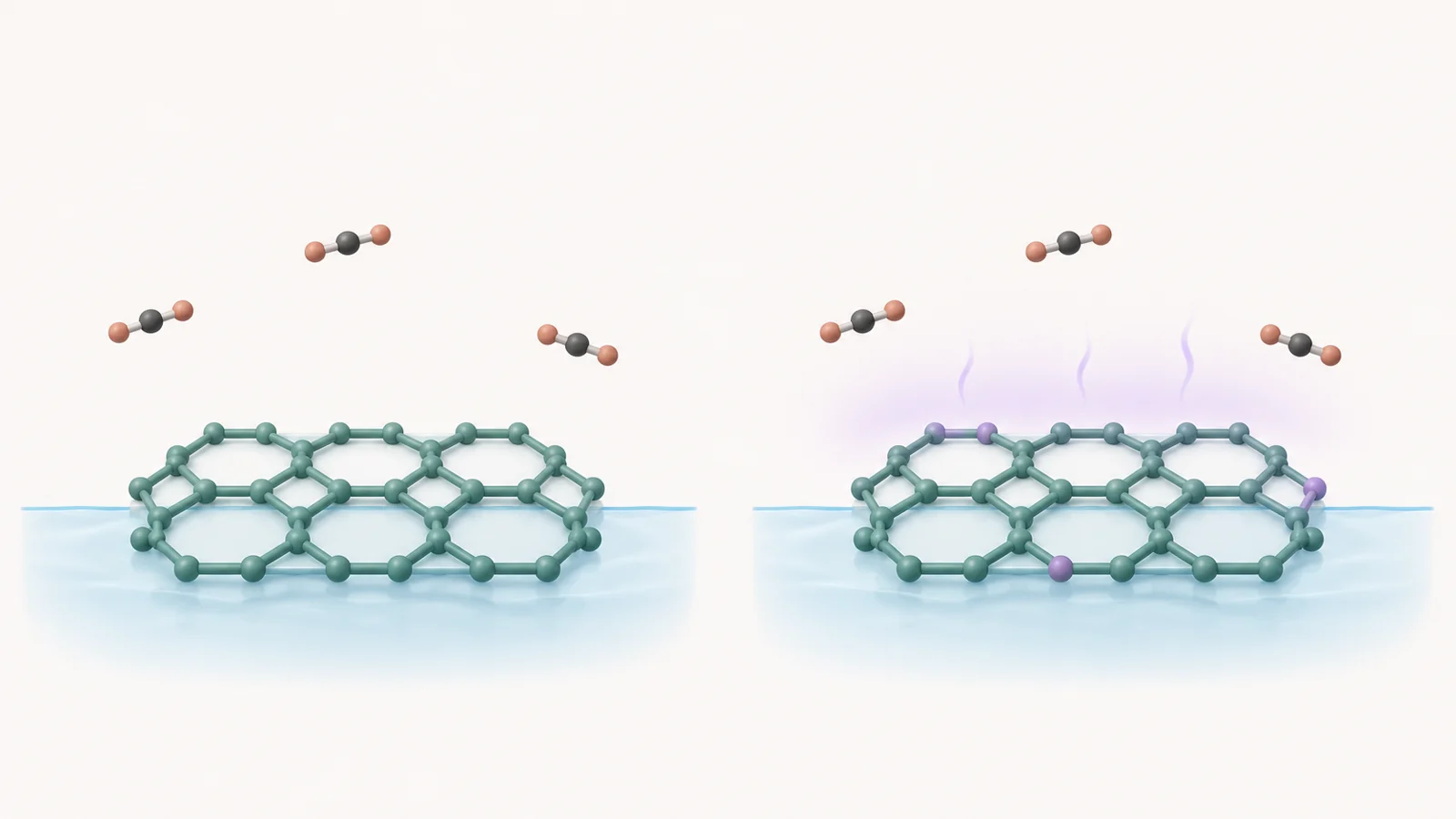
Treating an already-made porous material changed two reported measurements: its surface area rose by 43%, and its carbon dioxide uptake increased by up to 67%. The findings, published in 2023, suggest that a finishing step can tune a material after it has been made. They do not show that the surface-area increase alone caused the uptake gain.
From synthesis to a second treatment
The study began with a covalent organic framework, or COF: a material built from linked organic molecules and containing pores. The researchers made it using a hydrothermal process, a synthesis carried out in a heated liquid environment. The resulting framework had a measured surface area of 1,428 square meters per gram.
They then applied an air–liquid interfacial plasma (ALIP) treatment after synthesis. In other words, the plasma step was used to finish an existing framework, rather than to make the original material. After treatment, the reported surface area was 2,051 square meters per gram, which the authors describe as a 43% increase.
The abstract presents ALIP as a controlled post-synthesis approach. It does not specify a mechanism for the change, so the result should be read as a before-and-after material comparison rather than proof of how the treatment altered the framework.
Two measurements answer different questions
Surface area per gram describes how much measured surface the material presents relative to its mass. Carbon dioxide uptake describes how much CO₂ the material adsorbs under a test condition. Adsorption is the accumulation of a substance on a material’s surface. A larger area may be relevant to adsorption, but area and uptake are different measurements.
That is why the paired result is more informative than an area figure alone. The study reports that the treated framework’s CO₂ uptake improved by as much as 67%, alongside the 43% increase in measured surface area. The percentages refer to separate outcomes; their coexistence does not establish that one produced the other.
The abstract says adsorption was assessed across variable temperature ranges, but it does not provide exact temperatures or uptake units. Those details matter when comparing results across conditions or judging how much CO₂ a material could capture in a particular setting.
A capture unit has to work with real gas
A material measurement is an early part of the case for a capture material. An operator would also need to know how the treated framework behaves with mixed gases, how consistently it captures CO₂ over repeated cycles, and what is required to release the captured gas so the material can be used again. These conditions help distinguish a promising laboratory result from dependable operation.
The supplied abstract establishes neither performance in a working capture system nor those operating details. That is a limit on what can be concluded from the evidence summarized here, not a claim about what the full paper did or did not test. For now, the result is a report of improved material measurements, not a demonstration of industrial capture or emissions reduction.
What this could change
At a facility handling gas that contains carbon dioxide, engineers could benefit from having a reliable way to improve a capture material after fabrication. If the plasma treatment’s paired surface-area and uptake gains hold up under relevant operating conditions, it could give a capture unit a better-performing material option and make a framework’s properties less fixed at the moment it is made. Carbon capture materials already exist; the potential advance is the ability to tune one dependably after synthesis. Real-world capture would still depend on other process advances.
A useful next milestone would be a head-to-head comparison of treated and untreated versions of this framework under relevant mixed-gas and repeated-use conditions, reporting both CO₂ uptake and regeneration results. That would connect the promising laboratory comparison to the demands of a working capture process.
Key Sources
- Primary source: Enabling Ultrahigh Surface Area of Covalently-linked Organic Framework for Boosted CO 2 Capture: An Air Liquid Interfacial Plasma as Post-furnishing Protocol.
DOI or Journal Page · Peer-Reviewed Paper · 2023-05-11
Keep exploring