
Research Signal – Source date 2021-10-30
Plant residues contain carbon that microbes can use to make plastic. That makes agricultural leftovers an appealing alternative to purified sugars used in production. But the starting material is only part of the bill. Turning a resistant plant fiber into a usable polymer involves releasing its sugars, supporting microbial growth and recovering material with the right properties.
A review published on October 30, 2021, examines that journey for polyhydroxybutyrate, or PHB, a plastic made by microbes. PHB belongs to a larger family called polyhydroxyalkanoates, abbreviated PHA. The distinction matters because much of the paper discusses this broader family, and a result reported for PHA does not necessarily describe PHB specifically.
The authors bring together studies of different plant materials, microorganisms and processing methods. Their account explains how several conversion routes could work, while showing why success at one stage does not establish a complete manufacturing process.
Opening the plant structure
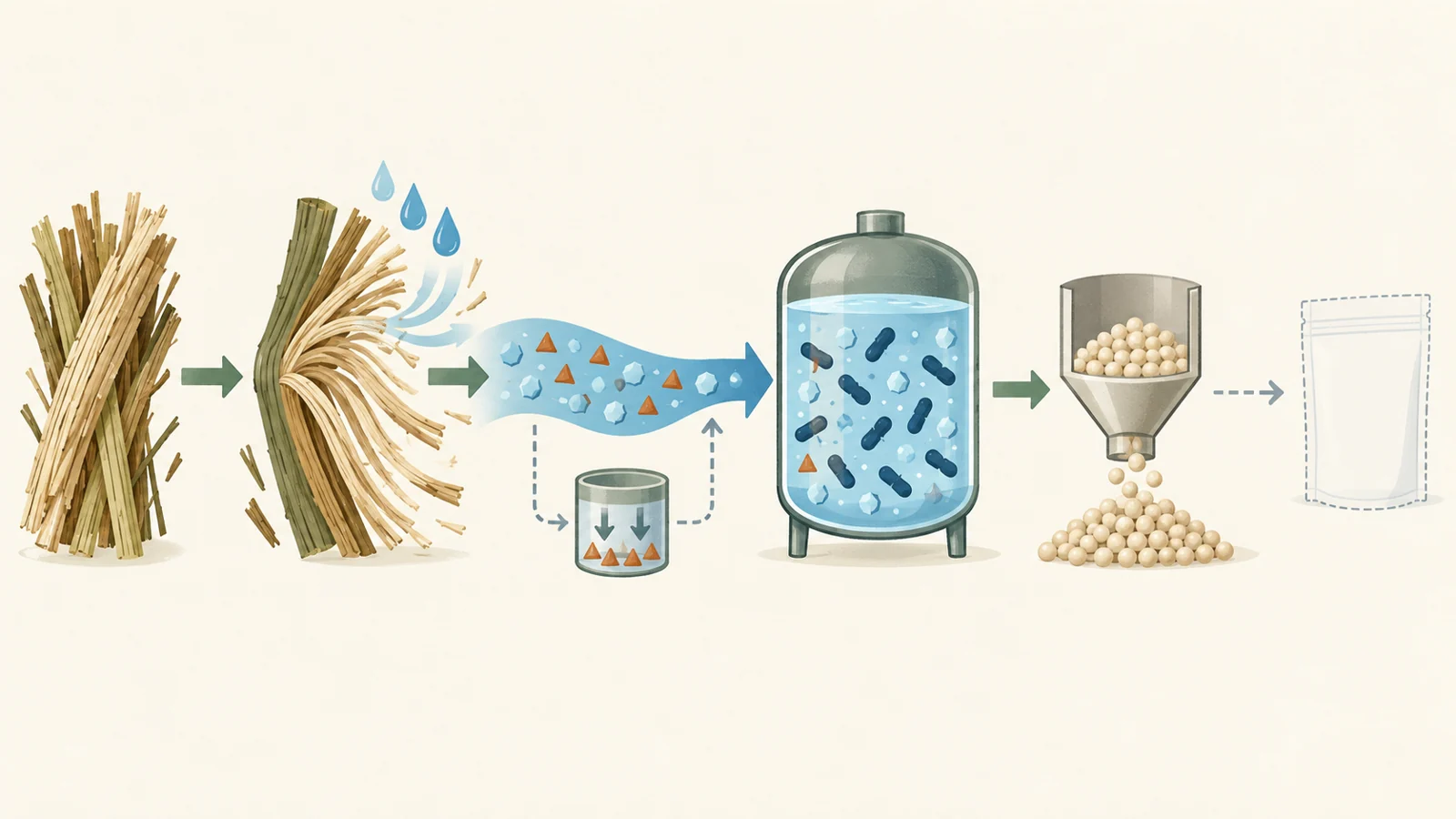
Lignocellulosic material is the tough structural material in plants. Its resistance to breakdown helps explain why a fibrous residue cannot simply replace a purified sugar solution in a fermentation vessel. The sugars must first become accessible.
Pretreatment changes the material’s structure so that hydrolysis—the breakdown of larger carbohydrates into smaller sugars—can proceed more effectively. Enzymes help perform that breakdown. The resulting liquid, called a hydrolysate, carries fermentable sugars that suitable microbes can use to produce polymer. That polymer must then be recovered from the microbial biomass.
The review surveys ways to open up the plant material, including acid and alkaline treatments, steam explosion, ball milling and biological pretreatment. These are alternative approaches with different effects on the starting material. A treatment that suits one residue may perform differently on another because lignin content, cellulose structure, particle size and moisture all influence access to the sugars.
This makes pretreatment a question of matching a method to a material. A high sugar yield is useful, but so is preserving those sugars through processing and making them available in a liquid the chosen microbes can tolerate. The chemical changes that help release sugars also shape what happens during fermentation.
When the sugar solution also inhibits microbes
The hydrolysate contains more than microbial food. Pretreatment and hydrolysis can generate compounds that interfere with subsequent biological processing. The review describes organic acids, phenolic compounds and furans, including furfural and hydroxymethylfurfural. Which compounds occur depends on the feedstock and the treatment conditions.
That creates a practical connection between two stages often described separately. Changing how a residue is treated can change both the sugars released and the mixture of inhibitors entering fermentation. A process that opens the fibers effectively may still produce a liquid that is difficult for a particular microorganism to use.
Detoxification offers several ways to address this. Chemical conditioning can involve alkalis or reducing agents; biological approaches use microbes to remove or transform troublesome compounds. These choices bring their own demands. Additional treatment can require reagents and processing time, while biological detoxification can also consume some of the sugars intended for polymer production.
Yet detoxification is not obligatory for every hydrolysate. The review describes work in which particular plant-derived liquids could be used without an extra detoxification step. It also reports that the bacterium Ralstonia eutropha could use certain biomass-derived compounds, including furfural, hydroxymethylfurfural and acetate, in PHA production.
Those examples make the organism–hydrolysate pairing especially important. A compound described as an inhibitor in one setting may be manageable in another. The useful question is whether the selected microbes can work with the actual liquid produced by the selected treatment, including its accompanying compounds.
More cells and more plastic are different results
The reported production figures need careful reading because they describe different things. In one study summarized by the review, hydrolysates from Miscanthus, barley and pine supported R. eutropha. The reported dry cell weights were 4.6, 3.2 and 2.7 grams per liter, respectively.
Dry cell weight measures microbial biomass after water has been removed. It answers how much dried cellular material is present in a given volume. It does not, by itself, tell us how many grams of polymer are present. The Miscanthus figure therefore describes more microbial biomass per liter in that reported comparison, rather than establishing it as the universally best source of plastic.
A different example uses spent liquor from the kraft pulping process. The review reports PHA amounting to 15.5–18.5% of cell dry weight. Here the measurement describes the share of dried microbial biomass made up of polymer. It does not describe the amount of polymer per liter or the fraction of the original plant material converted into plastic.
The kraft example also begins with a stream that has already undergone industrial processing. Its reported ability to bypass a pretreatment step should be understood in that context; it does not mean untreated plant fibers are equally accessible to microbes.
Together, these examples show why production claims cannot be compared by placing all their numbers in one ranking. Cell concentration, polymer content and conversion from feedstock answer distinct questions. Recovering the polymer adds another measurement, because the material ultimately collected is what a manufacturer has available to use.
Recovering a material that can do a job
Polymer inside microbial cells still has to become a usable material. The review identifies downstream recovery, solvent use and energy demand as important parts of production. Replacing purified feedstocks with residues may reduce one expense while leaving substantial extraction and processing costs. The economic promise depends on how these operations work together.
Consistency matters as well. Mixed microbial cultures can accommodate a wider range of substrates and may reduce operating costs, according to studies discussed in the paper. But the authors also flag the possibility that polymer recovered from mixed cultures may not meet the quality required for a particular application. A useful production route must deliver material with sufficiently uniform properties.
Mechanical behavior presents a separate challenge. The review discusses brittleness and rigidity, along with attempts to improve performance through blending. Potential additions include plasticizers, lignin and cellulosic fibers derived from residues. These formulation choices can change properties such as how far a material stretches before breaking.
For packaging, obtaining a polymer is therefore one achievement and making it suitable for a particular package is another. Recovery and formulation connect microbial production to that application. The production examples discussed here do not establish that a resulting material is ready for food contact, or that it can match conventional plastics on cost.
Degradation depends on where the material goes
The same attention to conditions is needed after use. The review describes PHA degradation as dependent on both the polymer and its surroundings. Temperature, moisture, pH and microbial communities influence breakdown, as do the material’s structure, crystallinity, additives and exposed surface area.
Evidence of degradation in one environment does not provide a universal disposal timetable. The paper discusses activity in settings including soil, wastewater sludge and aquatic environments, but these settings differ in the organisms and conditions available to break the material down. Calling a polymer biodegradable does not tell a reader how quickly a finished item will disappear wherever it ends up.
Industrial composting and anaerobic digestion are among the end-of-life routes considered. Composting involves biological breakdown under managed conditions. Anaerobic digestion takes place without oxygen and can produce methane that may be captured for energy. Whether either route is useful for a product depends on an appropriate collection and treatment system as well as the material itself.
These disposal choices also belong in the environmental assessment of manufacturing. Plant-derived carbon alone cannot settle the overall comparison with a conventional plastic. Pretreatment, fermentation, recovery and waste handling all contribute to the process being assessed. The evidence discussed here supports examining those operations together; it does not justify a universal numerical environmental saving.
The review also reports pilot-scale progress in the broader production of PHA from wastewater and organic waste. That is relevant evidence that waste-fed microbial production can move beyond laboratory work. It does not give every lignocellulosic PHB route the same level of validation. The authors identify continuing gaps in bioprocessing, downstream processing and product specifications, including the challenge of making laboratory work reflect realistic raw-material supplies.
What this could change
If reliable sugar release, microbial conversion and polymer recovery can be combined with suitable material performance, agricultural residues could supply feedstock for some packaging plastics. Processors handling those residues would gain another productive use for their material streams, while polymer manufacturers could rely less on purified carbon inputs.
The downstream opportunity is a connection between residue processing and packaging manufacture. A processor could provide a fermentable stream suited to microbial production; recovery and formulation could then turn the resulting polymer into material for a defined packaging use. Where the complete process works and appropriate end-of-life arrangements exist, that could reduce reliance on fossil-derived materials in those applications and give plant residues a further role beyond their original use.
Key Sources
- Primary source: A review on enzymes and pathways for manufacturing polyhydroxybutyrate from lignocellulosic materials.
DOI or Journal Page · Peer-Reviewed Paper · 2021-10-30
Keep exploring