
Research Signal – Source date 2023-03-07
A material that helps hold a plant upright might seem an unlikely starting point for repairing human tissue. Yet some of its useful qualities are physical ones: fibers can form supporting structures, and water-holding materials can provide a moist environment. Researchers are investigating how to reshape those ingredients into surfaces where cells can attach and dressings that carry medicines.
A review published on March 7, 2023, brings together research on cellulose, a structural fiber in plant cell walls, and lignin, a plant-stiffening polymer. It examines engineered materials made from these ingredients across tissue engineering, wound care, and drug delivery. Wound repair offers a concrete way to understand the work, whose laboratory findings concern particular formulations rather than a demonstrated treatment for patients.
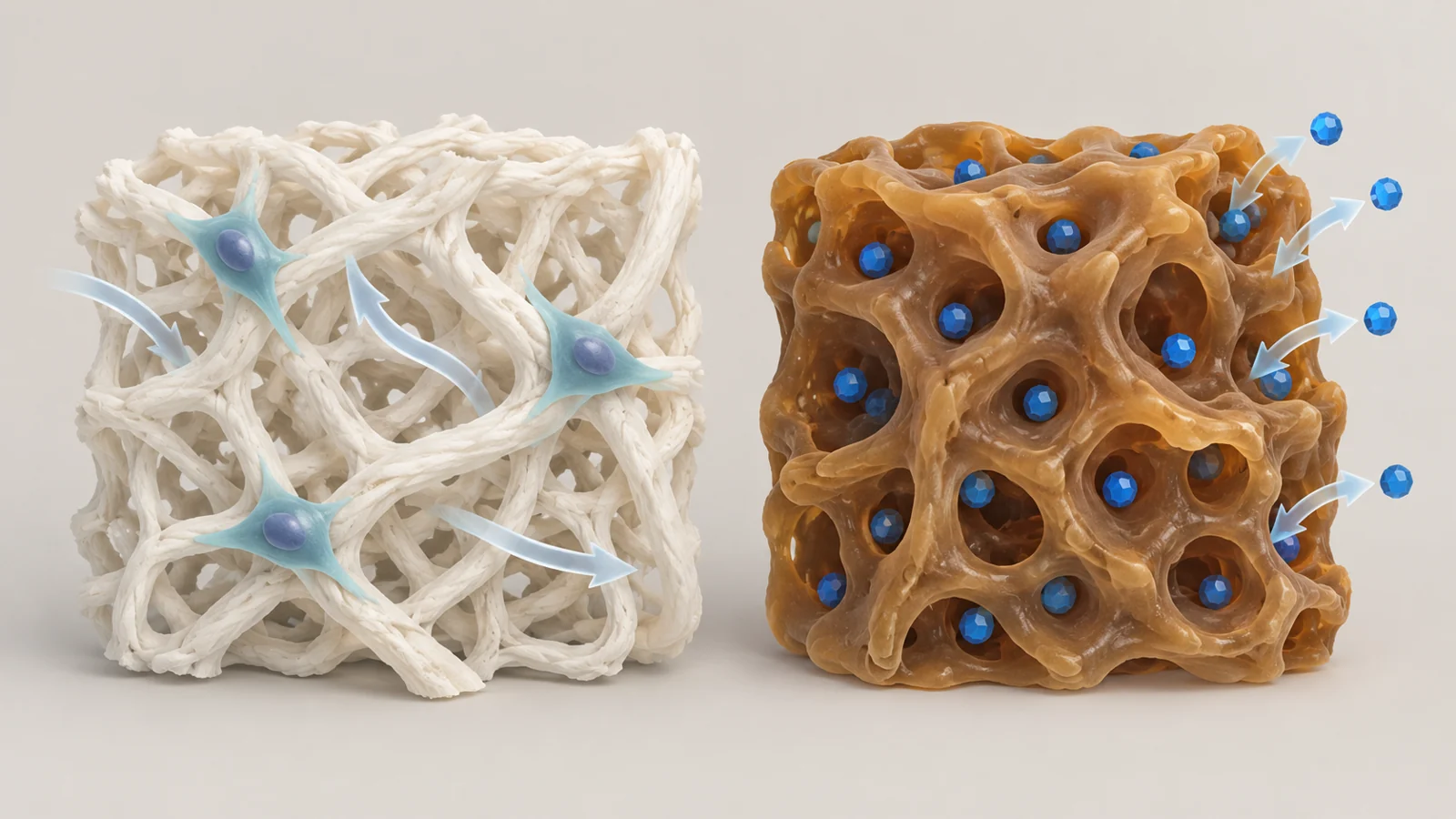
The central idea is a scaffold—a support for growing cells. In tissue engineering, that support works alongside suitable cells and biological signals, such as growth factors. It takes on some of the structural role of the extracellular matrix, the material surrounding cells in tissue. Providing somewhere for cells to attach is one part of building tissue; the cells also need the conditions and signals that guide their activity.
Two ingredients with different engineering jobs
Cellulose can take the form of fibers, very fine fibrils, or tiny crystalline particles. Its source and the way it is processed influence particle dimensions and geometry. Those differences matter because the building blocks help determine the structure of the finished material. A network assembled from long, fine fibers presents a different physical environment from a material built with differently shaped particles.
Although familiar as a plant component, cellulose also comes from sources including bacteria and algae. The review therefore covers a broader material family than the phrase “plant-derived” might suggest. Knowing that a scaffold contains cellulose is only a starting point; its origin, processing, and final arrangement help explain how it behaves.
Lignin contributes a different chemistry. The review connects its phenolic hydroxyl groups—chemical groups within the polymer—to its ability to neutralize free radicals. This underlies interest in antioxidant activity, including the possibility of limiting oxidative stress, a form of chemical stress that can damage cells.
Turning lignin into a useful membrane introduces a practical problem. Its brittleness and processing characteristics make it difficult to form fibrous membranes on its own. Researchers combine or chemically link it with other polymers, including cellulose and polyethylene glycol, to make materials suitable for different purposes. The resulting formulations can become gels, membranes, or nanoparticles. Their behavior depends on the whole formulation, including the ingredients added to make it workable.
Cells need access as well as support
A scaffold’s empty spaces are as important as its solid parts. Cells within a three-dimensional structure need nutrients to reach them and waste products to leave. The review identifies interconnected pores as a central design requirement: an opening is useful only if the surrounding structure allows material to move through it.
Mechanical properties must be considered at the same time. A support needs to suit the tissue where it will be used and withstand handling during implantation. Designing for porosity therefore goes together with designing for strength and flexibility. A material’s chemical composition alone cannot tell researchers whether its finished architecture meets those demands.
These transport requirements become especially important when the aim extends beyond a thin cell-covered surface toward more complex tissue. The authors emphasize vascular-like structures as a step toward keeping larger tissue assemblies supplied. Such architecture describes a design ambition for transport through a scaffold; it does not establish a working human blood supply or a replacement organ.
For wound-related materials, this shifts attention to a manageable set of physical questions. How does the surface interact with cells? What can pass through the structure? Can the material retain an appropriate environment while remaining suitable for its intended location? Each question concerns a different aspect of the finished support.
What the skin experiments actually observed
The skin-related studies summarized in the review examine several formulations and experimental settings. One example involves a lignin film containing titanium dioxide nanoparticles, with reported mechanical, flexible, and antimicrobial properties. Those observations concern a composite material, so the added nanoparticles are part of the formulation being evaluated.
In mouse fibroblast experiments described by the authors, lignin scaffolds were associated with cell growth, reduced apoptosis, and lower oxidative stress. Fibroblasts are cells involved in building and maintaining the surrounding tissue matrix; apoptosis is a regulated form of cell death. These measurements give information about how cultured cells respond to a tested surface. They address cell behavior at that surface rather than the healing of an entire wound.
Other laboratory work summarized in the skin section reports growth and attachment of cultured dermal fibroblasts on tested membranes. Antibacterial tests also found activity against selected gram-positive and gram-negative bacteria, two broad bacterial groups. The cellular and microbial observations answer separate questions: whether cells can interact favorably with a material, and whether the tested formulation inhibits particular microbes under the experimental conditions.
That distinction also matters when reading the ingredient list. The review describes membranes whose stability was modified with glycerol and formulations containing antimicrobial substances. A result belongs to that prepared material and its test conditions. It cannot automatically be assigned to cellulose or lignin in isolation.
A dressing can also carry medicine
Supporting cells is one possible role for these materials. Holding and releasing a medicine is another. In drug delivery, the polymer serves as a carrier whose formulation helps determine how the incorporated substance becomes available.
Wound dressings bring this function together with moisture management. The review discusses hydrogel dressings, which hold water and provide a moist local environment, as well as cellulose- and lignin-containing nanoparticle formulations incorporating antimicrobial medicines such as tetracycline and mupirocin. Here, the added medicine has a distinct role from the polymer that carries it. The dressing’s physical properties and its drug content contribute different functions.
Release speed is also a design choice. The authors describe lignin used as a matrix for sustained delivery and as a film intended for rapid release of poorly soluble drugs. These are different formulation goals. One aims to make a substance available over time; the other aims to release it quickly. “Drug delivery” therefore does not describe a single property shared by every lignin-containing material.
Combining a dressing and a carrier gives researchers several interacting features to engineer: water retention, structure, drug incorporation, and release behavior. A material that performs well as a cell support does not thereby establish how it will release a medicine. That function needs its own evaluation.
The distance from a tested material to patient care
One particularly important qualification concerns biodegradation. The review uses broad language about the biodegradability of these polymers, but also acknowledges that their organized structures can resist breakdown without the relevant enzymes. The useful question is how a specific formulation breaks down in its intended biological setting, over what period, and into what products. A natural origin does not establish that a scaffold will disappear as new tissue forms.
Compatibility requires similar care. Growth of cultured fibroblasts on a tested membrane supports a limited conclusion about those cells under those conditions. It does not settle immune responses, the effects of breakdown products, or interactions elsewhere in the body. The authors also note toxicity concerns in some studies and call for further investigation of material structure, reaction mechanisms, and interactions with the body’s microbiota.
The review’s conclusion identifies a lack of clinical-trial results as a barrier to wider application. The laboratory observations discussed here consequently do not establish improved healing, fewer infections, or superiority over existing dressings for a specified treatment. Reaching those conclusions requires evidence connecting a defined formulation and use to outcomes in patients. Neither favorable cell tests nor antibacterial activity alone completes that connection.
What this could change
If engineered formulations achieve suitable biological compatibility, appropriate material persistence, and clinical performance, cellulose and lignin could help provide wound dressings that combine physical support with local medicine delivery. Their structure could help maintain a supportive wound environment while an incorporated medicine is released according to the formulation’s intended schedule.
For people needing wound care, the potential benefit would come from those functions working together in a usable dressing. The material could help manage the local environment and serve as a carrier, giving designers more ways to match a dressing to a particular wound-care task. The review also raises the possibility that abundant plant-derived ingredients could simplify material sourcing or reduce costs. Any such saving would depend on the processing and quality requirements of the finished medical material.
Key Sources
- Primary source: Cellulose and Lignin-Derived Scaffold and Their Biological Application in Tissue Engineering, Drug Delivery, and Wound Healing: A Review.
DOI or Journal Page · Peer-Reviewed Paper · 2023-03-07
Keep exploring