
Research Signal – Source date 2025-06-16
A plant fiber’s performance in plastic depends on more than its name. Fibers from the same broad plant category can differ because of how they were extracted, how mature the plant was, which part supplied the fiber, and the conditions in which it grew. A 2025 review of cellulosic plant fibers and polyester- and epoxy-based composites brings those differences together with another design question: what happens at the fiber’s surface before it is combined with plastic?
The review connects fiber characterization, surface modification and composite manufacturing to mechanical performance. It does not establish a treatment or recipe that guarantees a stronger material. Instead, it shows why both the starting fiber and the way it is prepared and arranged matter when comparing composite designs.
A fiber’s origin can change what it brings to a composite
Cellulosic plant fibers contain cellulose, hemicellulose and lignin, but their properties are not fixed by those broad ingredients alone. Extraction method, plant maturity, plant part and soil conditions all contribute to variation. Two samples described by the same plant name may therefore start with different characteristics.
That matters because a designer choosing reinforcement needs more than a label. The review discusses measurements that answer different questions: density and diameter describe the fiber’s size and mass; tensile testing asks how it responds to pulling; thermal characterization concerns its response to heat; and analysis of functional groups, crystallography and surface morphology examines chemical features, internal structure and the outer surface. Together, such observations can help characterize a batch and inform material selection.
These measurements are useful precisely because no single one stands in for all the others. A fiber may be described by its dimensions, its mechanical behavior, its structure and its surface, while the eventual composite also depends on how the fiber is incorporated. The review covers this characterization for both raw and surface-modified fibers, but the supplied abstract does not give numerical comparisons among particular fiber types.
Surface treatment changes one part of the design
Surface modification is a separate choice from selecting and measuring the raw fiber. The review discusses several modification techniques, especially chemical methods, and considers how they affect fiber properties. That makes surface condition one factor to consider when preparing reinforcement for a polymer composite.
The abstract does not identify a best treatment or rank methods by performance. It also does not provide figures showing how much a treatment improves a fiber or a finished composite. So the supported point is narrower: surface modification can change properties that researchers characterize, and surface condition is among the factors associated with composite mechanical performance. A treatment cannot be judged in isolation from the rest of the design.
The finished material depends on the whole recipe
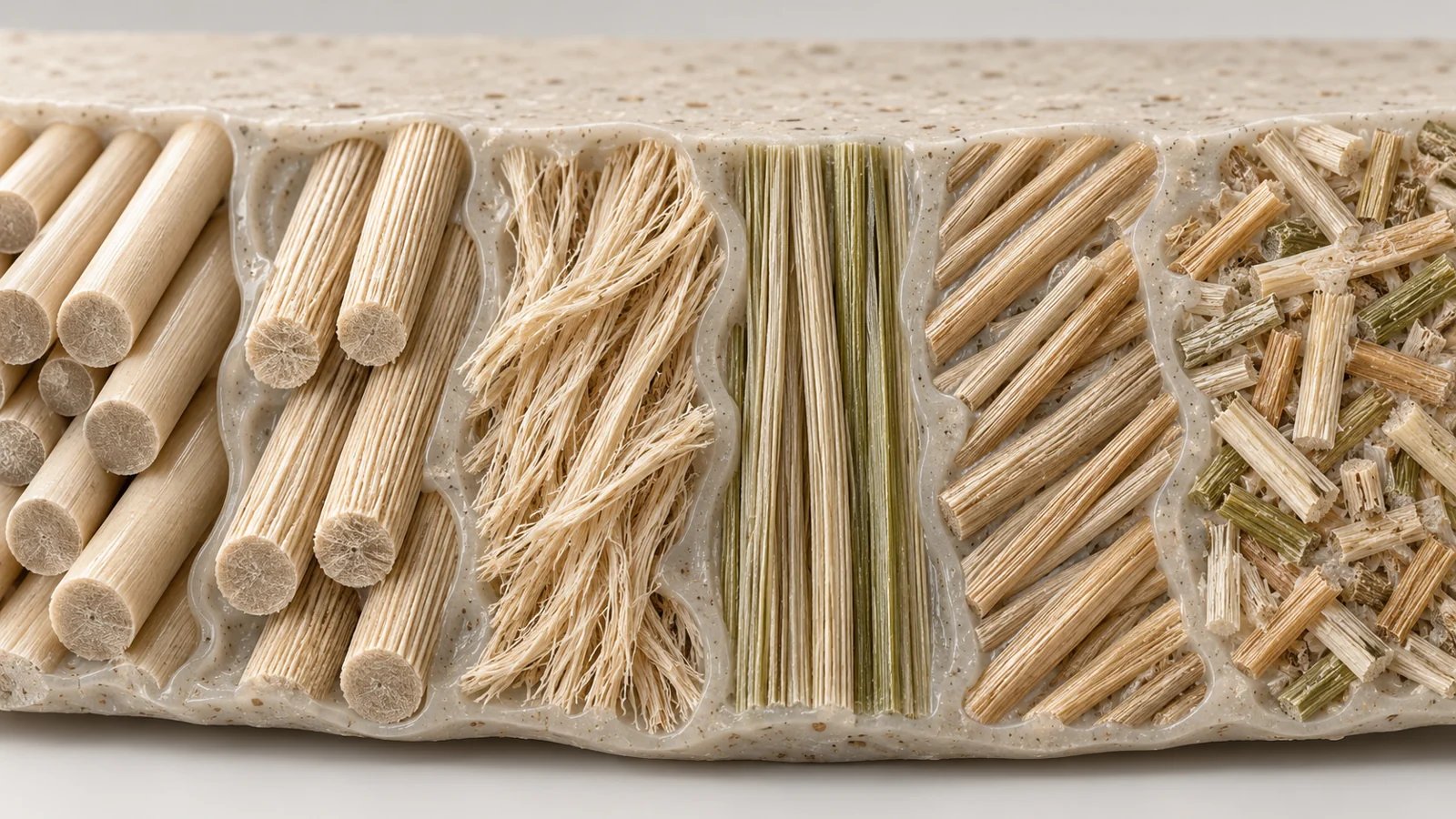
Once fibers are combined with polyester or epoxy, the composite’s mechanical properties depend on more than the fiber surface. The review identifies fiber weight percentage, fiber length, orientation, secondary fillers and manufacturing method as additional variables.
The amount of fiber changes how much reinforcement is included. Fiber length describes the size of each fiber piece, and orientation describes its direction in the material; secondary fillers are other materials added to the composite, and the manufacturing method matters too. The review identifies each as a variable tied to mechanical performance, but the abstract does not quantify their separate effects or prescribe an optimum combination.
This is why comparisons need to account for several choices at once. If two composites use fibers with different surface conditions but also differ in fiber amount, length, orientation or fabrication, the performance difference cannot be attributed to surface treatment alone. The same caution applies when comparing polyester- and epoxy-based materials: the review covers both, but the abstract does not report a direct ranking between them.
Possible uses need component-level evidence
The review points to automotive and construction materials as areas where lightweight, durable materials are sought. Plant-fiber-reinforced plastics are relevant to that interest because the review considers ways to characterize fibers, modify their surfaces and relate manufacturing choices to mechanical properties.
That application context is a reason to study these composites, not evidence that a particular fiber recipe is ready for a car or building component. Suitability would depend on the component and the performance it requires. The abstract does not establish durability or readiness for any specific part, nor does it identify a product or industrial deployment.
What this could make possible
A designer specifying a vehicle or building component could, in the future, have a more dependable way to choose prepared plant fibers whose properties suit a particular composite. That capability would build on the relationships the review describes: fibers vary with their origin and extraction, their surfaces can be modified, and the final mechanical behavior depends on how they are combined and manufactured. Plant-fiber composites already exist; the prospective gain is more predictable suitability for a specific component.
Reaching that point would require controlled comparisons and validation at the component level. A nearer milestone is reproducible mechanical testing that varies fiber surface condition while reporting and controlling fiber amount, length, orientation and fabrication. Such comparisons could help separate the contribution of surface preparation from the other choices that shape a composite’s performance.
Key Sources
- Primary source: A comprehensive review of the characterization of raw and surface-modified cellulosic plant fibers and their polyester- and epoxy-based composites.
DOI or Journal Page · Review or Meta-Analysis · 2025-06-16
Keep exploring