
Research Signal – Source date 2021-04-29
A plant fiber can make poly(butylene succinate), or PBS, stronger in one measurement and less able to stretch before breaking. Some fiber-filled PBS samples also lost more weight in soil-burial tests than samples made from PBS alone. Those findings come from different studies and formulations: they do not show that one material combines both effects.
The contrast matters because a biodegradable plastic still has to do its job while it is being used. PBS is a polyester with chemical links that can be broken down through processes including hydrolysis, but its performance depends on how it is made and what is mixed into it. The 2021 review compares earlier work on PBS, natural-fiber composites and applications. Its examples show why “stronger” and “biodegradable” each need more explanation.
A stronger sample may stretch less
Tensile strength describes how much pulling force a material withstands before it breaks. Elongation describes how far it stretches before breaking. Stiffness, often measured as a modulus, describes how much a material resists changing shape under force. These measures capture different properties, so an improvement in one does not guarantee improvements in the others.
In cotton-fiber PBS tests summarized in the review, adding 10–40% cotton fiber increased tensile strength by 15–78%, while elongation decreased as the fiber loading rose. The result suggests that the samples resisted greater pulling force, but gave up some stretch. A cited set of tests with kenaf fiber showed a related trade-off: the tensile modulus increased by 53%, while tensile strength and fracture strain fell as kenaf content increased. Fracture strain is the amount a sample deforms before it breaks.
These are comparisons from separate formulations and experiments. They help explain why a single headline property cannot show whether a composite suits a particular product. A material that needs to flex may call for a different balance from one whose main requirement is resisting deformation.
Fibers need a good connection to the plastic
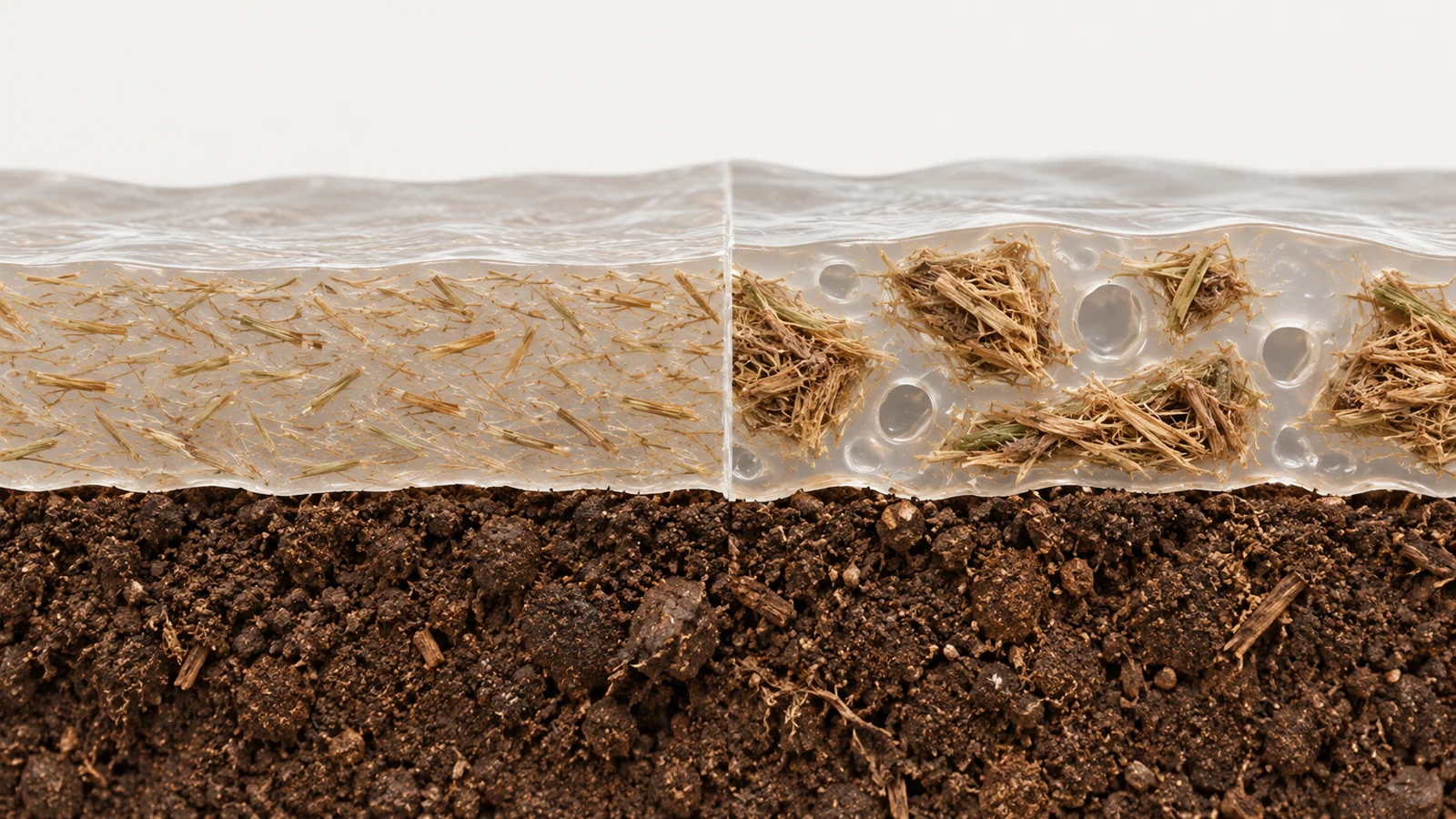
For a reinforcing fiber to help carry force through a composite, it needs to be spread through the plastic and bonded well enough to transfer that force. If fibers gather into clumps, or leave voids between themselves and the PBS, the connection is weaker. The surrounding plastic then has less effective contact with the fibers, and the composite may perform worse as more filler is added.
The review describes these problems in PBS composites. In one palm-fiber example, tensile and flexural strength decreased as fiber content rose; the authors associated the decline with poor dispersion and incompatibility between the fiber and plastic. Other examples also link voids, fiber clumping or weak adhesion to reduced force transfer. Fiber geometry and the details of the interface matter too, so increasing the amount of plant material alone cannot predict the finished material’s behavior.
Researchers can also change PBS with plasticizers, blends, additives or surface treatments for fibers. The review describes these as ways to adjust properties, but the desired balance depends on the application. A formulation that improves one measure may change another, and the studies collected in the review do not all use the same fibers, proportions or tests.
Soil breakdown depends on the material and conditions
PBS contains ester links that can be broken by hydrolysis, reducing the polymer’s molecular weight. The review describes biodegradation as dependent on factors that include molecular weight, water permeability, pH, temperature, purity and crystallinity. Crystallinity is how regularly polymer chains are packed into ordered regions; the review notes that more crystalline material can degrade more slowly because its less ordered regions are easier to attack.
Plant fibers may also affect a composite’s breakdown. In a cited soil-burial test lasting 90 days, a PBS composite containing abaca fiber lost 40% of its weight, compared with 7% for neat PBS. That is a result for those samples in that test. Weight loss during burial is not a universal countdown for how long a product will take to disappear in soil, and it does not establish how the same material behaves in a field or another disposal setting.
The review reports other examples with different fibers and test conditions, including differences in weight loss and timing. Those results reinforce that composition and surroundings both affect observed degradation. A burial comparison can help researchers study a material, but it cannot by itself describe the whole life of a product in use and after use.
A farm film and a food package face different demands
Mulch film is laid over soil to help conserve moisture, control weeds and create conditions that support crop production. Conventional polyethylene films can be difficult to recover completely after weathering and fragmentation, according to the review. A biodegradable film would still need to perform during use; its later breakdown is a separate requirement. The review discusses PBS among materials used in biodegradable mulch films, including blends, but does not establish an affordable plant-fiber PBS film that reduces farm waste at scale.
Food packaging has another job: it must protect its contents. The review describes PBS blends investigated for packaging and mentions work on PBS with polylactic acid to change strength, flexibility and ductility. It also discusses chitosan-containing blends in relation to antimicrobial packaging. These examples illustrate how researchers explore combinations for specific functions; they do not make one formulation suitable for every package or prove that its end-of-life behavior will match a soil-burial test.
Renewable ingredients do not determine biodegradability
PBS can be synthesized from succinic acid, or dimethyl succinate, and 1,4-butanediol. The review says these building blocks can come from fossil-based or renewable sources, including fermentation routes. That origin is separate from biodegradability: feedstock describes where the ingredients came from, while the polymer’s chemistry and its conditions after use affect how it breaks down.
The distinction matters when describing a material as bio-based or biodegradable. Those labels do not answer the same question, and one does not guarantee the other. The review’s account of PBS connects potential renewable sourcing with degradable ester links, while also describing petroleum-derived routes for its building blocks.
What plant-fiber films could change on farms
If researchers can develop a low-cost PBS formulation that performs through a growing season and breaks down under relevant end-of-life conditions, it could offer growers an alternative to difficult-to-recover polyethylene mulch. Achieving that possibility would require the mechanical properties, fiber bonding, price and availability to work together at practical scale. The review’s varied laboratory comparisons point to material options and trade-offs, but they do not yet demonstrate that farm-ready outcome.
Key Sources
- Primary source: A Review on Properties and Application of Bio-Based Poly(Butylene Succinate).
DOI or Journal Page · Review or Meta-Analysis · 2021-04-29
Keep exploring