
Research Signal – Source date 2023-06-24
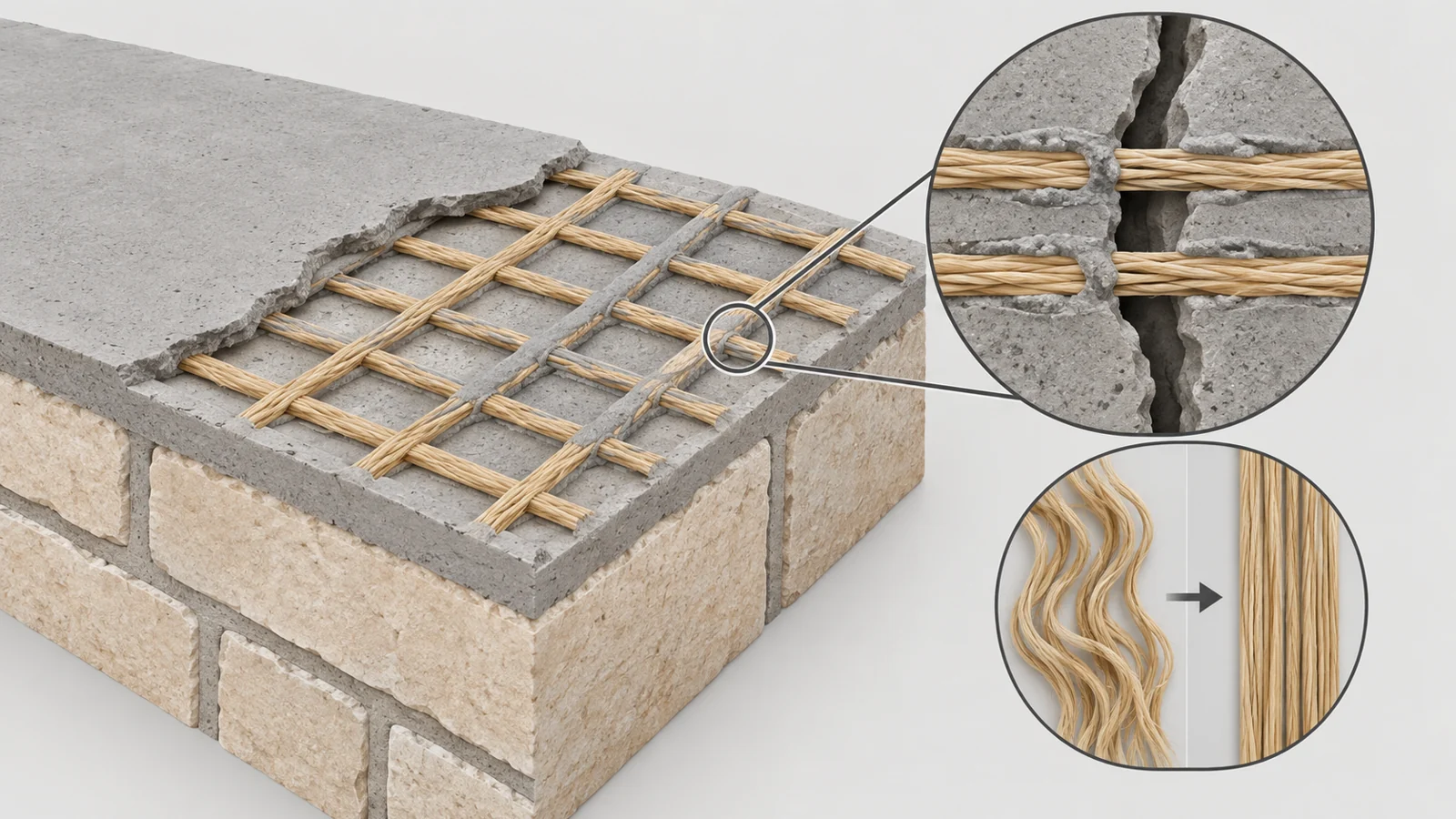
A grid of plant-fiber yarns embedded in mortar could help strengthen existing masonry. The mortar holds the textile in place, while yarns crossing a crack can carry tension across the opening. Together, they form textile-reinforced mortar, or TRM, which can be applied as a relatively thin reinforcing layer on a building.
But a textile capable of carrying a large load eventually may contribute surprisingly little at the moment the mortar first cracks. Understanding that mismatch is central to a review published on June 24, 2023, in Materials. It brings together natural-fiber experiments, comparisons with conventional reinforcement and a proposed theoretical design approach. Its practical question reaches beyond choosing a strong fiber: how can yarn, mortar and their bond work together throughout loading?
Why a strong yarn can start out soft
Plant-fiber yarns are usually bundles of twisted fibers. When pulled, their crimped or wavy fibers initially straighten and turn toward the direction of the force. Only after that rearrangement do they develop their higher stiffness.
Stiffness describes how strongly a material resists stretching; strength describes the stress it can withstand before breaking. A yarn can have useful strength yet stretch relatively easily early in loading. Measuring its elastic modulus—a measure of stiffness—from the later, straighter part of its tensile response can therefore give a misleading picture of its contribution inside mortar. The mortar may crack while the yarn is still taking up its internal waviness.
The tensile experiments discussed in the review make that distinction tangible. Some composites reinforced with untreated flax textiles lost more than 70% of their stress capacity when the first matrix crack formed, even though they could later develop multiple cracks and carry increasing load. Polymer-coated yarns reduced those drops in the reported comparisons, and adding short fibers to the mortar improved the response further.
The desired behavior is called pseudo-strain-hardening. After the mortar begins cracking, the composite can continue carrying increasing tensile load as deformation grows and cracks develop at multiple locations. The term describes the response of the combined material; it does not mean the plant fibers themselves become intrinsically stronger. Cracking is part of this behavior, so achieving it is no promise of crack-free construction.
Mortar and bonding must suit the textile
Choosing a stronger mortar does not automatically improve the composite. Its stiffness matters relative to that of the yarns. A stiff matrix paired with a much more compliant textile can make it difficult for the reinforcement to provide the intended response. Yet simply making the mortar softer can also reduce its useful strength.
The authors consequently propose selecting mortar and textile together. Their comparison points toward lime-based or lower-strength cement mortars for coated flax and hemp yarns. They suggest a textile-to-matrix stiffness ratio greater than two, alongside a minimum mortar compressive strength, as a starting point for material selection. These are proposed criteria arising from their analysis, rather than universal or code-approved design requirements. Particularly flexible textiles may be difficult to accommodate because reducing mortar stiffness enough would compromise its strength.
The interface introduces another balance. Bonding must transfer force between mortar and yarn so that reinforcement can bridge a crack and load can be redistributed along the specimen. If the yarn slips too readily, the composite cannot make effective use of it. Excessively strong interfacial bonding can instead cause fibers to rupture prematurely, cutting short the deformation needed for strain-hardening. Maximizing adhesion alone would miss this competing failure mode.
For an overlay on masonry, there is also a bond between the mortar and the wall. The review describes cases in which high-strength conventional textiles could not reach their tensile capacity because an interface or the underlying substrate failed first. This helps explain the interest in more flexible plant textiles for weak masonry: compatibility with the wall can matter more than the highest fiber strength available.
Calculating more than the amount needed to survive
Much of the natural-TRM work reviewed involves experimentally varying materials and textile quantities. The paper proposes giving those experiments a more explicit mechanical basis. Its calculations distinguish three demands on reinforcement: preventing failure when the matrix cracks, controlling the spacing of cracks and limiting the loss of resistance during crack formation. Meeting the first demand need not satisfy the other two.
A theoretical hemp-and-lime example shows how this changes the calculation. The authors assume a hydraulic lime mortar with an elastic modulus of 9.5 gigapascals and hemp yarns with a tensile strength of 250 megapascals. They compare a treated yarn modulus of 20 gigapascals with an untreated value of 4 gigapascals. The allowable load drop is set at 20%. These properties and the permitted drop are inputs to a calculation, not measurements of a newly fabricated composite or an established acceptance limit.
Under those assumptions, a fiber volume fraction above 0.61% is enough to avoid composite failure after matrix cracking in both cases. Other requirements can demand considerably more reinforcement. At low modeled bond resistance, keeping the untreated-yarn composite within the chosen load-drop limit requires more than 3.5% fiber by volume. The difference shows why a calculation based only on surviving cracking can underestimate the quantity needed to achieve a specified tensile response.
The approach combines rule-of-mixtures calculations, which relate constituent properties to those of the composite, with fracture mechanics, which considers the energy involved in crack formation. It also simplifies the material substantially. Among its assumptions are aligned, uniformly distributed reinforcement, fixed material properties, idealized brittle behavior and a matrix without voids. Shrinkage stresses are excluded. Real yarn variability, textile geometry and imperfections still have to be addressed when testing how well the approach predicts experiments.
More reinforcement can become harder to embed
A calculated fiber fraction must eventually become a physical textile that workers can place and mortar can penetrate. Closely packed yarns leave smaller openings. If the mortar cannot pass through and surround the grid properly, adding reinforcement can undermine the contact needed to transfer load.
The same theoretical example makes this construction constraint concrete. For a 10-millimeter-thick overlay, some untreated-hemp cases would require a single textile layer with mesh spacing below 5 millimeters. The authors judge that spacing impractical for effective mortar penetration and point toward using several textile layers. Treated yarns could permit a single layer under suitable modeled bond conditions.
Layering, however, adds its own demands. The review reports that dense textiles and multiple plies can lead to poor mortar impregnation, promoting slippage or delamination—the separation of layers. Textile architecture therefore belongs in the mechanical design. Reinforcement quantity, opening size and the arrangement of layers jointly determine whether the intended composite can actually be made.
Keeping useful properties inside wet, alkaline mortar
An initially successful tensile test cannot answer how the material will behave after exposure. Plant fibers readily absorb water, and changes in moisture content can alter their dimensions. Swelling and shrinking can affect contact at the yarn–mortar interface, changing the very bond on which the reinforcing action depends.
Cement- and lime-based mortars also create alkaline environments. The review describes degradation involving mineralization of fibers and deterioration of lignin and hemicellulose, components of plant material. These processes can reduce fiber strength and diminish the composite’s toughness and ability to develop multiple cracks. Durability is therefore connected directly to the mechanical behavior designers are trying to achieve.
Treatments and impregnation offer possible ways to stabilize yarns, protect fibers and increase their initial stiffness. Polymer or resin impregnation can lock fibers together within a yarn. Processing matters, though: unless the yarn is adequately tensioned during coating, twist and crimp can remain fixed into the treated material, with losses in strength and deformation capacity.
Bonding does not respond uniformly to coatings either. The review brings together studies reporting both improvements and reductions in bond performance. A coating may improve interactions with a particular mortar, but it can also create a weak intervening layer or make the yarn surface smoother. A treatment that stiffens a yarn cannot therefore be assumed to improve its anchorage as well.
The environmental case also depends on the finished system. Plant fibers are renewable, but coatings introduce additional materials and processing. Mortar composition and the durability achieved matter to any whole-system comparison. The evidence discussed here does not establish a quantified environmental saving for a complete reinforcing layer merely because its textile comes from plants.
Taken together, these issues keep the proposed calculations at the stage of a design approach requiring experimental validation. The reviewed experiments span different fibers, treatments, mortars and interfaces, making their results sensitive to the particular combination tested. Promising laboratory and masonry results support further development, but dependable behavior across buildings, exposure conditions and service lifetimes remains to be demonstrated.
What this could change
If durable fiber treatments, compatible mortars and experimentally validated design methods can be combined, plant-textile overlays could give engineers another way to strengthen existing masonry while improving its capacity to deform without brittle failure. The review describes encouraging experiments on brick, stone and adobe elements, including increases in load capacity and ductility under particular loading conditions.
For building repair and heritage masonry, the potential benefit is a thin reinforcing layer whose mechanical properties can be suited to a relatively weak existing wall. Translating that possibility into dependable practice would expand the options for strengthening buildings without major changes to their geometry, using plant textiles where their flexibility and strength match the structure’s needs.
Key Sources
- Primary source: Design of Strain-Hardening Natural TRM Composites: Current Challenges and Future Research Paths.
DOI or Journal Page · Review or Meta-Analysis · 2023-06-24
Keep exploring