
Research Signal – Source date 2024-08-19
A plate that holds a broken bone together needs strength. But making it as stiff as possible can introduce another problem. Titanium alloy and stainless steel, the usual plate materials, are much stiffer than bone. An overly stiff plate can limit movement at the fracture and reduce the load carried by the bone beneath it.
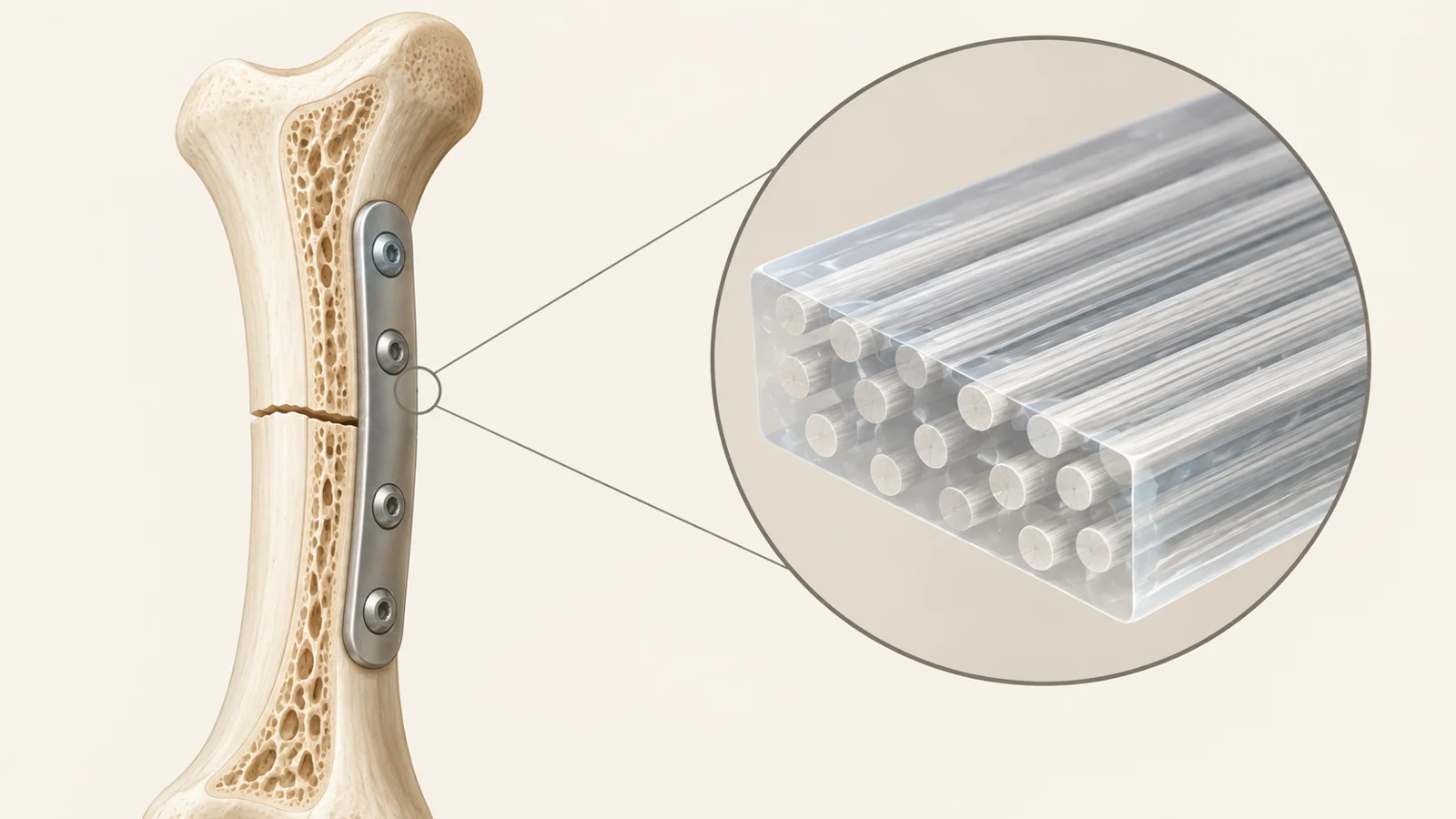
A review published on August 19, 2024, examines an unexpected material direction for these devices: plant fibers embedded in polymer resin. Fibers such as flax, roselle, and sisal could become reinforcement within a manufactured plate. The design question is how the resulting material behaves, from its individual fibers to the assembled bone–plate system.
Why stiffness is a balancing act
Stiffness describes resistance to deformation under a load. It differs from strength, which concerns how much stress a material can withstand before failure. A plate can therefore be very resistant to bending without that property alone making it the best design for supporting a fracture.
The review identifies two concerns associated with excessive stiffness. One is restricted axial interfragmentary motion—the small movement between broken bone fragments along the bone’s length. Too much restriction can delay formation of callus, the healing tissue that develops around a fracture, and delay healing.
The other concern is stress shielding. When a plate carries load that the underlying bone would otherwise bear, that bone receives less mechanical loading. The review connects this shielding with bone atrophy, resorption, and plate loosening. This is a different mechanism from restricted movement at the fracture gap, even though both involve how the plate and bone share forces.
These concerns make stiffness a design variable to tune. They do not establish that simply choosing a more flexible material will produce a better plate.
What plant fibers would contribute
A fiber-reinforced composite combines reinforcing fibers with a surrounding polymer resin—a plastic material that binds them into a solid structure. Earlier efforts to customize nonmetallic fracture plates have used synthetic fibers, including aramid, carbon, and glass. Plant fibers extend that existing approach to a different set of reinforcement materials.
The review covers both plant fibers used as the sole reinforcement and combinations of plant and synthetic fibers. A plant-fiber plate therefore need not consist entirely of plant-derived ingredients. Its identity depends on the combination of fibers and resin, not just the origin of its reinforcement.
Why consider changing the fibers? The authors identify availability, biodegradability, lower financial cost, recyclability, and less toxicity during processing as reasons for interest. These are motivations for investigating the materials. They also broaden the design choices available to researchers beyond the synthetic reinforcements already explored.
From a fiber to a functioning plate
The review’s scope spans three scales, each answering a different engineering question.
At the fiber scale, elastic modulus describes how strongly a fiber resists elastic deformation. Ultimate strength describes the maximum stress it can sustain. These properties help characterize a possible reinforcement, but a fiber measurement is not a measurement of a finished implant.
At the plate scale, the questions include fatigue strength and impact toughness. Fatigue concerns resistance to failure under repeated loading; impact toughness concerns the ability to absorb energy under a sudden load without breaking. A material’s response to one steadily applied force cannot, by itself, describe either behavior.
At the bone–plate scale, the review considers overall stiffness and stress in the plate. Here the object being assessed is the assembled system. Researchers need to understand how the plate and bone behave together, rather than infer that behavior from a promising fiber property.
Moving across these scales is the useful distinction. Fiber properties inform material selection, plate properties characterize the manufactured component, and system performance addresses its mechanical role when attached to bone.
What the evidence lets us conclude
The verified abstract establishes the review’s design rationale and breadth of engineering coverage. It does not establish that a particular plant-fiber plate outperforms a metal plate or another composite. Nor is it enough to judge patient safety, healing speed, complications, or clinical readiness. Those conclusions require examination of the underlying evidence beyond the abstract.
The material advantages also need careful interpretation. A biodegradable plant fiber does not establish that the finished composite safely resorbs inside the body. Lower fiber costs do not establish lower treatment costs. Recyclability and processing advantages at the material level likewise do not demonstrate that a used implant can be recycled or that the complete device has a smaller environmental footprint.
What this could change
If plant-fiber composite plates achieve suitable mechanical behavior, durability, and biological safety, engineers and surgeons could gain more options for supporting fractures while limiting excessive shielding of the underlying bone. The potential benefit comes through a wider choice of materials whose behavior can be tailored to the device’s job. Patients would be the downstream beneficiaries if those designs prove useful in practice; faster healing remains a possibility to investigate, not a demonstrated outcome of this review.
Key Sources
- Primary source: Material Properties and Engineering Performance of Bone Fracture Plates Made from Plant Fiber Reinforced Composites: A Review.
DOI or Journal Page · Review or Meta-Analysis · 2024-08-19
Keep exploring