
Research Signal – Source date 2021-04-18
Plant fibers could help reduce the weight and cost of some boat composites, but the finished panel depends on more than which fibers go into it. A bubble trapped in the resin or a layer that starts to separate can change how loads move through the material. A 2021 review of earlier composite studies examines these manufacturing and bonding problems alongside the promise of mixing plant fibers with glass fiber or Kevlar.
The review is not a performance test of a particular boat hull or panel. Its examples come from different materials and experiments. They help explain why the internal structure of a composite matters, but they do not supply one performance estimate that can be applied to boat structures generally.
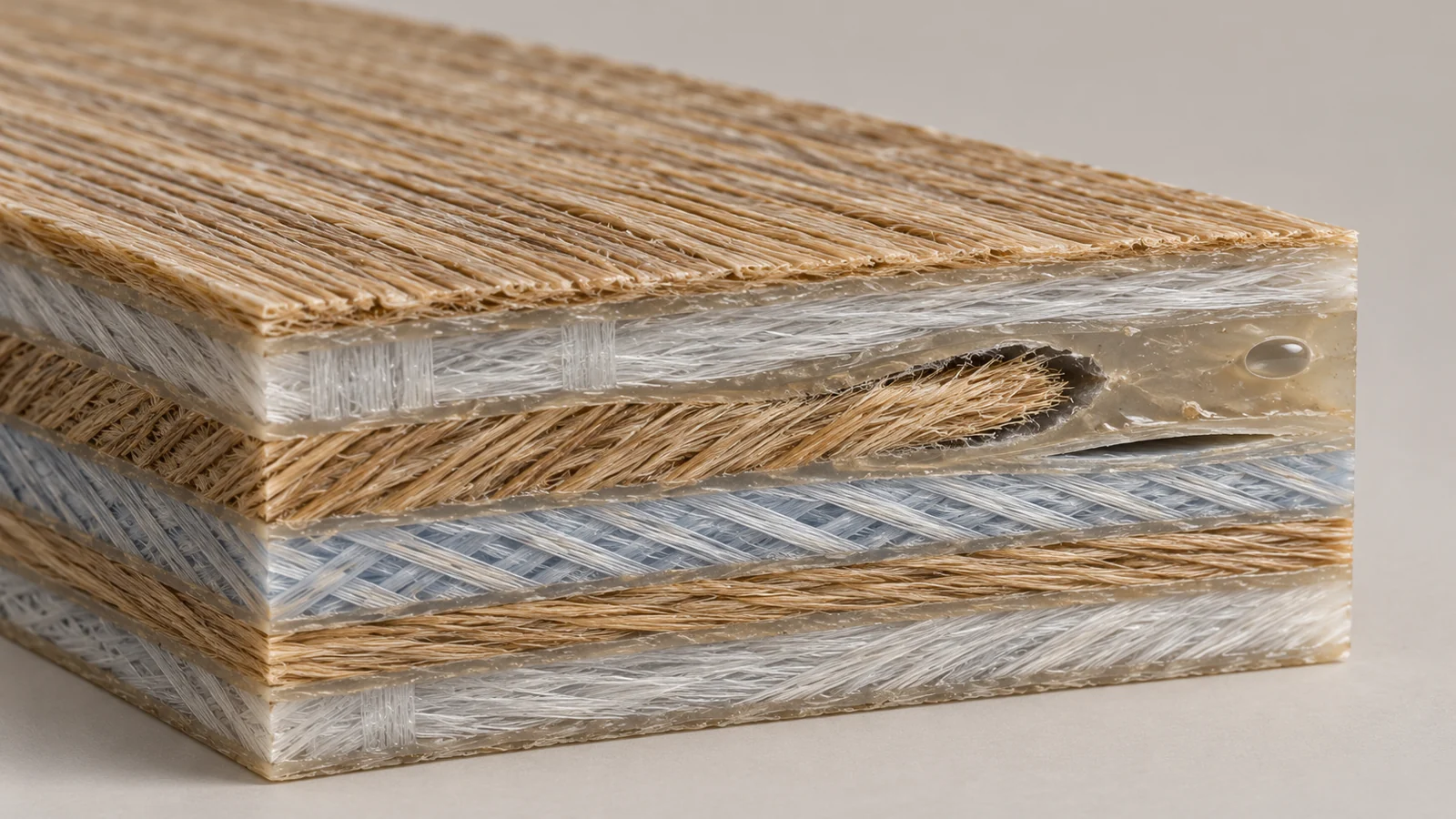
Why layers can come apart
A laminate is built from layers, or plies, that hold fibers in set directions. Delamination is the separation of those layers. It can begin with a manufacturing imperfection or with an impact during use. The underlying difficulty is that fibers usually reinforce the plane of their layer much more than they reinforce the thickness of the whole laminate.
Loads moving from one layer to another therefore rely heavily on the surrounding resin, or matrix. The review describes this through-thickness strength as comparatively low. When a panel under compression begins to buckle locally, the bending and stress around that area can help a separation grow. The review illustrates a progression from an unbuckled panel to local buckling, then growing delamination and structural collapse. This is a described failure path, not a prediction that every small separation will cause collapse.
Joints can also create conditions where separation starts or grows. Around a bolt hole, tensile loading can produce local compression near the hole; the review discusses that stress as relevant to delamination growth. These examples show why a strong fiber within each layer does not by itself guarantee a strong laminate. The links between layers must also carry load.
A void interrupts the resin’s work
During fabrication, air can remain trapped in the resin and leave a void, or small gap, in the matrix. This matters because the matrix helps transfer load between fibers and supports them under compression. A gap can weaken properties that depend heavily on the resin: strength under loads across the fibers, resistance to sliding forces, and strength under compression along the fibers. When the material is pulled along aligned fibers, its response depends more on the fibers themselves. The same defect can therefore affect different loading directions differently.
The review cites an earlier study reporting that a one percentage-point increase in void content was associated with decreases of 10–20% in tensile strength, about 10% in flexural strength and 5–10% in interlaminar shear strength. Those figures belong to the cited study and its material and test conditions; they are not a general conversion rule for all composites. The review also notes that some applications set very low void-content limits, but the examples do not establish one limit suitable for every material or use.
Voids can form in several ways. In liquid molding, air may be trapped as resin moves through a fiber preform, the shaped arrangement of dry fibers. Some regions let resin pass more easily than others, so the flow can vary from place to place. Gas produced during curing or already dissolved in the resin can also contribute. The exact route depends on the material and process, so identifying a void is only part of understanding how it formed.
How the mold can leave resin-rich regions
Resin does not always flow around a layered reinforcement evenly. In a tightly shaped mold corner, the fiber preform can pull close together as the mold closes, leaving a space between the fibers and the mold surface. Resin fills that space during infusion, producing a resin-rich region: an area with more resin and less reinforcing fiber than its surroundings.
The review describes such regions as a source of residual stress, deformation and variation between parts. It also summarizes a study of molded U-beams in which failure involved delamination at the radii, or curved corners. The corner shape and the movement of the reinforcement helped determine where the resin-rich area formed. This is a different manufacturing route to a flaw than air trapped during resin flow, even though both can affect how a finished part carries load.
Other production defects include gaps, misaligned fibers, pockets where a resin-curing ingredient has not mixed evenly, and areas where resin has not properly wetted the fibers. Each points to a different problem in placement, mixing or contact between materials. The review stresses that producing a composite with no defects is not realistic; the engineering question is how defects arise and how their effects matter for the intended part.
Plant fibers make the interface important
Plant fibers bring practical attractions described in the review: they are relatively low cost and low density. They also absorb moisture, vary in composition and can be difficult for resin to wet evenly. Wetting means the resin spreads over and makes contact with the fiber surface. When contact and compatibility are poor, the bond that transfers load between fiber and matrix can be weaker.
Hybridization combines natural and synthetic fibers in one composite. The intended balance is to retain useful reinforcement while using less synthetic fiber. The review notes that chemical treatments have been studied to improve adhesion at the fiber–matrix interface and reduce water absorption. But the natural fibers themselves vary: their composition and physical properties depend on fiber type and origin. A treatment or mixture that works in one material system cannot automatically be assumed to work in another.
One cited impact study gives a concrete example of how composition and manufacturing quality can interact. It tested kenaf with fiberglass and Kevlar in a polyester matrix at kenaf volume fractions of 0%, 15%, 45%, 60% and 75%. Impact energy absorption and strength increased through the intermediate kenaf fractions, then declined at 75%. The review links the decline in those specimens to manufacturing defects, including poor fiber–resin adhesion, voids and fibers pulling out of the matrix.
That result is a comparison among those specimens under that study’s conditions. It does not identify a universally best kenaf fraction. Nor does it isolate the effect of a single defect from the rest of the material and fabrication choices. It does show why adding more plant fiber is not, by itself, a reliable guide to better impact performance.
What the collection of tests can tell us
The review brings together studies of different fiber types, resins, layer arrangements and manufacturing methods. Their tests also ask different questions. Tensile tests pull a specimen, bending tests load it across a span, and impact tests examine its response to a sudden blow. A result in one test cannot be substituted for a result in another or carried directly from one composite design to a boat panel.
For example, the review discusses glass-fiber polyester composites with increasing glass content, as well as other work on banana, abaca, jute, date-palm and kenaf combinations. Their reported strengths depend on their particular materials and specimen designs. The collection is useful because it shows recurring design concerns: fibers need suitable orientation, resin must reach and bond to them, and layers must transfer loads. It does not combine the examples into a single prediction for a hull’s strength, service life or safety margin.
The central engineering puzzle is therefore not simply whether plant fibers can replace some synthetic fibers. It is whether a particular mix, interface and manufacturing process can produce a laminate that performs as required in its intended shape and loading conditions. The review provides reasons to investigate that question, along with examples of ways manufacturing defects can complicate the answer.
What better defect control could mean for boatbuilding
Better control of fiber–resin bonding, trapped air and layer separation could help manufacturers use plant fibers in some boat composite structures while reducing reliance on synthetic fiber and retaining the structural performance those parts require. That possibility depends on validating the specific material, part geometry and service conditions. The review’s studies explain why defect control matters; they do not establish that a particular plant-fiber boat structure is ready, safe or longer-lasting.
Key Sources
- Primary source: Delamination and Manufacturing Defects in Natural Fiber-Reinforced Hybrid Composite: A Review.
DOI or Journal Page · Review or Meta-Analysis · 2021-04-18
Keep exploring