
Research Signal – Source date 2025-07-18
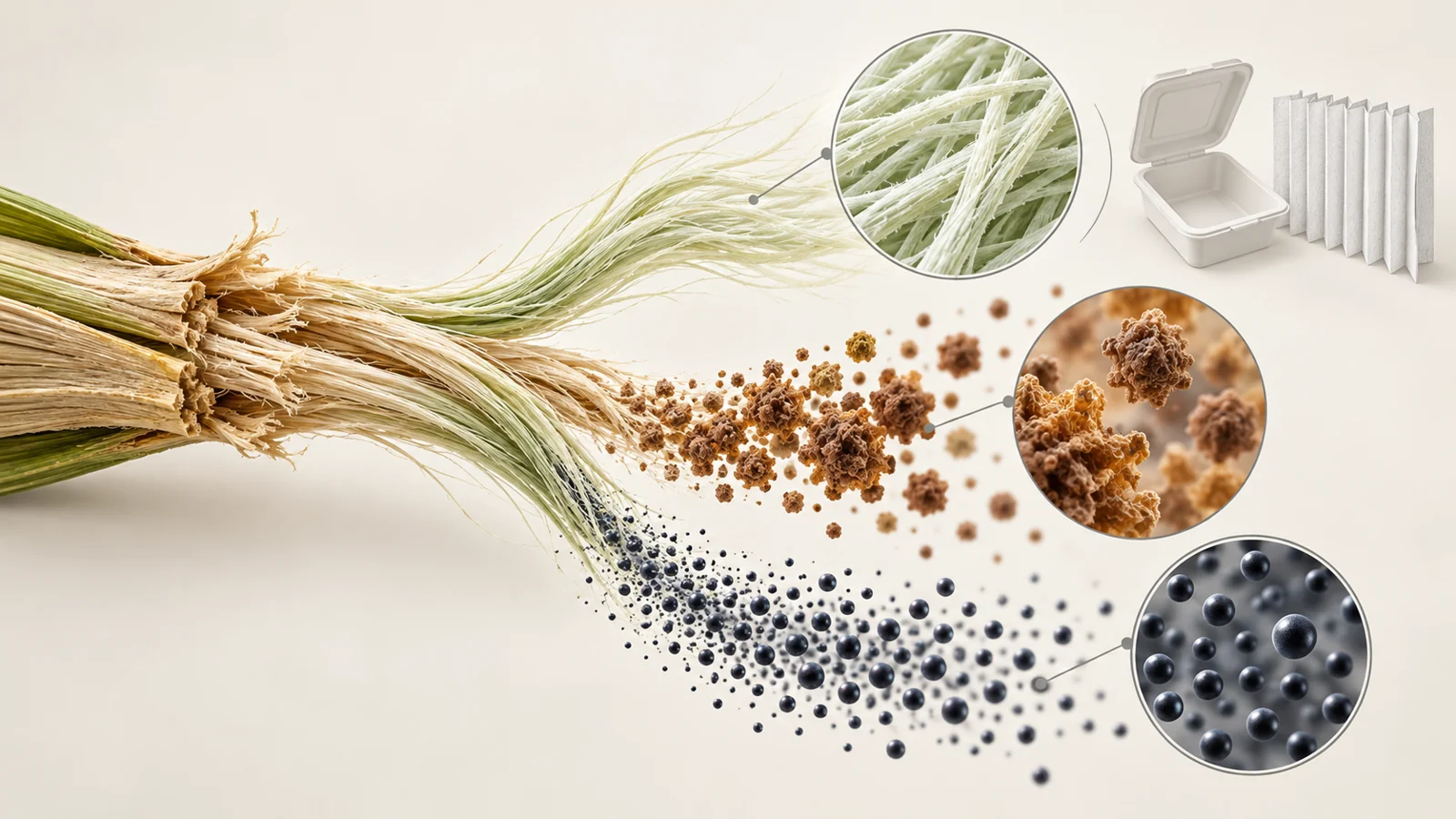
A single plant material can lead to several kinds of tiny particles, each with different properties and possible jobs. That variety is part of the appeal of lignocellulosic biomass, the plant material built from cellulose, hemicellulose and lignin. But a renewable starting material does not make every particle alike—or make it simple to produce.
A review published on July 18, 2025, brings together work on turning these plant components into nanoscale materials. Its central distinction is practical: the properties and applications discussed depend on which component is used and what form it takes. “Plant-based” alone does not tell a designer what a material might do.
One feedstock, several material families
Cellulose, hemicellulose and lignin are distinct components of lignocellulosic biomass. The review describes routes from them to nanocellulose, nanohemicellulose and lignin-derived nanoparticles, as well as carbon nanomaterials such as carbon dots. These are different material families, not interchangeable versions of one particle.
The component names identify where each family comes from. The “nano” forms are materials produced at a very small scale; the label by itself does not specify a recipe, performance level or end use. The review’s abstract groups these outputs by their reported properties and areas of interest, rather than giving a single preparation method that applies to all of them.
That matters because the same broad feedstock can support different design questions. A material valued for strength may be considered for a different task from particles whose appeal lies in their chemistry or functional versatility.
Strength is one route to an application
The review highlights nanocellulose for its high-strength properties and names paper and pulp, packaging, drug delivery and filtration among its possible applications. For packaging or filters, strength is a relevant reason to investigate the material: the job may call for a structure that holds together while serving its intended function. The review identifies areas of use, though the supplied evidence does not provide comparative performance results for particular products.
Lignin-derived nanoparticles have a different set of areas of interest. The review names medical research, facilities that turn biomass into useful products, and composite materials that combine ingredients for particular properties. It also discusses carbon dots—tiny carbon particles made from lignocellulosic biomass—as promising because of their compatibility with living systems and their potential to serve different functions. These are research possibilities; the review does not establish a clinical benefit or validate a commercial product.
Nanohemicellulose is part of the set of materials the review discusses, but the supplied summary does not assign it a particular application. Keeping that distinction clear avoids treating every component as though it already had the same evidence or role.
Processing still sets a practical test
Plants provide renewable feedstock, but converting their components into useful particles has its own demands. The review identifies limited access to monomeric units—the smaller building blocks used in processing—and high energy requirements as challenges. A renewable origin, on its own, therefore does not show that a given particle or production route saves energy or has a lower environmental impact.
The review discusses combining chemical and biochemical processes as a direction for making synthesis more efficient and scalable. That is a proposed avenue, not a quantified result in the evidence available here. Establishing what it achieves would require results tied to specific biomass, particles and production routes.
What this could make possible
If production advances and application testing confirms dependable performance, packaging or filters could use purpose-selected particles made from renewable plant biomass. A package designer, for example, could choose nanocellulose to meet a demonstrated strength requirement, instead of treating a broad plant-based label as evidence that a material fits the job. The review points to the material possibilities behind that future; reliable selection at wider scale still depends on application validation and better production routes.
A useful nearer milestone would be comparative results for specific biomass-derived particles that report both application-relevant performance and processing energy, including an integrated chemical and biochemical route. That would help show whether a promising material can meet a real use requirement while being made efficiently.
Key Sources
- Primary source: Preparation and applications of nanoparticles from lignocellulosic biomass: A review.
DOI or Journal Page · Review or Meta-Analysis · 2025-07-18
Keep exploring