
Research Signal – Source date 2022-09-16
A gene change linked to a cancer’s growth pathway can raise questions about drug resistance. Yet one woman with ovarian clear cell carcinoma and a reported PIK3CA mutation had favorable observations after surgery and platinum chemotherapy. Her case raises a question about how much the gene finding can tell us about treatment response. It cannot show that the mutation predicted her response.
The report, published September 16, 2022, describes a 48-year-old patient whose care combined several treatments. The genetic analysis came after that care, so it did not guide the decisions described. Understanding the sequence helps explain both what happened and what the gene result can—and cannot—tell us.
A tumor discovered after months of symptoms
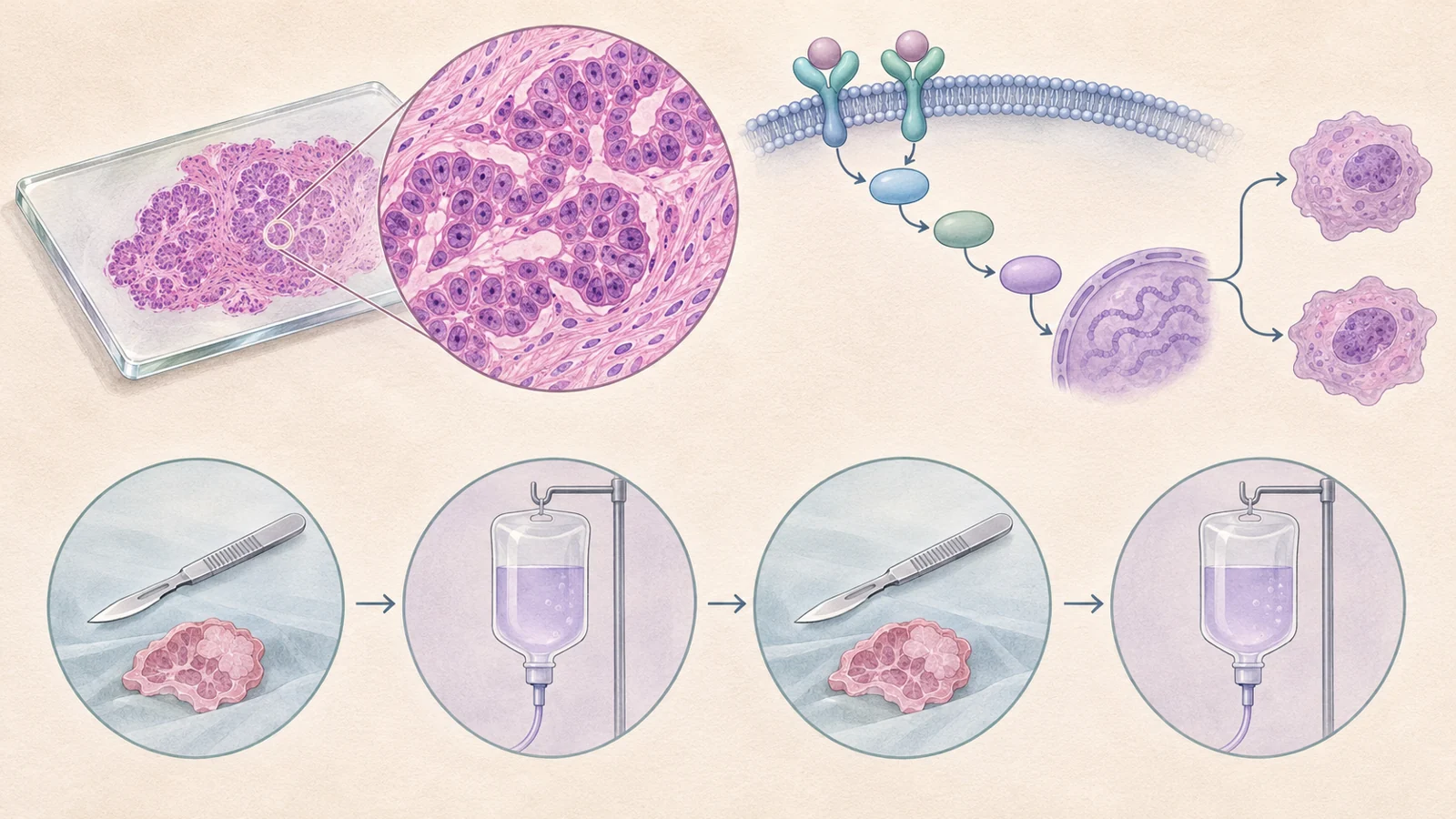
The patient sought care after four months of irregular, painful bleeding. She also had a pelvic mass and abdominal distension. At a local hospital, she underwent surgery to remove the right ovary and fallopian tube and to excise a cyst on the left ovary. Pathology identified clear cell carcinoma in the right ovary and an endometriosis cyst on the left. The report also says the tumor ruptured during surgery, making it impossible to complete certain staging procedures at that time. Testing of fluid from the abdomen found no cancer cells.
Ovarian clear cell carcinoma, or OCCC, is an uncommon ovarian cancer subtype. The report’s background describes it as less sensitive to platinum-based chemotherapy than some other ovarian cancers, particularly in later-stage disease. Even so, platinum chemotherapy remained a standard first-line treatment in the authors’ account. This context makes the patient’s later course notable, while also leaving open why she did well.
The treatment sequence included more than chemotherapy
After reviewing the initial pathology, the care team gave three courses of paclitaxel plus carboplatin before another operation. On January 26, 2021, surgeons removed the uterus and remaining ovary and fallopian tube, along with the omentum and lymph nodes in the pelvis and near the aorta. Pathology found no cancer in those removed tissues or nodes. The team classified the cancer as stage IC. The patient then received one additional course of paclitaxel and carboplatin after surgery.
The second operation matters to the interpretation because it was extensive and the report describes no cancer in the sampled removed tissues. The patient’s early stage and the combined treatment also matter. A favorable result after this sequence cannot be assigned to one component from a single case. The report’s authors considered complete removal important, but the case cannot measure how much surgery, chemotherapy, or the disease’s stage contributed individually.
During chemotherapy, the authors report that tumor markers stayed within the normal range. After the fourth course, they recorded CA125 at 22.8 U/mL, CEA at 0.65 ng/mL, and CA72-4 at 0.7. They also report no recurrence during approximately one year of follow-up and describe the patient as being in good health. These are encouraging observations over that period, not evidence of long-term freedom from recurrence.
A pathway gene, not a treatment forecast
PIK3CA provides instructions for one part of a cell-signaling system involved in growth and survival. Changes in this pathway have been studied in OCCC because the pathway is implicated in how the cancer develops and may relate to chemotherapy resistance. The report notes that studies have not agreed on whether PIK3CA mutations indicate a better prognosis; the mutation’s clinical importance remains unsettled.
After the patient’s treatment, the authors tested tumor tissue and blood as part of a review of her case. The test examined parts of 139 genes and reported a PIK3CA change alongside changes in two other genes. The authors singled out PIK3CA as significantly altered.
Because the test followed the treatment sequence, it could not have predicted the patient’s response in real time. Nor can the outcome establish that PIK3CA made her sensitive to platinum drugs. Her early-stage disease, surgery, chemotherapy, and the mutation were all present together, with no comparison group to separate their effects. The case shows that a PIK3CA-mutated tumor and a favorable short-term outcome can coexist; it does not explain why.
The authors conclude that surgery plus platinum chemotherapy remains the best strategy for OCCC and recommend genetic testing to help predict treatment effects. Their recommendation is broader than this one case can establish. The report documents one patient’s treatment and follow-up, while the literature discussion itself describes uncertainty about what PIK3CA means for prognosis. A mutation may be biologically relevant without serving as a dependable forecast for an individual patient.
How this could shape the future
A newly diagnosed patient could eventually receive a clearer account of what a PIK3CA result means when it is considered alongside tumor stage, surgical findings, and response to treatment. That would turn a biologically suggestive result into information patients and clinicians could use more confidently in treatment discussions and follow-up planning, if research validates the connection. This case points to the challenge: the mutation raised questions about resistance, while the patient did well after combined treatment, and the report cannot identify which factors explain the outcome.
A useful next step would be to follow patients from diagnosis, recording their PIK3CA results, cancer stage, whether tumor remained after surgery, treatment, and later recurrence, to test whether the gene adds information beyond those clinical details. Further studies would be needed before such a result could change care. Until then, this case is a reason to investigate how the pieces fit together, not a forecast for other patients.
Key Sources
- Primary source: Clinical analysis and literature review of a case of ovarian clear cell carcinoma with PIK3CA gene mutation: A case report.
DOI or Journal Page · Review or Meta-Analysis · 2022-09-16
Keep exploring