
Research Signal – Source date 2026-01-01
Poly(l-lactic acid), or PLLA, already has a place in medicine: the biodegradable, biocompatible polymer is used in FDA-approved resorbable devices. A newer research direction asks whether it can also respond electrically when deformed, opening possibilities for sensors and other devices designed to break down over time.
Those are separate claims about separate functions. Existing approval for some resorbable PLLA devices does not establish approval or clinical readiness for newer piezoelectric designs. A review published in January 2026 surveys how researchers are engineering this electrical response and the kinds of medical applications they are exploring.
When a material turns deformation into a signal
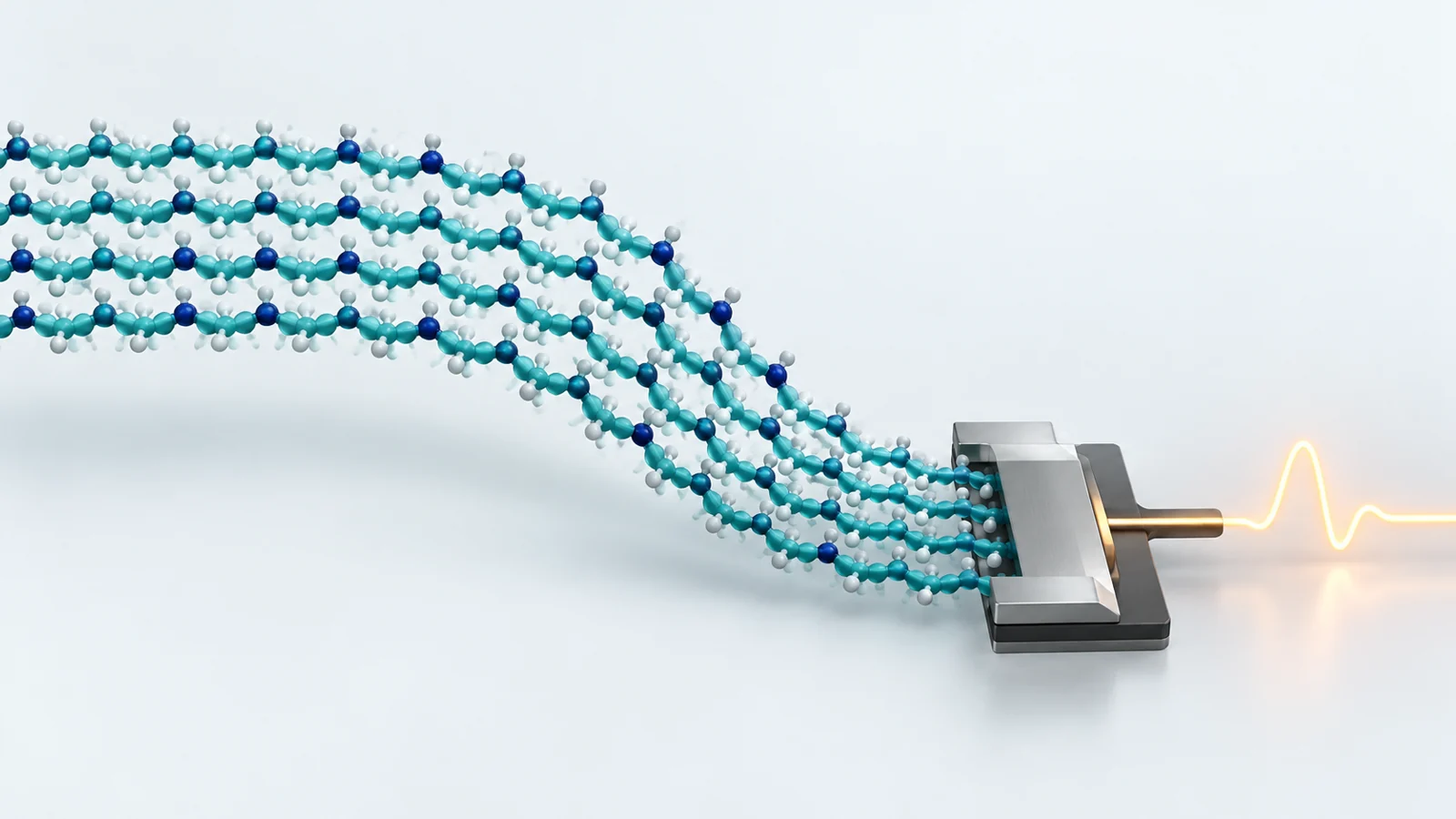
Piezoelectricity is an electrical response to physical deformation, such as bending or pressure. In many of the applications covered by the review, the response depends on PLLA’s molecular chains being highly oriented. Their alignment is central to the polymer’s electroactive behavior; the material’s biodegradability alone does not produce that function.
This connection between structure and response gives device designers a material-level challenge. A useful design needs PLLA arranged to produce an electrical signal when the device experiences the physical change it is meant to detect or use. The review describes the relationship and engineering approaches, but its supplied abstract gives no numerical response values for comparing device performance.
Two routes for shaping the response
The review covers processing strategies that generate piezoelectric PLLA by arranging its molecular structure, as well as composite formulations intended to enhance the response. These are distinct design routes: one concerns how the polymer is processed, while the other concerns combining it with additional materials.
The abstract does not rank the approaches or identify a universally best formulation. Their relevance depends on the device being designed and the properties it needs. Alongside the electrical response, a medical application must meet the material and cytocompatibility requirements relevant to its intended use. The review discusses those considerations and the challenges and limitations across the field; the application list itself does not validate any particular device for clinical use.
From sensing to scaffolds
The applications surveyed serve different functions. Energy-harvesting designs seek to use the electrical response as a source of energy, while biomonitoring and biodegradable sensors use it to register changes. Actuators, by contrast, are intended to produce an action rather than register a change. Drug delivery devices and scaffolds for tissue regeneration bring the material into designs aimed at delivery or support for tissue growth.
This range describes a research landscape, not a single level of development. A sensor’s task differs from an actuator’s, and both differ from a scaffold or delivery device. Each would need a design-specific electrical response and suitable material performance. The review’s survey does not establish clinical benefit or readiness across these categories.
What resorbable sensors could make possible
A temporary sensor that responds to a physical change and later resorbs could offer useful monitoring without leaving a permanent polymer component. That possibility depends on a particular design maintaining a useful electrical response while meeting the material requirements of its intended use. The review points to the design opportunity; it does not establish a clinical outcome.
Key Sources
- Primary source: Piezoelectric polylactic acid-based biomaterials: Fundamentals, challenges and opportunities in medical device design.
DOI or Journal Page · Review or Meta-Analysis · 2026-01-01
Keep exploring