
Research Signal – Source date 2026-01-01
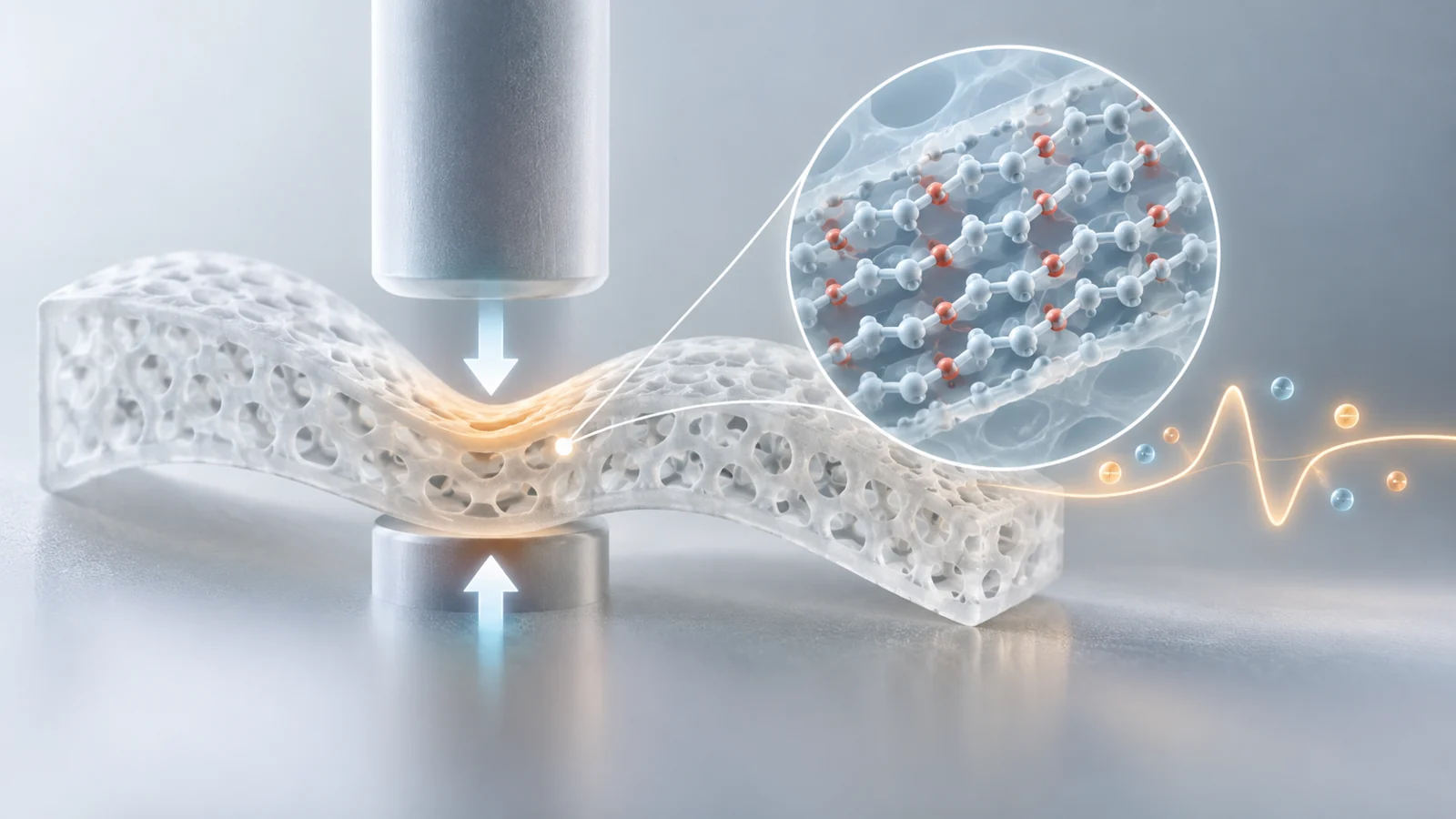
Poly(l-lactic acid), or PLLA, already has a place in medicine as a material used in FDA-approved resorbable devices. A review published January 1, 2026, considers a different possibility: using PLLA’s response to pressure in sensors, actuators, drug delivery devices and tissue-regeneration scaffolds.
The prospect rests on a material property, not on an established clinical result. The review surveys ways to make PLLA electrically responsive and potential device functions, while the available account does not provide performance figures or patient outcomes. Existing use of resorbable PLLA therefore does not establish approval or readiness for these electrically active designs.
Chain alignment gives PLLA an electrical response
Piezoelectricity is an electrical response to pressure or other mechanical force. For many applications discussed in the review, PLLA’s response depends on its molecular chains being highly oriented: the chains need to be arranged in a consistent direction within the material. Their alignment is central to creating the electroactive phase that gives the polymer this function.
That makes PLLA’s electrical behavior a design outcome as well as a material characteristic. A device concept has to account for how the polymer is formed and arranged, because ordinary familiarity with PLLA as a resorbable material does not by itself provide the chain orientation needed for a piezoelectric response.
Processing and composites offer different design routes
The review discusses processing strategies for generating piezoelectric PLLA. These approaches focus on shaping or treating the polymer so it develops the structure associated with an electrical response. A separate route is to formulate PLLA composites, combining it with other material components to seek an enhanced response.
The two routes pose different design choices: processing changes how the PLLA itself is prepared, while a composite changes the material formulation. The review addresses both, along with PLLA’s physicochemical characteristics and cytocompatibility. The supplied evidence does not identify a best-performing process, quantify an electrical response or compare finished devices, so it cannot show which route would be preferable for a particular medical use.
One material, several intended functions
The applications surveyed ask the electrical response to do different jobs. Energy-harvesting designs aim to capture energy. Biomonitoring and biodegradable sensors would use a signal to monitor or detect something; actuators would use electrical or mechanical responsiveness to produce an action. Drug-delivery devices would seek to connect that responsiveness with delivery, while smart scaffolds would bring it to materials intended for tissue regeneration.
These are proposed biomedical functions covered by the review, not evidence that each type of device has reached patients. The review considers advantages as well as challenges and limitations, and it discusses cytocompatibility. The abstract available here does not establish clinical safety or benefit for any specific application, or show how a finished device performs in its intended setting.
What responsive resorbable devices could enable
A resorbable sensor that could both serve a medical role and respond to pressure might, in principle, add monitoring capability to a device that is designed to be absorbed over time. A responsive scaffold could similarly add sensing or actuation to a material intended to support tissue regeneration. Such capabilities could be useful to patients if a finished design retains its electrical response, remains cytocompatible and performs usefully in the body for its intended purpose.
The review frames these as opportunities for medical-device design. Whether any one becomes a patient benefit depends on how the material and device work together; established use of resorbable PLLA alone cannot answer that question.
Key Sources
- Primary source: Piezoelectric polylactic acid-based biomaterials: Fundamentals, challenges and opportunities in medical device design
DOI or Journal Page · Peer-Reviewed Paper · 2026-01-01
Keep exploring